

A 4040 element and an 8040 element use the same basic spiral-wound architecture, but that does not make their bills of materials interchangeable. Diameter, active area, leaf design, tube interface, spacer selection, glue path and outer construction all change the manufacturing decision.
Direct answer: the main difference between 4040 and 8040 RO membrane materials is not the list of material names. Both normally require membrane sheet, feed spacer, permeate carrier, a perforated product tube, adhesive and external components. What changes is the approved specification, width, quantity, geometry, interface and process control for every item. A reliable 8040 BOM therefore cannot be created by simply multiplying a 4040 BOM.
What Do 4040 and 8040 Actually Mean?
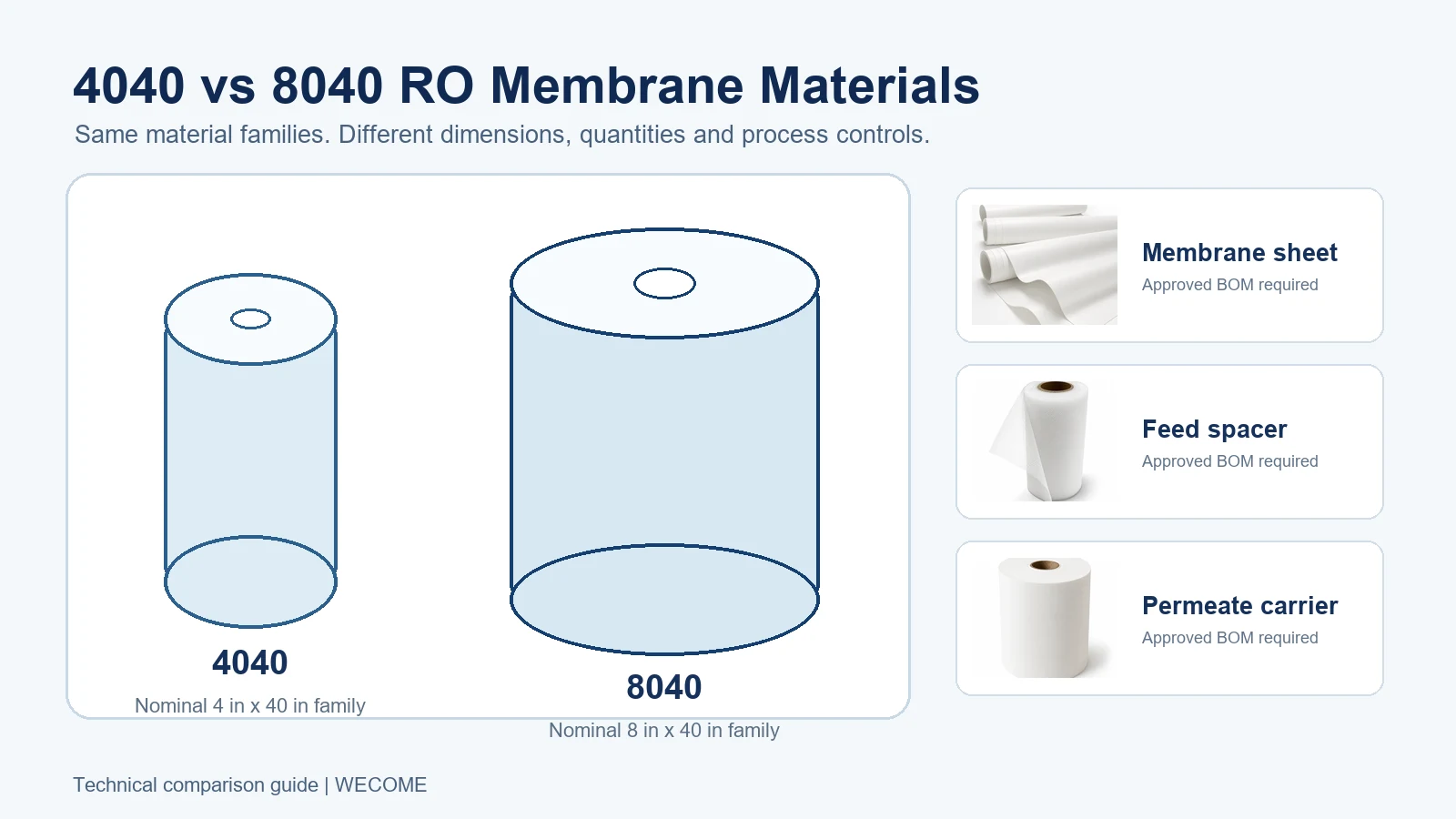
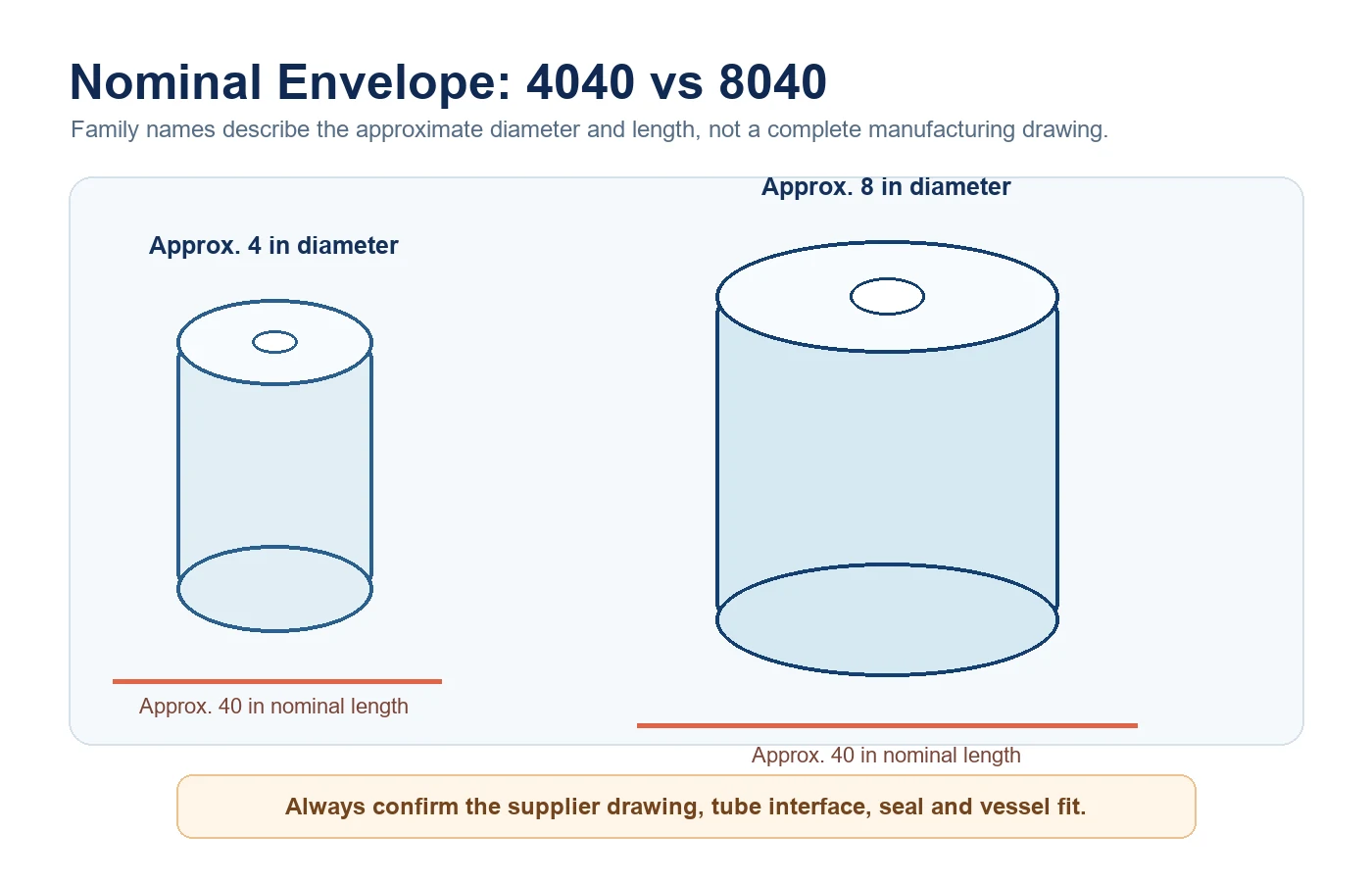
In common RO industry naming, 4040 describes a nominal element family approximately four inches in diameter and 40 inches long. 8040 refers to the approximately eight-inch-diameter, 40-inch-long industrial family. The name is a useful envelope description, not a production drawing.
That distinction matters. Two products carrying the same family name can still differ in active membrane area, feed-spacer thickness, leaf count, product-tube design, end components and operating purpose. Some manufacturers also identify eight-inch elements by active area rather than putting “8040” in the model name. Always work from the supplier drawing and approved BOM.
4040 vs 8040 RO Membrane Materials at a Glance
| Material or interface | 4040 production question | 8040 production question | Why it matters |
|---|---|---|---|
| Membrane flat sheet | What is the approved leaf width, length and active-area target? | Can the wider/heavier leaf be handled without creasing or contamination? | Sheet dimensions drive yield, cutting plans and active area. |
| Feed spacer | Which thickness, mesh geometry and width match the element? | Does the selected spacer preserve feed flow while meeting pressure-drop and fouling requirements? | Spacer choice affects channel hydraulics, cleaning behaviour and winding build. |
| Permeate carrier | Does the fabric width and drainage structure match the leaf? | Can it support a larger permeate path without wrinkles or local compression? | Carrier properties affect permeate transport and leaf stability. |
| Central tube | Are diameter, hole pattern and end connection approved? | Are tube stiffness, perforation pattern, connector and seal interfaces correct? | The tube receives permeate and controls the core interface during rolling. |
| Adhesive | What mix ratio, bead geometry, open time and cure are validated? | Can dispensing maintain a continuous path over the larger leaf and production cycle? | Glue-line integrity protects the separation between feed and permeate paths. |
| Outer components | Which tape, seal and end components suit the element and vessel? | Is FRP wrapping, shell construction or another outer method required? | External construction controls diameter, handling and pressure-vessel compatibility. |
The Six Material Groups That Must Be Requalified
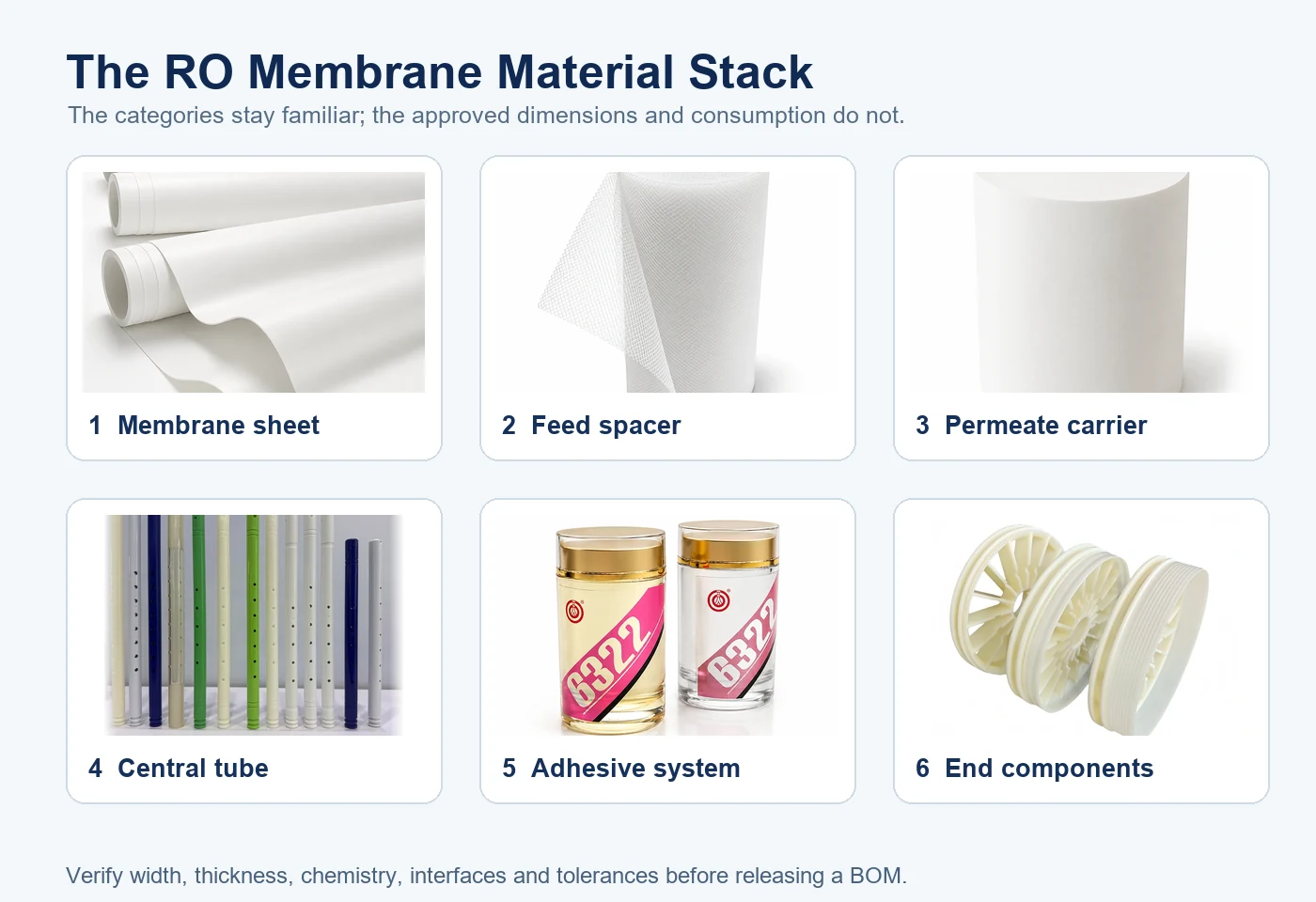
1. Membrane flat sheet: performance plus convertibility
The membrane sheet is selected first for separation performance, but production teams also need to evaluate how it behaves during slitting, cutting, folding, wetting, bonding and rolling. A sheet that meets coupon performance can still cause conversion problems if backing stiffness, edge quality, curl, surface contamination or dimensional stability is inconsistent.
Moving from 4040 to 8040 normally increases the physical scale of each prepared leaf. That makes clean handling, supported transport and repeatable alignment more important. The correct question is not “How many square metres are needed?” but “Which approved leaf geometry delivers the target active area while leaving the required glue margin and trim allowance?”
For supplier qualification, record membrane chemistry, backing construction, roll width, usable width, thickness tolerance, storage conditions, shelf-life information and lot traceability. See the RO membrane materials overview before building the final BOM.
2. Feed spacer: channel geometry changes the element
The RO membrane feed spacer keeps adjacent membrane leaves apart and creates the feed-flow channel. Thickness is important, but it is not the only variable. Filament geometry, opening, resin, surface condition, stiffness, width and edge quality also influence handling and hydraulic behaviour.
A thinner feed channel can support a different balance of active area and pressure drop than a thicker channel. A more open channel may be selected for feeds with higher fouling potential or where cleanability is prioritised. These are engineering choices, not universal 4040-versus-8040 rules. Never substitute spacer solely because the width appears correct.
3. Permeate carrier: drainage must remain stable inside the leaf
The permeate carrier sits between the membrane sheets in each envelope and provides a path for product water toward the central tube. Its thickness, compressibility, capillary structure, width and cleanliness all need to match the element design.
Larger leaves create a bigger handling challenge. Wrinkles, folded edges or local compression can disturb the permeate path and change the wound geometry. Incoming inspection should therefore include width and basis consistency as well as visual checks for contamination, broken yarns and edge damage.
4. Central tube: the mechanical and hydraulic reference
The central tube is more than a winding mandrel. It receives permeate through its openings and establishes the core interface for every leaf. Tube outside diameter, inside diameter, straightness, wall thickness, hole pattern, end geometry, connector fit and material compatibility should all be documented.
Do not assume a tube used for a 4040 program can be replaced by a visually similar tube in another element. Even within the same nominal family, the hole arrangement and connection system can differ. Trial-fit the connector and end components, verify runout, and confirm that the tube is supported correctly during rolling.
5. Adhesive: geometry and cure are part of the BOM
The RO membrane adhesive system must create continuous, controlled glue lines while remaining compatible with the membrane, carrier and intended service. Procurement data should include component ratio, viscosity window, working time, cure schedule, storage and lot control. Production data should add bead width, bead height, dispensing path and environmental conditions.
An 8040 leaf is not simply a wider place to apply the same bead. The longer path and larger assembly can change dispensing time, operator reach, robotic travel, material exposure and cure management. Validate the complete process with destructive section checks or another approved bond-integrity method before increasing output.
6. Outer wrap, seals and end components: vessel compatibility comes last, not least
Tape, brine seals, O-rings, anti-telescoping devices, connectors and outer wrapping complete the assembly. These parts must match the final element diameter, pressure-vessel interface, operating direction and mechanical requirements. For many industrial designs, the outer construction also requires controlled fiberglass wrapping and curing.
Dimension checks should be performed after curing and trimming, not only on loose components. A small build-up difference repeated across many wound layers can become a final-diameter or fit problem.
Why the 8040 BOM Does Not Scale Directly from 4040
Doubling nominal diameter does not produce a universal material multiplier. The finished cross-section is larger, but the internal design is governed by usable membrane area, leaf length, leaf count, spacer thickness, glue margins, tube diameter, compression, outer wrap and target final diameter. Changing one variable can alter several others.
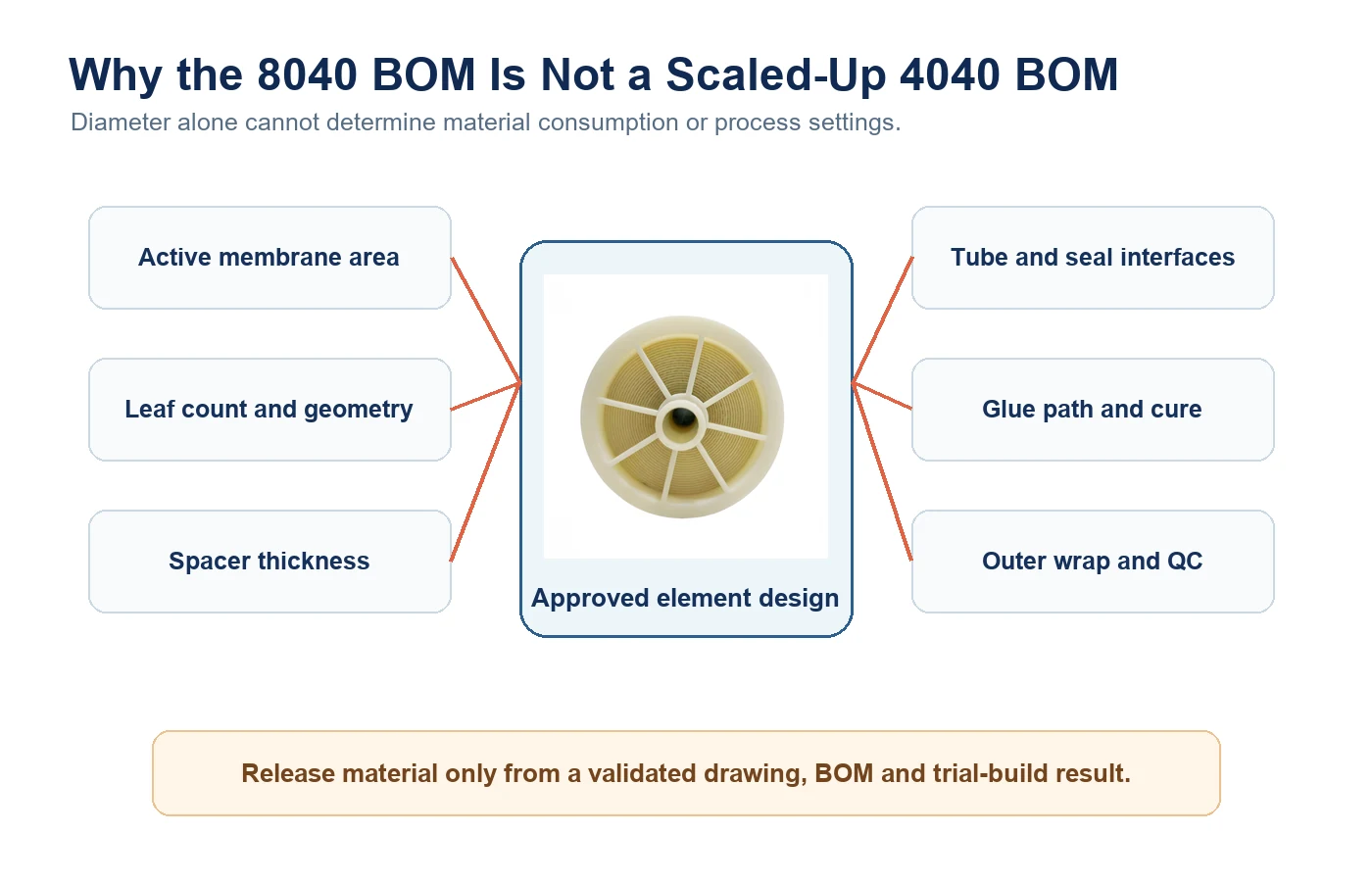
For early planning, a calculator can help estimate material consumption, but estimation must remain separate from production release. Use the RO membrane element BOM calculator and membrane sheet usage calculator to compare scenarios, then replace assumptions with drawing-controlled values and trial-build results.
What Changes on the Production Floor?
① Slitting, cutting and leaf preparation
Confirm that raw roll widths support the cutting plan with acceptable trim loss. Larger leaves need flat, clean support and repeatable alignment. Review table size, web guiding, static control, blade condition, fold position and weld geometry. Material identification should remain visible through staging so different sheet and spacer lots are not mixed.
② Loading, adhesive dispensing and rolling
An 8040 assembly is heavier and occupies more working space. The process may require assisted loading, a different mandrel or chuck, higher torque capacity and stronger tension control. Adhesive dispensing needs a validated path, stable mix and uninterrupted bead. Winding speed should be set by layer control and bond quality, not by copying a 4040 recipe.
③ Curing, trimming and dimensional control
Curing fixtures, support spacing and environmental control should prevent movement while the adhesive develops strength. After cure, verify length, final diameter, end-face quality and tube position. Trimming capacity must match the larger cross-section without overheating, tearing or contaminating the element.
④ Integrity and performance testing
A finished element should pass the approved integrity checks before performance data is accepted. Vacuum or pressure-decay methods can reveal assembly leakage, while hydraulic testing confirms flow, rejection and pressure behaviour under defined conditions. Test method, feed composition, temperature, pressure, recovery and stabilisation time must be recorded so 4040 and 8040 results remain comparable.
Incoming Inspection Checklist for 4040 and 8040 Materials
Information Needed for an Accurate BOM or Quotation
A useful RFQ should describe the element you intend to manufacture, not only the family name. Include:
- Target model and nominal format: 4040, 8040 or another configuration.
- Element drawing, final diameter and length tolerances.
- Target active membrane area and approved leaf arrangement.
- Membrane sheet, feed spacer and permeate carrier specifications.
- Central-tube drawing, hole pattern and connector details.
- Adhesive technical data, glue path, mix and cure requirements.
- Outer-wrap method, brine seal, end cap and O-ring interfaces.
- Target output, shift pattern, operator plan and quality-control method.
- Required material certificates, sample quantities and trial acceptance criteria.
When these inputs are incomplete, mark the unknowns clearly. A controlled assumption register is far safer than hiding estimates inside a purchasing spreadsheet.
Frequently Asked Questions
Are 4040 and 8040 RO membrane materials the same?
They use the same broad material groups, but the approved widths, lengths, quantities, thicknesses, interfaces and tolerances can differ. Treat them as separate BOMs.
Can I calculate an 8040 BOM by multiplying a 4040 BOM?
No universal multiplier is reliable. Use the target active area, leaf geometry, spacer, tube, glue margin, compression and outer construction to calculate the design, then confirm it through a trial build.
Does every 8040 element use the same feed spacer?
No. Spacer thickness and geometry vary with application and element design. Pressure drop, fouling risk, cleanability, active-area target and winding build all influence selection.
What should be approved before mass production?
Approve the drawing, BOM, incoming specifications, process parameters, cure conditions, dimensions, integrity test and hydraulic performance criteria. Keep lot traceability for the materials used in the validation build.
Need a 4040 or 8040 Material Review?
Send WECOME your element drawing, target active area, material specifications and output requirement. We can help review the BOM assumptions, prepare material samples and match the material plan to the intended production workflow.
Request samples or a BOM reviewTechnical References
- DuPont Water Solutions, FilmTec element construction manual excerpt.
- DuPont Water Solutions, FilmTec reverse osmosis membranes technical manual, Rev. 19, February 2026.
- DuPont Water Solutions, FilmTec RO-4040-FF and RO-390-FF product data sheet.

Bessie has 10+ years of experience in RO membrane materials and water treatment supply chains. At WECOME, she helps manufacturers and system integrators worldwide source the right membrane components — from feed spacers and permeate carriers to NSF-certified adhesives — backed by hands-on technical support.