

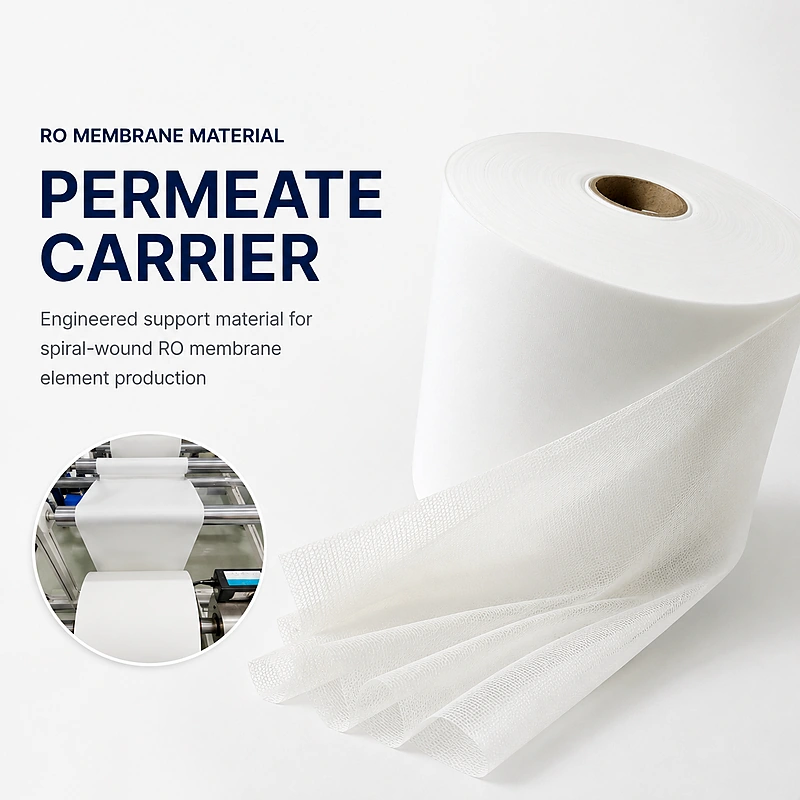


RO membrane permeate carrier is a finely knitted PET tricot fabric placed inside each membrane-leaf envelope of a spiral-wound element. It supports the membrane surfaces, maintains a permeate-side drainage path and carries product water toward the central permeate tube.
WECOME supplies permeate carrier fabric from 8 to 16 mil, with listed widths from 254 to 1016 mm, basis weights from 55 to 165 g/m² and pressure classes covering 0 to 1500 psi. Multiple wale and course densities are available for household, 4040, 8040 and application-specific RO membrane element designs.
A permeate carrier, also called RO tricot or permeate spacer, sits inside the sealed membrane envelope. Water that has passed through the RO membrane moves through this knitted PET layer toward the central tube. It should not be confused with the feed spacer, which forms the feed-water channel outside the membrane envelope.
How Permeate Reaches the Central Tube
Membrane sheet
The membrane separates the feed stream from permeate according to the complete element design and operating conditions.
Membrane envelope
Permeate enters the sealed leaf envelope while the feed stream remains in the channel created by the feed spacer.
Permeate carrier
The knitted PET structure supports the membrane and provides a path for product water to move inward.
Central tube
Permeate enters the perforated central tube and is directed to the product-water outlet.
Why Permeate Carrier Construction Matters
Permeate carrier selection influences membrane support, permeate-side flow resistance, membrane-leaf thickness and the number of leaves that can fit within the finished element diameter. Thickness, basis weight, wale density and course density must therefore be treated as a combined fabric specification rather than selected independently.
A thicker or denser tricot is not automatically better. The correct construction depends on membrane sheet, leaf geometry, target element diameter, rolling recipe, product-water flow path and compression conditions. Final approval should come from a controlled element build and hydraulic validation.
Key Material Advantages
Knitted PET drainage structure
Fine tricot construction provides membrane support and a defined permeate path inside the sealed leaf envelope.
Multiple thickness options
Standard listings from 8 to 16 mil allow buyers to match leaf construction, element diameter and flow requirements.
Controlled wale and course density
Specified warp and weft density ranges support repeatable fabric structure across production lots.
Household and industrial widths
Widths from 254 to 320 mm support smaller formats, while 1016 mm rolls serve common industrial element programs.
Standard and high-pressure grades
Listed configurations cover 0-300, 300-600 and 1200-1500 psi pressure classes, subject to finished-element validation.
Custom textile specification support
Wale, course, thickness, basis weight and width can be reviewed against a buyer drawing or approved reference sample.
RO Membrane Permeate Carrier Specifications
The table preserves all 13 configurations supplied for this update. Packing fields without confirmed source data are intentionally left blank.
| Product Model | Material | Thickness | Density | Warp / Inch | Weft / Inch | Pressure Range | Outer Carton Size | GW / Box |
|---|---|---|---|---|---|---|---|---|
| WTB-25-280mm | PET | 10 ± 1 mil | 90 ± 10 g/m² | 40 ± 2 | 35 ± 2 | 0-300 psi | ||
| WTB-25-1016mm | PET | 10 ± 1 mil | 90 ± 10 g/m² | 40 ± 2 | 35 ± 2 | 0-300 psi | 1040 × 395 × 375 mm | 40 kg |
| WTD-25-254mm | PET | 10 ± 1 mil | 80 ± 5 g/m² | 33 ± 2 | 35 ± 2 | 0-300 psi | ||
| WTD-25-270mm | PET | 10 ± 1 mil | 80 ± 5 g/m² | 33 ± 2 | 35 ± 2 | 0-300 psi | 775 × 395 × 292 mm | 21 kg |
| WTD-25-280mm | PET | 10 ± 1 mil | 80 ± 5 g/m² | 33 ± 2 | 35 ± 2 | 0-300 psi | 775 × 395 × 292 mm | 21 kg |
| WTD-25-320mm | PET | 10 ± 1 mil | 80 ± 5 g/m² | 33 ± 2 | 35 ± 2 | 0-300 psi | 785 × 400 × 350 mm | 15 kg |
| WTD-25-1016mm | PET | 10 ± 1 mil | 80 ± 5 g/m² | 33 ± 2 | 35 ± 2 | 0-300 psi | 1040 × 395 × 375 mm | 36 kg |
| WT-20-1016mm | PET | 8 ± 1 mil | 55 ± 5 g/m² | 40 ± 2 | 36 ± 2 | 0-300 psi | 1040 × 395 × 375 mm | 26 kg |
| WT-30-1016mm | PET | 12 ± 1 mil | 100 ± 10 g/m² | 33 ± 2 | 35 ± 2 | 0-300 psi | 1040 × 395 × 375 mm | 38 kg |
| WT-35-1016mm | PET | 14 ± 1 mil | 135 ± 10 g/m² | 33 ± 2 | 35 ± 2 | 0-300 psi | 1040 × 395 × 375 mm | 43 kg |
| WT-40-1016mm | PET | 16 ± 1 mil | 165 ± 10 g/m² | 33 ± 2 | 35 ± 2 | 0-300 psi | ||
| HD-25-1016mm | PET | 10 ± 1 mil | 105 ± 10 g/m² | 50 ± 2 | 40 ± 2 | 300-600 psi | ||
| HD-25-1016mm | PET | 10 ± 1 mil | 135 ± 5 g/m² | 48 ± 2 | 60 ± 2 | 1200-1500 psi |
On tablet and mobile screens, each permeate carrier configuration is displayed as a structured specification card.
Pressure range is supplier classification data for model selection. Finished-element operating limits must be established by the complete element design and validation program.
How to Select the Correct RO Tricot
Finished element format
Confirm household, 4040, 8040 or custom dimensions, including membrane-leaf width and finished-element diameter.
Thickness and basis weight
Match nominal mil thickness and g/m² to membrane support, leaf count, rolling recipe and permeate-path requirement.
Wale and course density
Specify warp and weft counts from the approved fabric sample or controlled element drawing.
Roll width
Select 254-320 mm or 1016 mm formats according to cutting plan, edge allowance and production equipment.
Pressure class
Use the pressure range as a selection input, then validate compression and hydraulic behaviour in the finished element.
Chemical and thermal conditions
State cleaning chemicals, pH, temperature and exposure time so PET compatibility can be reviewed for the intended process.
Permeate carrier vs feed spacer
The permeate carrier is sealed inside the membrane envelope and drains product water to the central tube. The RO membrane feed spacer is outside the envelope and forms the feed / concentrate channel across the membrane surface. The two materials are not interchangeable and should target separate SEO keywords.
Quality-Control Points for Bulk Permeate Carrier
PET identity
Confirm the specified polyester construction, colour and any required material documentation.
Mil consistency
Measure under the agreed test method because contact pressure can affect textile thickness readings.
Mass per area
Verify g/m² against the model tolerance and approved production sample.
Warp and weft count
Check wale and course density, pattern uniformity and local defects across the usable width.
Cutting readiness
Confirm roll width, edge condition, telescoping and alignment before automatic cutting or welding.
Channel retention
Evaluate thickness retention and permeate drainage under the element’s intended compression conditions.
Controlled handling
Inspect for oil, dust, loose fibres, stains and foreign matter before membrane-leaf assembly.
Element validation
Approve the carrier through cutting, leaf assembly, rolling and hydraulic testing of the complete element.
Applications
Household RO membrane elements
Narrow-width tricot for common residential and household spiral-wound membrane production programs.
4040 and 8040 RO elements
1016 mm carrier rolls for industrial membrane-leaf preparation and large-format element manufacturing.
Brackish-water RO
Standard permeate-side support and drainage material for validated brackish-water element constructions.
Seawater and high-pressure programs
Higher-pressure carrier configurations for element development after compression and hydraulic qualification.
Pure and ultrapure water
Carrier selection for process-water and high-purity element designs with controlled cleanliness requirements.
Wastewater reuse elements
Permeate carrier matching for application-specific reuse and industrial wastewater membrane programs.
Frequently Asked Questions
What does a permeate carrier do in an RO membrane element?
It supports the membrane surfaces inside each sealed leaf envelope and provides a drainage path for permeate to travel toward the central collection tube.
Is permeate carrier the same as feed spacer?
No. Permeate carrier is inside the membrane envelope and carries product water. Feed spacer is outside the envelope and forms the feed / concentrate flow channel.
How should permeate carrier thickness be selected?
Thickness must be considered together with basis weight, knit density, membrane sheet, leaf count, element diameter, compression and target permeate-side flow resistance. Validate the selection in a complete element.
What do warp and weft density mean for tricot fabric?
They describe the knit density in two fabric directions, commonly expressed as wales and courses per inch. They help define fabric structure and should match the approved sample and test method.
Can WECOME supply custom widths and textile specifications?
WECOME can review custom width, thickness, basis weight and wale/course construction. Send the controlled drawing or reference sample, target application and annual quantity.
Does the listed pressure range define the finished RO element rating?
No. It is model-selection data for the carrier. The finished element pressure rating depends on all materials, bonding, rolling, outer construction and the manufacturer’s validation program.
Is PET compatible with every cleaning chemical?
No material should be treated as universally compatible. Review chemical type, concentration, pH, temperature, exposure time and mechanical stress before approving a carrier for the intended cleaning program.
Related Materials, Equipment and Technical References
Use these WECOME pages to match the permeate carrier with surrounding element materials and production equipment:
Match the Tricot to Your Membrane Leaf and Pressure Class
Send the element model, carrier width, thickness, basis weight, wale/course specification and expected annual quantity for sample matching.