

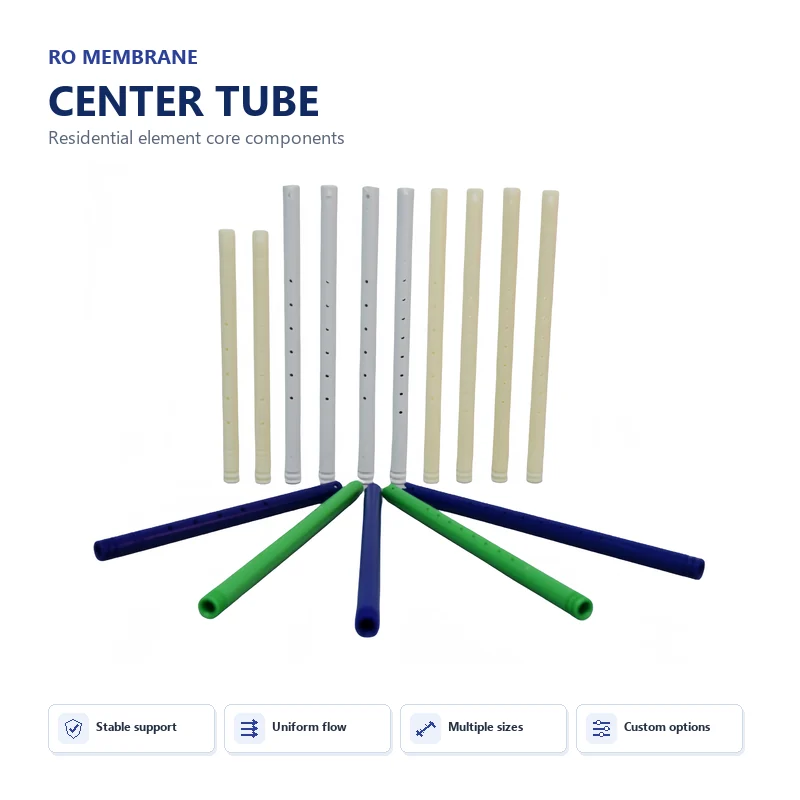
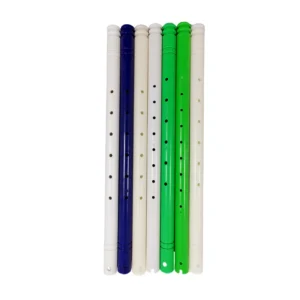
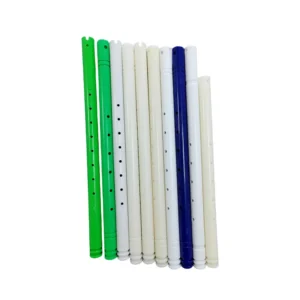
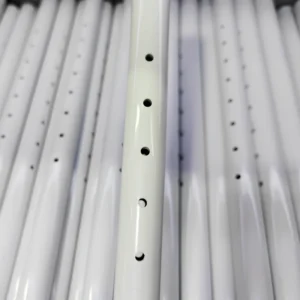
The RO membrane central tube, also called a permeate tube or product-water collection tube, forms the winding core of a spiral-wound membrane element. Permeate moves through the permeate carrier inside each membrane envelope and enters the perforated central tube before leaving the element through the product-water connection.
WECOME supplies injection-moulded ABS central tubes for common household element programs and 4040 / 8040 industrial element production. Multiple lengths, end configurations, colours and OEM designs are available, subject to drawing or sample confirmation.
An RO membrane central tube is the permeate collection channel and structural winding core of a spiral-wound element. It does not create the feed-water channel across the membrane surface; that function belongs to the feed spacer. Correct tube length, diameter, perforation pattern, end geometry and connector interface are therefore essential for reliable rolling, permeate collection and final element assembly.
How the Central Tube Works Inside a Spiral-Wound Element
During operation, feed water travels through channels created by the feed spacer. Water that permeates through the membrane sheet enters the membrane envelope, flows along the permeate carrier and is collected by the central permeate tube. The tube then directs product water to the element outlet or to an interconnector in a multi-element pressure vessel.
Membrane sheet
Separates the feed stream from the permeate according to the complete element design and operating conditions.
Permeate carrier
Supports the membrane envelope and provides a path for permeate to move toward the tube.
Central tube
Receives permeate through its openings and acts as the core around which the membrane leaves are rolled.
Product-water connection
Transfers collected permeate to the element outlet or the next connected element.
Why Central Tube Geometry Matters
A central tube is more than a plastic support. Its dimensions affect rolling-tool compatibility, membrane-leaf alignment, finished-element concentricity and connection to downstream fittings. Its perforations must allow permeate entry without burrs or uncontrolled obstruction, while the tube body must retain dimensional stability during winding, curing, trimming, handling and normal element operation.
WECOME operates plastic injection production for RO membrane components. Standard and OEM tubes can be supplied after the customer confirms the tube drawing, required tolerances, end configuration, perforation layout, resin grade, colour and packing method.
Key Product Advantages
Clean permeate-entry openings
Controlled moulding and finishing reduce burr risk around the perforations, supporting cleaner assembly and a consistent flow path into the product-water tube.
Dimensional consistency for rolling
Stable tube geometry supports fixture fit, membrane-leaf positioning and repeatable spiral-wound element production.
ABS construction
The listed range uses ABS for structural rigidity and practical component production. Final resin compatibility must be checked against temperature, cleaning chemistry and regulatory requirements.
Household and industrial formats
Standard supply covers 9-inch to 13-inch household programs plus 40-inch central tubes for 4040 and 8040 element manufacturing.
Multiple end configurations
Hexagon and half-circle specifications are available in the listed household range. Confirm the required geometry against your tooling and element drawing.
OEM supply support
Custom colour, dimensions, perforation layout and packaging can be evaluated for repeat orders and complete RO element material programs.
RO Membrane Central Tube Specifications
The following standard range is intended for procurement comparison. Product Spec wording follows the current WECOME supply list. For tooling approval, use the controlled drawing rather than the nominal model name alone.
| Part Number | Product Spec | Material | Color | Qty / Box | Boxes / Pallet | Outer Carton Size | GW / Box |
|---|---|---|---|---|---|---|---|
| TUBE-09L-IVORY | 9 inches, Hexagon | ABS | Ivory | 500 pcs | 40 | 280 × 300 × 300 mm | 18 kg |
| TUBE-10L-IVORY | 10 inches, Hexagon | ABS | Ivory | 500 pcs | 40 | 280 × 300 × 300 mm | 20 kg |
| TUBE-10Y-IVORY | 10 inches, Half circle | ABS | Ivory | 500 pcs | 40 | 280 × 300 × 300 mm | 20 kg |
| TUBE-12L-IVORY | 12 inches, Hexagon | ABS | Ivory | 500 pcs | 40 | 300 × 300 × 300 mm | 22 kg |
| TUBE-12Y-IVORY | 12 inches, Half circle | ABS | Ivory | 500 pcs | 40 | 300 × 300 × 300 mm | 22 kg |
| TUBE-13L-IVORY | 13 inches, Hexagon | ABS | Ivory | 500 pcs | 40 | 300 × 300 × 300 mm | 25 kg |
| TUBE-13Y-IVORY | 13 inches, Half circle | ABS | Ivory | 500 pcs | 40 | 300 × 300 × 300 mm | 25 kg |
| TUBE-4040 | 40 inches tube | ABS | Ivory | 100 pcs | 20 | 220 × 220 × 1050 mm | 20 kg |
| TUBE-8040 | 40 inches tube | ABS | Ivory | 25 pcs | 20 | 220 × 220 × 1050 mm | 16 kg |
On tablet and mobile screens, each SKU is displayed as a structured specification card.
Nominal specifications and packing data are provided for preliminary purchasing reference. Final dimensions, tolerances, resin grade, carton size and gross weight should be confirmed in the approved drawing, sample and quotation before mass production.
How to Select the Correct RO Membrane Permeate Tube
Two central tubes with the same nominal element length are not automatically interchangeable. Send the following information before sampling or bulk production:
Tube length and diameter
Confirm overall length, outside diameter, inside diameter and any stepped or reduced sections.
End and connector geometry
Provide drawings for the tube ends, product-water outlet, O-ring location, coupler or interconnector interface.
Perforation layout
Specify hole shape, diameter, pitch, row count, open area and any no-hole zones required by the membrane-leaf design.
Rolling and tooling interface
Check the tube against the rolling spindle, central tube tape position, leaf stack and downstream trimming process.
Resin and compatibility
State intended water type, operating temperature, cleaning chemicals and any regulatory or test-document requirements.
Commercial requirements
Share colour, annual demand, box quantity, pallet plan, labelling and traceability needs.
4040 and 8040 buyer note
Both industrial models use a nominal 40-inch tube length, but tube diameter, end interface, perforation pattern and connector requirements may differ. Select TUBE-4040 or TUBE-8040 only after matching the finished-element drawing or an approved physical sample.
Injection Moulding and Quality-Control Focus
For repeat RO membrane element production, the central tube must be controlled as a functional component rather than only checked by colour and nominal length. A practical approval plan should include the following checkpoints:
Resin identity
Confirm the specified ABS grade, colour masterbatch and applicable supporting documents for the order.
Stable geometry
Monitor moulding conditions that influence straightness, shrinkage, end shape and repeatability.
Clean openings
Check for burrs, flash, blockage, cracks, deformation and other defects around the permeate-entry holes.
Drawing conformity
Verify critical length, diameters, interface dimensions and perforation positions against the controlled drawing.
Tooling fit
Run sample tubes through taping, rolling and trimming fixtures before final batch approval.
Interface fit
Validate the tube with the specified connector, O-ring, end cap or pressure-vessel interconnector.
Traceable supply
Apply agreed lot identification, sample retention and inspection records for repeat OEM programs.
Transit protection
Use cartons and pallet loading that reduce bending, impact and contamination during international transport.
Applications
Household RO element production
Central winding and permeate-collection tube for common residential and household spiral-wound element programs.
4040 industrial RO elements
Product-water collection tube for 4040 element manufacturing after drawing and interface confirmation.
8040 industrial RO elements
Permeate tube for 8040 element production with the required tube diameter, hole pattern and connection geometry.
Brackish-water and desalination programs
Component supply for manufacturers building application-specific RO elements; full chemical and hydraulic validation remains with the element design.
Industrial reuse and ultrapure-water programs
Central tube matching for elements intended for process-water, reclaimed-water and high-purity-water systems.
OEM development and pilot production
Samples and custom configurations for new element designs, tooling trials, line commissioning and supplier qualification.
Packaging and OEM Supply
The listed 9-inch to 13-inch tubes are packed 500 pieces per box and 40 boxes per pallet.
TUBE-4040 is listed at 100 pieces per box; TUBE-8040 is listed at 25 pieces per box, with 20 boxes per pallet.
Colour, geometry, labels and packing can be reviewed for OEM orders after drawing, sample and quantity confirmation.
Frequently Asked Questions
What is an RO membrane central tube?
It is the perforated tube at the centre of a spiral-wound membrane element. It acts as the winding core and collects permeate from the membrane envelopes through the permeate carrier before directing product water to the outlet.
Is the central tube responsible for distributing feed water across the membrane?
No. The feed spacer creates the flow channel for feed water across the membrane surface. The central tube receives and carries permeate, also called product water, from inside the membrane envelopes.
Which household and industrial tube sizes does WECOME supply?
The published standard range covers 9-inch, 10-inch, 12-inch and 13-inch household options, plus 40-inch central tubes for 4040 and 8040 industrial element programs. Exact compatibility must be confirmed from the element drawing or sample.
Are 4040 and 8040 central tubes interchangeable?
Not necessarily. Although both are used in nominal 40-inch elements, their diameter, end connection, perforation layout and interface dimensions can differ. Confirm the controlled drawing before ordering.
Can the tube colour, perforation pattern or dimensions be customized?
Yes, OEM configurations can be evaluated. Send the tube drawing or sample, required tolerances, resin and colour requirements, annual quantity and packing plan for technical review.
Is ABS compatible with every RO cleaning chemical?
No material should be treated as universally compatible. Suitability depends on chemical type, concentration, temperature, exposure time and mechanical stress. Confirm the actual cleaning and operating conditions before approving the tube resin.
What information should be included in an RFQ?
Include the target element model, tube drawing or sample, length, inside and outside diameters, end geometry, perforation layout, connector interface, resin and colour requirements, order quantity, documentation needs and packing method.
Related Central Tube Materials and Production Support
Use the following verified WECOME pages to match the tube with its surrounding materials, preparation equipment and technical reference:
Confirm the Tube Drawing Before You Quote
Send your element model, central tube drawing or sample, required quantity and packing plan. WECOME will review the fit before sample or bulk production.