



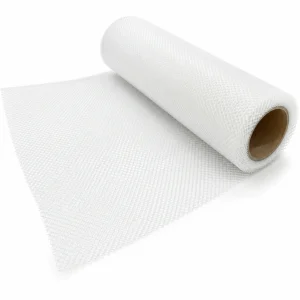

RO membrane feed spacer, also called RO membrane spacer or feed spacer mesh, is the polypropylene net placed between adjacent membrane leaves in a spiral-wound element. It establishes the feed and concentrate channel through which source water travels across the active membrane surface.
WECOME supplies 1016 mm PP feed spacer rolls in multiple strand geometries for household, 4040 and 8040 RO membrane element production. Consistent channel height, strand profile and surface finish help manufacturers control pressure drop, flow distribution, membrane protection and repeatability during element rolling.
An RO feed spacer forms the feed-water channel outside the sealed membrane envelope. Its geometry affects channel height, crossflow pattern, pressure loss, concentration polarization, fouling behaviour and cleaning access. It is different from permeate carrier fabric, which sits inside the envelope and carries product water to the central tube.
Where the Feed Spacer Sits in an RO Membrane Element
Source water enters
Pressurized feed water enters the spiral-wound element and is directed into the membrane-leaf channels.
Spacer separates leaves
The PP mesh maintains a defined gap between facing membrane surfaces and creates a crossflow path.
Water crosses the membrane
Permeate passes through the membrane while retained salts and contaminants remain in the feed channel.
Reject stream exits
Crossflow carries the concentrated stream toward the element outlet according to the complete system design.
Why Feed Spacer Geometry Matters
Feed spacer selection is a hydraulic and manufacturing decision. Strand height, crossing angle, strand count, contact points and surface condition influence pressure drop, local velocity, mixing, membrane contact and available space inside the finished element. No single geometry is optimal for every feed-water condition.
A thicker or more open spacer may improve channel clearance and fouling tolerance in some applications, but it can also reduce the membrane area that fits inside a fixed element diameter. A tighter geometry may increase packing density while raising pressure-drop or plugging risk. Selection should be validated through an element build, hydraulic test and cleaning review.
Key Product and Manufacturing Advantages
Defined feed-channel geometry
Controlled strand layout creates a repeatable feed and concentrate path between membrane leaves.
Consistent flow distribution
Uniform mesh structure supports stable crossflow and reduces avoidable local restriction caused by dimensional variation.
Controlled strand tolerance
Listed ±1 and ±2 tolerance classes help buyers compare production requirements once the measurement basis is confirmed.
Membrane-safe surface requirement
Strands should be smooth and free from sharp burrs that could mark or puncture the membrane sheet during rolling and operation.
Polypropylene construction
PP provides a practical balance of chemical resistance, low mass and processing stability for common RO element programs.
Household and industrial conversion
1016 mm rolls can be converted to specified leaf sizes for residential, commercial, 4040 and 8040 element production.
RO Membrane Feed Spacer Specifications
The table retains the 13 configurations supplied for this update. Packing fields without source data are left blank.
| Product Model | Material | Strand Tolerance* | Outer Carton Size* | GW / Box |
|---|---|---|---|---|
| 1033-1016mm | PP | ±2 | ||
| 1333-1016mm | PP | ±2 | 38 × 38 × 113 | 22 kg |
| 1716-1016mm | PP | ±1 | 43 × 43 × 113 | 19 kg |
| 2016-1016mm | PP | ±1 | 47 × 47 × 113 | 22 kg |
| 2216-1016mm | PP | ±1 | ||
| 2409-1016mm | PP | ±1 | 47 × 47 × 113 | 22 kg |
| 2709-1016mm | PP | ±1 | 52 × 52 × 114 | 24 kg |
| 2809-1016mm | PP | ±1 | 52 × 52 × 114 | 26 kg |
| 3009-1016mm | PP | ±1 | 52 × 52 × 111 | 26 kg |
| 3109-1016mm | PP | ±1 | 55 × 55 × 111 | 30 kg |
| 3209-1016mm | PP | ±1 | 56 × 56 × 111 | 30 kg |
| 3407-1016mm | PP | ±1 | 59 × 59 × 111 | 30 kg |
| 3409-1016mm | PP | ±1 | 59 × 59 × 111 | 30 kg |
On tablet and mobile screens, each feed spacer model is displayed as a structured specification card.
* Strand tolerance values are reproduced exactly as supplied. Confirm the unit, reference dimension and inspection method on the controlled data sheet before quotation or batch acceptance.
Packaging-unit confirmation required: the source heading states millimetres, but values such as 38 × 38 × 113 cannot physically describe a carton for a 1016 mm-wide roll if interpreted as millimetres. Confirm whether the dimensions are centimetres or should be converted to values such as 380 × 380 × 1130 mm before publishing a final packing specification.
How to Select an RO Membrane Spacer
Element format
State household, commercial, 4040, 8040 or custom dimensions, including finished diameter and target membrane area.
Nominal channel height
Confirm spacer thickness with the approved drawing because channel height affects packing, flow velocity and pressure drop.
Strand geometry
Specify crossing angle, strand count, strand profile and orientation rather than relying only on the sales model.
Feed-water condition
Provide salinity, suspended solids, organic load, biological risk and pretreatment because fouling behaviour is application-specific.
Hydraulic target
Review feed flow, acceptable element pressure drop, recovery and cleaning velocity across the complete membrane system.
Rolling and cutting plan
Confirm roll width, cut length, stiffness, edge condition and compatibility with automated converting equipment.
Pressure drop
Channel height and strand layout influence frictional loss along the membrane leaf. Compare candidates under representative flow conditions.
Mixing and polarization
Spacer-induced flow changes can affect boundary-layer behaviour, but the result depends on geometry and operating conditions.
Fouling and cleaning
Open area, contact points and surface finish influence deposit accumulation and access during flushing or chemical cleaning.
Feed spacer is not permeate carrier
The feed spacer forms the feed / concentrate channel outside each sealed membrane envelope. RO membrane permeate carrier is a knitted fabric inside the envelope that supports the membrane and drains product water to the central tube. The materials are not interchangeable and should not share the same primary SEO keyword.
Quality-Control Points for Bulk Feed Spacer
PP identity
Confirm the specified polymer, colour and any required material declaration against the approved order.
Thickness and angle
Measure channel height, crossing angle and strand count using the agreed method and sampling plan.
Batch consistency
Verify the stated tolerance against a controlled reference dimension; the tolerance value alone is incomplete.
Burr and sharp-point inspection
Inspect contact surfaces for protrusions, rough edges and local defects that could damage the membrane sheet.
Width and alignment
Check usable width, telescoping, wrinkles, edge condition and winding stability before cutting.
Foreign-matter control
Inspect for oil, dust, loose particles, stains and contamination before membrane-leaf assembly.
Cutting and welding trial
Confirm flatness, feeding, cut quality and positioning on the intended production equipment.
Finished-element test
Approve the spacer through rolling, integrity checks and hydraulic testing of the complete RO element.
Applications
Household RO membrane elements
Feed-channel mesh converted for residential and household spiral-wound membrane production.
4040 and 8040 RO elements
1016 mm spacer rolls for common industrial membrane-leaf preparation and element manufacturing.
Brackish-water RO
PP feed spacer matched to validated brackish-water element construction and hydraulic requirements.
Seawater RO programs
Application-specific mesh geometry selected against high-pressure element design and testing requirements.
Pure and ultrapure water
Controlled spacer material for process-water elements with defined cleanliness and traceability requirements.
Wastewater reuse elements
More open channel options can be evaluated for feed streams with higher fouling risk and cleaning demand.
Frequently Asked Questions
What does a feed spacer do in a spiral-wound RO membrane element?
It separates adjacent membrane leaves and creates the feed / concentrate flow channel. Its geometry influences channel height, pressure drop, crossflow, mass transfer, fouling and cleaning behaviour.
Is RO membrane spacer the same as permeate carrier?
No. Feed spacer is outside the sealed membrane envelope and carries feed and concentrate. Permeate carrier is inside the envelope and carries product water toward the central tube.
Does a thicker feed spacer always perform better?
No. A thicker or more open spacer can improve channel clearance in some services, but may reduce membrane area inside a fixed element diameter. Pressure drop, fouling tolerance, packing density and hydraulic performance must be balanced.
Can sharp spacer strands damage an RO membrane sheet?
Yes. Sharp burrs or local protrusions can mark or puncture membrane surfaces during rolling or operation. Surface inspection and an element-build trial should be part of material qualification.
Is polypropylene compatible with every RO cleaning chemical?
No polymer should be treated as universally compatible. Review chemical type, concentration, pH, temperature, exposure time and mechanical stress before approving a spacer for the cleaning program.
Can WECOME supply feed spacer for 4040 and 8040 elements?
The listed models are supplied in 1016 mm width and can be reviewed for 4040 and 8040 element production. Final selection requires the element drawing, target spacer geometry and conversion plan.
What information should be included in an RFQ?
Provide the element model, nominal spacer thickness, strand angle and count, roll width, feed-water application, annual quantity, approved drawing or sample, packing requirements and acceptance test method.
Related Materials and Technical References
Use these WECOME pages to match feed spacer geometry with the surrounding membrane materials and production process:
Match Feed Spacer Geometry to Your RO Element Design
Send the element model, approved spacer drawing or sample, target channel height, roll width and annual quantity for material review.