
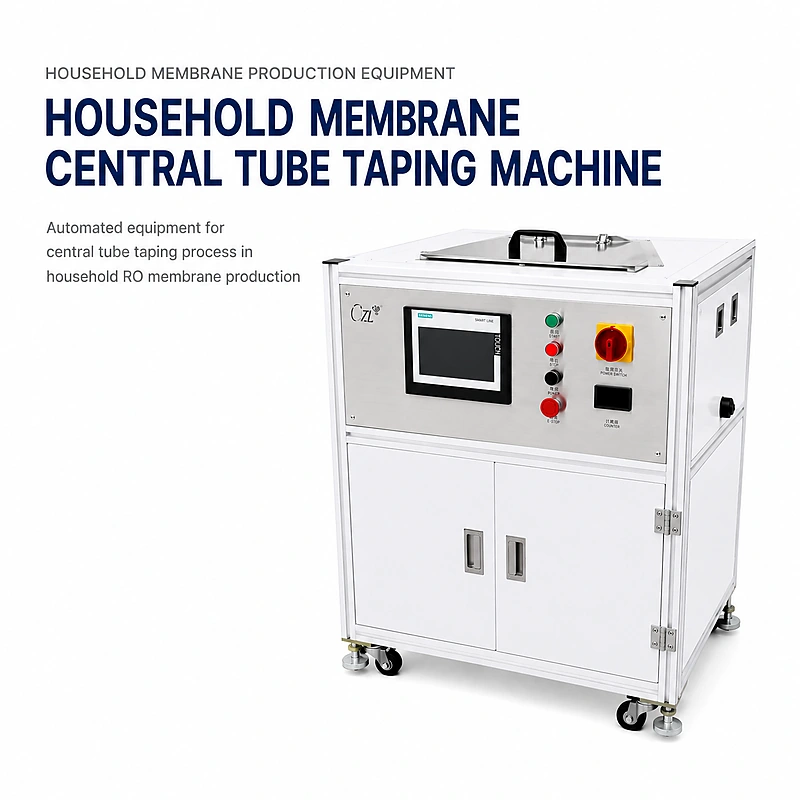

The Household Membrane Central Tube Taping Machine automatically applies central tube tape to both ends of 10-inch, 12-inch and 13-inch permeate tubes used in residential spiral-wound RO membrane elements. Model LS-ZGZCR-T combines automatic tube transfer, controlled tape placement and a servo-driven winding cycle with a reference processing time of approximately three seconds per tube.
The tape forms a temporary glue-separation zone at the tube ends before membrane rolling. After the adhesive cures, the taped end sections help the downstream trimming process remove excess membrane material cleanly without leaving unwanted adhesive residue on the defined tube-end area.
Why Apply Central Tube Tape Before Membrane Rolling?
During household RO element rolling, adhesive is applied along the membrane leaf. The RO membrane central tube tape protects the designated end sections of the RO membrane central tube from direct glue contact. Consistent tape position makes the cured element easier to trim and helps keep the tube-end finishing process repeatable.
This equipment is also described by buyers as an RO membrane central tube tape wrapping machine, permeate tube taping machine or automatic tube tape winding machine. Its function is specific to central tube preparation; it does not wind the membrane element itself.
Automatic Central Tube Taping Process
Load tube and tape
Install the approved central tube format and matched tape, then select the validated recipe.
Transfer the central tube
The automatic handling sequence positions the tube for repeatable tape placement at both ends.
Apply tape with controlled winding
The servo-driven mechanism places and winds the tape according to the configured position and tension.
Discharge and inspect
Check tape position, adhesion and wrap consistency before the tube moves to membrane rolling.
Key Production Advantages
Tape placement at both tube ends
The automatic sequence prepares both ends of the central tube for the subsequent adhesive and trimming process.
Fast servo-driven winding
A servo winding motor supports a reference cycle of approximately three seconds per tube under matched settings.
Multiple household tube formats
Recipe and fixture adjustments cover common 10-inch, 12-inch and 13-inch household RO central tubes.
Capacity for multi-machine lines
One taping station can support up to 15 rolling machines when their cycles, shifts and material flow are properly balanced.
Simple touchscreen workflow
Recipe-based operation reduces the learning threshold while retaining required setup, inspection and safety training.
Compact production station
The 1050 × 900 mm floor footprint supports efficient workstation placement in new and existing household lines.
Central Tube Taping Machine Specifications
| Technical Item | Standard / Reference Data |
|---|---|
| Product Name | Household RO Membrane Central Tube Taping Machine |
| Model | LS-ZGZCR-T |
| Primary Function | Automatic central tube tape placement and winding at both tube ends |
| Applicable Tube Formats | 10-inch, 12-inch and 13-inch household RO central tubes |
| Operation | Automatic tube transfer and tape-wrapping cycle with operator replenishment and supervision |
| Reference Processing Time | Approximately 3 seconds per tube under validated production conditions |
| Standard PLC / Touchscreen for LS-ZGZCR-T | Taida PLC and Taida touchscreen |
| Winding Drive | Servo motor; final motor brand and electrical BOM confirmed in the quotation |
| Alternative Control Package | Siemens motor, PLC and touchscreen only when specified in the signed technical configuration |
| Frame | European-standard heavy-duty industrial aluminum profile |
| Operating Voltage & Power | 220 V / 50 Hz, 1 kW |
| Air Source Pressure | 0.5-0.6 MPa, clean and dry compressed air |
| Overall Dimensions (L × W × H) | 1050 × 900 × 1250 mm |
| Equipment Weight | 150 kg |
| Packing Size | Confirm after the final machine configuration and export-packing design |
The supplied data contains more than one historical control-system and machine-size configuration. This page uses the latest stated mechanical dimensions and identifies Taida PLC/HMI as the model-specific standard for LS-ZGZCR-T. Siemens components should only be presented as standard when they appear in the signed quotation and final electrical bill of materials.
Capacity Matching with Household Rolling Machines
A three-second cycle corresponds to a theoretical maximum of approximately 1200 tubes per hour before replenishment, changeovers, inspection and planned stops. The statement that one machine can support up to 15 household RO membrane rolling machines is reasonable only when the rolling cycle is near the matched design rate and central tubes arrive continuously.
Use balanced-line data rather than machine count alone
Final capacity should be calculated from the rolling-machine cycle, number of shifts, tube sizes, tape change frequency, operator handling, buffer quantity and expected equipment utilization. WECOME can confirm whether one station is sufficient after reviewing the actual rolling line.
What the Machine Prepares – and What Comes Next
Prepared by this machine
- Matched 10-inch, 12-inch or 13-inch central tube handling
- Automatic central tube tape placement at both ends
- Servo-driven winding with configured tape position and tension
- Taped central tubes ready for household membrane rolling
Handled by downstream equipment
- Membrane leaf gluing and spiral winding
- Adhesive curing and element-end trimming
- Brine-seal assembly and any required external wrapping
- Vacuum integrity and hydraulic-performance testing
For the tube’s function and dimensional terminology, review What Is the Central Tube in an RO Membrane Element? and the RO Membrane Central Tube Specifications.
Where This Machine Fits Best
Household RO element factories
Standardize central tube preparation before recurring residential membrane rolling.
Overseas local assembly
Support membrane manufacturers and water-treatment factories establishing local production capacity.
OEM and ODM production
Use validated recipes for different customer tube lengths, tape positions and production orders.
New-model validation
Verify tape position and trimming behavior before a new household membrane format enters production.
R&D and pilot batches
Prepare controlled small batches for central tube, adhesive and process-development trials.
Technical training centers
Demonstrate tube preparation, recipe setup and inspection within a supervised RO element workflow.
Central Tube and Tape Compatibility Checks
Stable automation depends on matching the machine to the actual tube and tape, not only the nominal 10-inch, 12-inch or 13-inch description. WECOME should review drawings and physical samples before the final tooling is released.
Central tube information
- Overall length, outside diameter and end geometry
- Permeate-hole position and protected end-zone length
- Tube material, surface condition and dimensional tolerance
Tape and process information
- Tape width, thickness, liner structure and adhesive behavior
- Required wrap position, overlap and tension
- Rolling adhesive, curing and downstream trimming method
Configuration, Acceptance and Delivery
| Project Input | What WECOME Confirms |
|---|---|
| Tube Formats | 10-inch, 12-inch and 13-inch dimensions, tolerances and production mix |
| Tape Samples | Tape construction, roll format, adhesion, winding position and sample-trial requirements |
| Production Target | Tubes per shift, rolling-machine count, buffer requirement and recommended station quantity |
| Control Package | Taida standard or a separately quoted Siemens option, documented in the final electrical BOM |
| Utilities | Regional electrical standard and clean, dry compressed-air connection |
| Machine Acceptance | Cycle time, tape-position tolerance and approved sample criteria |
| Packaging | Final crate dimensions, gross weight and export-protective packing after configuration approval |
| Technical Support | Installation guidance, commissioning, operator training and after-sales assistance |
Frequently Asked Questions
What does an RO membrane central tube taping machine do?
It automatically places and winds central tube tape at both ends of a household RO permeate tube. The tape separates the defined tube-end area from rolling adhesive and supports cleaner downstream trimming.
Which central tube sizes can model LS-ZGZCR-T process?
The stated configuration supports common 10-inch, 12-inch and 13-inch household RO central tubes. Final compatibility depends on the actual tube drawing, outside diameter, end geometry, tape and tooling.
Why is tape applied to both ends of the central tube?
The taped zones help isolate the designated tube-end sections from membrane-rolling adhesive. After curing, the trimming process can remove excess end material more cleanly and reduce unwanted adhesive residue in those protected areas.
Is the machine fully automatic?
The tube transfer and tape-wrapping cycle are automatic for the confirmed configuration. An operator still replenishes tubes and tape, selects recipes, monitors operation and inspects finished tubes.
Does the standard LS-ZGZCR-T use Siemens or Taida controls?
The model-specific information identifies Taida PLC and Taida touchscreen as the standard control package. Siemens components should be treated as an optional or alternative configuration only when explicitly included in the signed quotation and electrical BOM.
Can one machine support 15 membrane rolling machines?
It can support up to 15 rolling machines under a balanced production plan. The final ratio depends on each rolling-machine cycle, tube size, shift pattern, replenishment time, buffer inventory and practical utilization.
Is this machine used to wrap the finished RO membrane element?
No. It tapes the central tube before membrane rolling. Finished-element outer wrapping and brine-seal tape winding are separate processes with different machines and materials.
What information is required before quotation?
Provide central tube drawings and samples, tape specifications and samples, required tape position, target tubes per shift, rolling-machine quantity, electrical standard and compressed-air conditions.
Related Equipment and Technical Resources
Confirm the Tube, Tape and Control Package
Send WECOME your central tube drawing, tape sample, rolling-machine quantity and target output. Our engineers will review tooling, capacity and the final electrical configuration.