

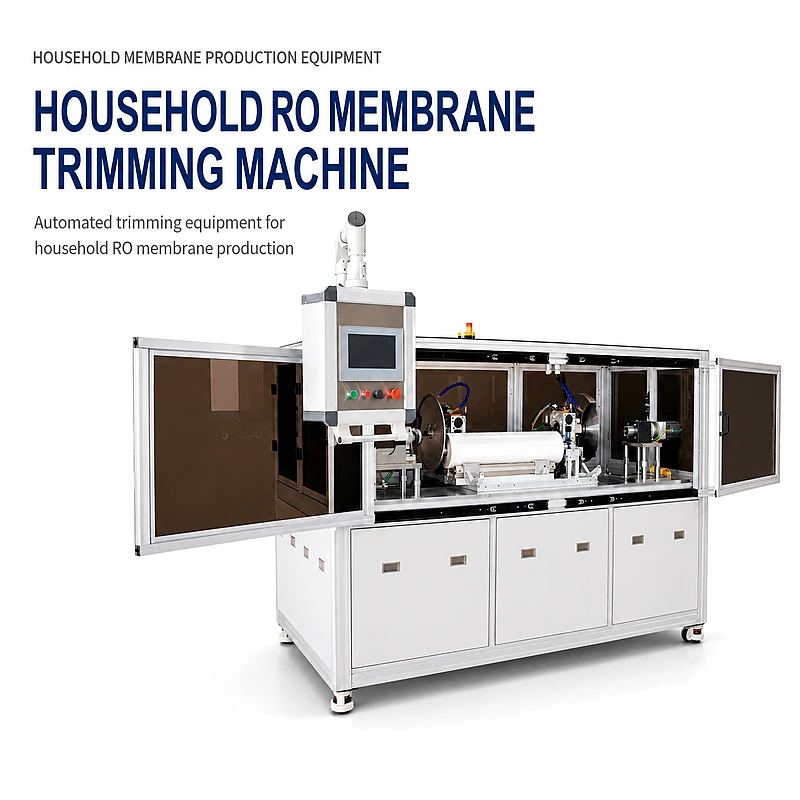
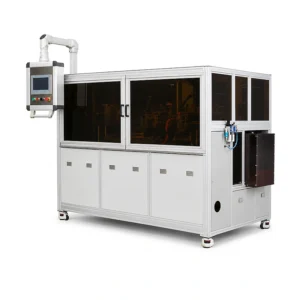
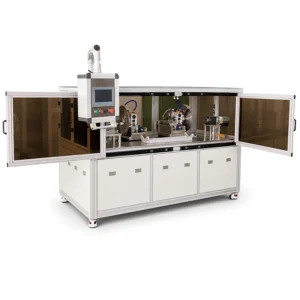
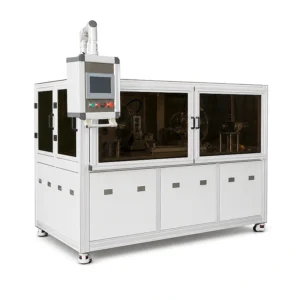

The Household RO Membrane Trimming Machine automatically trims both ends of a cured spiral-wound residential RO membrane element. One operator tends the station while the machine conveys and positions the element, performs the programmed end-trimming cycle, and unloads the finished piece for inspection and downstream quality control.
The adjustable configuration is designed around common 1812 two-layer through 3013 seven-layer membrane constructions. Servo-driven tooling and Siemens PLC/touchscreen control help produce consistent end faces at a reference rate of two to three elements per minute.
Automatic RO Membrane Element End Trimming
Spiral-wound RO elements leave the rolling process with excess membrane, spacer and adhesive at both ends. After the adhesive has reached the approved cure condition, the trimming machine removes the excess material and produces defined element ends for subsequent inspection and component assembly.
Correct trimming timing matters. Processing an element before the adhesive is sufficiently cured can disturb the rolled structure, smear adhesive or reduce end-face consistency. Cure requirements should follow the approved adhesive process and the RO Membrane Adhesive and Glue Data Sheet.
Integrated Trimming Workflow
Confirm adhesive cure
Release only elements that meet the validated curing condition.
Feed the element
The operator or matched buffer supplies the compatible rolled element.
Convey and clamp
The machine positions and secures the element for the cutting cycle.
Finish both ends
Servo-driven precision tooling trims the programmed end allowance.
Unload and inspect
The finished element exits for dimensional and visual quality checks.
Key Production Advantages
Integrated automatic sequence
Internal conveying, positioning, trimming and finished-element unloading are combined in one controlled cycle.
Servo-driven precision tooling
Controlled motion and matched cutting tools support repeatable end position and finished geometry.
Broad household compatibility
The standard range covers common 1812-3013 products, with additional legacy formats subject to tooling approval.
Siemens operator control
PLC and touchscreen recipes simplify size adjustment, status monitoring and one-operator production.
Productive single-operator station
A reference rate of two to three pieces per minute reduces repetitive manual trimming work.
Line-ready finishing step
The station can operate independently or connect curing, trimming and downstream QC through managed buffers.
Household RO Membrane Trimming Machine Specifications
| Technical Item | Standard / Reference Data |
|---|---|
| Product Name | Household RO Membrane Trimming Machine |
| Model No. | Project-specific; confirm before quotation |
| Primary Function | Automatic trimming of both ends of a cured household spiral-wound RO membrane element |
| Standard Element Range | 1812 two-layer through 3013 seven-layer constructions, subject to approved tooling |
| Additional Referenced Formats | 1810, 2012 and 2812 may be supported after drawing and sample confirmation |
| Operation | One operator; automatic internal conveying, positioning, trimming and finished-element unloading |
| Reference Production Rate | 2-3 pieces per minute |
| Reference 12-Hour Output | Approximately 1500-2200 pieces as a rounded production-planning range |
| Motor / PLC / Touchscreen | Siemens in the supplied configuration; final electrical BOM controls |
| Drive System | Servo-driven precision tooling; exact servo model confirmed in the final BOM |
| Reference Pneumatics | AirTAC / SMC components, subject to final configuration |
| Reference Motion and Electrical Parts | Taiwan Shangyin drive screw, Schneider contactors, Omron power/relay and Autonics sensors; final BOM controls |
| Frame | European-standard heavy-duty industrial aluminum profile |
| Operating Voltage & Power | AC 220 V / 1 kW |
| Air Source Pressure | 0.6-0.7 MPa, clean and dry compressed air |
| Overall Dimensions (L × W × H) | 1931 × 1256 × 1920 mm |
| Equipment Weight | 320 kg |
| Packing Size | 2131 × 1456 × 1980 mm |
The current supplied configuration identifies Siemens motor, PLC and touchscreen. A legacy equipment configuration also referenced a 750 W Sankyo servo drive. The signed quotation and final electrical bill of materials must therefore be used as the controlling component record.
When an RO Membrane Element Is Ready for Trimming
Release to trimming
- Required adhesive cure condition has been achieved
- Element model and trimming recipe are confirmed
- Required finished length and end allowance are approved
- Rolled element is stable, identifiable and free from obvious deformation
Hold for review
- Adhesive remains tacky or cure status is uncertain
- Element diameter or length falls outside the approved fixture range
- Visible telescoping, layer shift or structural deformation is present
- Tooling, cut allowance or product recipe has not been verified
Production Capacity and Line Balance
Two to three pieces per minute corresponds mathematically to approximately 1440-2160 pieces over 12 uninterrupted hours. The supplied 1500-2200-piece figure is a rounded production reference. Actual shift output will be lower when changeovers, tool inspection, material handling, cleaning and planned stops are included.
Balance curing capacity before adding trimming speed
The trimming station can only run continuously when cured elements arrive at a stable rate. Capacity planning should compare rolling output, adhesive cure time and buffer size with trimming cycle time and downstream vacuum-testing capacity.
What Trimming Improves – and What It Does Not Test
Trimming is designed to
- Remove excess membrane, spacer and cured adhesive from both ends
- Produce consistent finished length and defined end faces
- Prepare the element for inspection and component assembly
- Reduce repetitive manual cutting and handling variation
Trimming does not replace
- Vacuum-decay integrity screening
- Salt-rejection or permeate-flow performance testing
- Verification of adhesive cure before cutting
- Inspection for rolling defects, layer shift or incorrect material assembly
Where This Machine Fits Best
Household RO element factories
Standardize end finishing for recurring 1812-3013 residential membrane production.
OEM and ODM production
Store validated recipes and tooling settings for customer-specific element formats.
Line-capacity upgrades
Replace manual end cutting where finishing speed or operator consistency limits output.
Overseas local assembly
Add a controlled post-curing finishing station to a locally operated household RO line.
New-model validation
Confirm fixture fit, cut allowance and end-face quality before production release.
R&D and technical training
Demonstrate post-curing handling, trimming setup and finished-element inspection.
Quality Checks Before Downstream Assembly
Dimensional checks
- Finished element length and end allowance
- End-face squareness and consistency between both ends
- Central tube position and required exposed length
- Compatibility with the next assembly fixture
Visual and process checks
- Cut-edge quality, debris and adhesive residue
- Visible leaf damage, layer shift or telescoping
- Product identification and recipe traceability
- Routing to vacuum testing, rework or component assembly
Use the RO Membrane Element Quality Control Checklist to define the inspection handoff after trimming.
Configuration, Acceptance and Delivery
| Project Input | What WECOME Confirms |
|---|---|
| Element Models | Target formats, outside diameter, finished length, layer construction and production mix |
| Cured Element Samples | Fixture compatibility, cut allowance, adhesive behavior and trial-trimming requirements |
| Production Target | Pieces per shift, curing buffer, operator plan and recommended station quantity |
| Tooling and Recipes | Clamping method, cut position, tooling set and approved product recipes |
| Machine Acceptance | Cycle time, dimensional inspection, end-face quality and approved sample criteria |
| Electrical BOM | Motor, servo, PLC, HMI, sensors and reference component brands documented before production |
| Packaging | 2131 × 1456 × 1980 mm reference packing size and export-protective packing |
| Technical Support | Installation guidance, commissioning, operator training and after-sales assistance |
Frequently Asked Questions
What does a household RO membrane trimming machine do?
It trims excess membrane, spacer and cured adhesive from both ends of a spiral-wound household RO element, producing defined end faces for inspection and downstream component assembly.
When should an RO membrane element be trimmed?
Only after the rolling adhesive reaches the approved cure condition. Trimming too early can disturb the rolled structure, smear adhesive and reduce end-face consistency.
Which membrane element sizes can the machine process?
The standard stated range is 1812 two-layer through 3013 seven-layer household formats. Legacy configurations also reference 1810, 2012 and 2812, but each size requires drawing, sample and tooling confirmation.
Is the trimming process fully automatic?
The internal conveying, positioning, trimming and finished-element unloading sequence is automatic. One operator is still required to supply elements, select recipes, monitor operation and inspect finished pieces.
Can the machine produce 1500-2200 elements in 12 hours?
That is a rounded reference range based on two to three pieces per minute. Practical output depends on curing supply, changeovers, tool checks, inspection, handling and planned downtime.
Does trimming confirm that the membrane element will not leak?
No. Trimming finishes the element ends but does not verify air-tightness. A separate household RO membrane vacuum testing machine is required for vacuum-decay integrity screening.
Can the machine be integrated with a production line?
Yes. It can operate as a standalone one-operator station or connect through managed buffers with curing, vacuum testing and downstream assembly. Final integration depends on the line layout and equipment cycle times.
What information is required before quotation?
Provide element drawings, outside diameter, finished length, layer construction, cured samples, required cut allowance, shift output, adhesive cure process, electrical standard and line layout.
Related Equipment and Technical Resources
Confirm the Cured Element and Finished Dimensions
Send WECOME your element drawing, cured samples, finished-length tolerance and target output. Our engineers will review tooling, line balance and the final electrical configuration.