
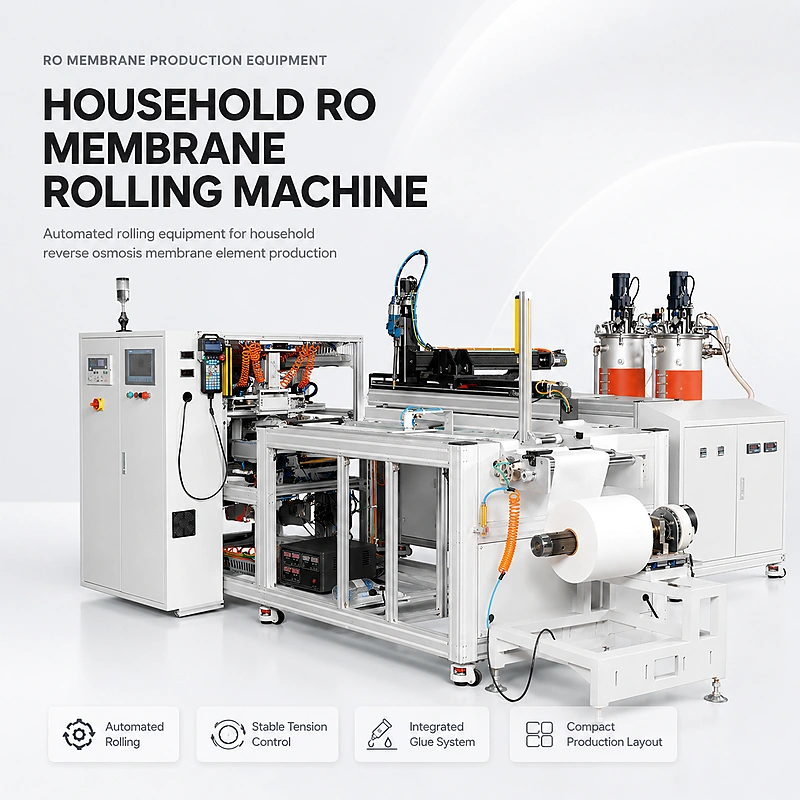
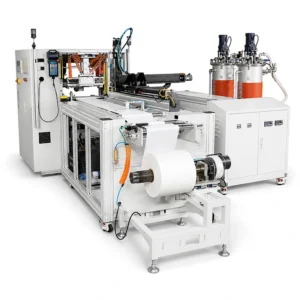

The Household RO Membrane Rolling Machine is a single-operator, servo-driven production cell for winding residential spiral-wound RO membrane elements. Model LS-JYJM10-13 supports most common household formats from 1812 two-layer elements through 3013 six-layer elements, with a maximum finished roll diameter of 100 mm.
After prepared membrane leaves and flow-channel materials are positioned, the machine coordinates adhesive application, tension control and servo rolling through a PLC touchscreen. The 35-45 second cycle reference is based on an experienced operator producing an 1812 two-layer element; actual output changes with element size, layer count, material preparation and operator proficiency.
Servo-Controlled Spiral-Wound Element Production
This semi-automatic RO membrane rolling machine is designed to improve winding consistency compared with fully manual element assembly. Precision tooling, a servo rolling spindle and closed-loop tension control help maintain membrane alignment and uniform winding pressure as the prepared membrane leaves, feed spacer and central tube are formed into a spiral-wound element.
A three-axis manipulator controls the adhesive-application path, while the temperature-controlled gluing system supports a more stable glue line. For a practical comparison of machine configurations, read how to choose an RO membrane rolling machine.
How the Household RO Membrane Rolling Process Works
Prepare the membrane leaf
Cut and arrange the membrane sheet, permeate carrier, feed spacer and central tube for the selected element recipe.
Load and align materials
The operator positions the prepared materials in the tooling and confirms the correct starting alignment.
Run the controlled cycle
The three-axis gluing mechanism and servo spindle execute the programmed adhesive and winding sequence.
Inspect the rolled element
Remove the finished core and verify diameter, alignment and appearance before downstream trimming and integrity testing.
Core Advantages for Household RO Production
Servo drive with precision tooling
The servo-driven winding system works with dedicated fixtures to improve repeatability across residential membrane formats.
Three-axis robotic gluing
Controlled movement supports a consistent adhesive path and reduces variation associated with manual glue application.
Closed-loop tension control
Automatic tension adjustment helps reduce wrinkles, layer offset and uneven winding pressure.
PLC touchscreen operation
The human-machine interface centralizes recipe selection, operating parameters and cycle control.
Infrared safety protection
An infrared light curtain and other safety controls help protect the operator around the active production area.
Lower dependence on manual winding
One trained operator can run the production cycle while the machine controls key gluing, tension and rolling movements.
Household RO Membrane Rolling Machine Specifications
| Technical Item | Standard Configuration |
|---|---|
| Product Name | Household RO Membrane Rolling Machine |
| Model No. | LS-JYJM10-13 |
| Applicable Element Range | Most common household RO membrane models from 1812 two-layer elements to 3013 six-layer elements, adjustable |
| Maximum Roll Diameter | 100 mm |
| Operation | Single-operator workflow |
| Reference Cycle Time | 35-45 seconds per piece for an 1812 two-layer element with a proficient operator |
| Control Mode | PLC and touchscreen operation |
| Drive and Gluing | Servo drive with precision tooling and three-axis manipulator gluing |
| Tension Control | Automatic adjustment with closed-loop control |
| Frame | European-standard heavy-duty industrial aluminum profile |
| Safety Protection | Infrared light curtain and configured machine-safety controls |
| Operating Power | AC 220 V, 5 kW |
| Air Source Pressure | 0.4-0.7 MPa |
| Overall Dimensions (L × W × H) | 2020 × 1620 × 2100 mm |
| Equipment Weight | 830 kg |
| Packing Size | 2050 × 1640 × 2200 mm |
The stated cycle time is a reference for the specified 1812 two-layer setup. Final element compatibility, tooling, glue system, safety layout and utilities must be confirmed against the customer’s drawings, material stack and signed technical agreement.
What This RO Membrane Making Machine Produces
The machine fabricates the spiral-wound membrane core used inside a household RO element. It is production equipment for membrane manufacturers, not an RO water purifier and not a machine that manufactures the membrane sheet itself.
Designed to process
- Prepared reverse osmosis membrane leaves for residential elements
- Membrane sheet, permeate carrier and feed spacer in the approved material stack
- Central tubes and adhesive systems matched to the selected household format
- 1812-3013 element recipes with two to six membrane layers
Separate equipment is required for
- Membrane-sheet slitting, leaf cutting or folding before the rolling station
- Finished-element trimming, brine-seal installation and vacuum integrity testing
- Salt-rejection, permeate-flow and other hydraulic-performance tests
- Industrial 4040 or 8040 membrane element rolling
Use the RO membrane element BOM calculator to organize the material stack, then verify dimensions with the RO membrane element size reference. Industrial element manufacturers should review the industrial semi-automatic RO membrane rolling machine.
Where This Machine Fits Best
Small household RO element factories
Build repeatable residential membrane output without relying entirely on manual winding skill.
Small OEM and ODM suppliers
Produce multiple household element formats for private-label water-filter and replacement-cartridge programs.
New-model membrane validation
Run controlled trial batches when adjusting layer count, element diameter, materials or adhesive parameters.
Water-treatment R&D laboratories
Prepare small batches of spiral-wound test elements for membrane-material and construction experiments.
Training and demonstration centers
Teach material preparation, alignment, gluing, tension control and residential element rolling workflows.
Refurbishment and prototype workshops
Wind newly prepared replacement or prototype membrane cores after separate disassembly and material-preparation steps.
Production Fit and Output Planning
The 35-45 second cycle is based on an 1812 two-layer element and a proficient operator. A 3013 six-layer product requires more material handling and can have a different cycle. Practical shift output must also include membrane-leaf preparation, glue replenishment, model changeover, inspection, trimming and operator breaks.
Send the actual element construction before quotation
To configure the rolling machine correctly, WECOME needs the membrane model, finished diameter, membrane-sheet size, leaf count, feed-spacer and permeate-carrier dimensions, central-tube drawing, adhesive system and target output per shift. This information is more reliable than selecting equipment from model names alone.
Quality Control After Rolling
Stable tension and controlled gluing reduce common process variation, but the rolled element still requires downstream inspection. Check finished diameter, end-face alignment, glue-line condition and exterior appearance before trimming. Then use the household RO membrane vacuum testing machine for dry integrity screening.
For troubleshooting and operator training, review common RO membrane rolling defects and causes and the RO membrane element quality control checklist.
Configuration, Documentation and Delivery
| Project Item | Available Support |
|---|---|
| Element Tooling | Configured after review of the customer’s membrane model, layer count and finished-element drawing |
| Material and Glue Trial | Process parameters confirmed against the approved membrane stack and adhesive system |
| Line Integration | Standalone supply or integration with upstream cutting and downstream finishing equipment |
| Electrical and Air Supply | Standard AC 220 V and 0.4-0.7 MPa compressed air; regional requirements subject to confirmation |
| Packing | Export-protective packing with a reference packing size of 2050 × 1640 × 2200 mm |
| Documentation | Operating manual, electrical documentation and packing list supplied with the confirmed order |
| Technical Support | Installation guidance, commissioning support, operator training and after-sales assistance |
| Lead Time | Confirmed after tooling, configuration and technical requirements are approved |
Frequently Asked Questions
What is a household RO membrane rolling machine?
It is manufacturing equipment used to wind prepared membrane leaves, feed spacer, permeate carrier and a central tube into a spiral-wound residential RO membrane element. It does not purify water and does not manufacture the membrane sheet.
Is model LS-JYJM10-13 automatic or semi-automatic?
It is best described as a single-operator, semi-automatic production machine. The operator prepares and positions the materials, while the servo drive, three-axis gluing mechanism, tension control and PLC execute key parts of the rolling cycle.
Which household RO membrane sizes can it produce?
The adjustable standard scope covers most common formats from 1812 two-layer elements through 3013 six-layer elements, with a maximum finished roll diameter of 100 mm. Compatibility must be confirmed from the actual element drawing.
What is the production cycle?
The reference is approximately 35-45 seconds per piece for an 1812 two-layer membrane element with a proficient operator. Larger formats, additional layers and upstream material preparation affect practical output.
What utilities are required?
The standard machine requires AC 220 V power, rated at 5 kW, plus clean compressed air at 0.4-0.7 MPa. Regional electrical requirements and the final air connection should be confirmed before production.
Can the machine refurbish used RO membrane elements?
It can wind newly prepared replacement or prototype membrane cores, but it does not disassemble used elements or automatically recycle failed membrane sheets. Those activities require separate preparation and inspection processes.
Can it roll 4040 or 8040 industrial RO elements?
No. This model is intended for household and residential formats up to 3013 and a maximum roll diameter of 100 mm. Industrial 4040 and 8040 production requires a dedicated industrial rolling machine.
What information is needed for an accurate quotation?
Provide the element model and drawing, layer count, membrane-sheet dimensions, spacer and carrier sizes, central-tube drawing, adhesive system, target shift output, plant voltage and available compressed-air pressure.
Related Equipment and Technical Resources
Configure the Rolling Machine Around Your Element
Send the element drawing, layer count, material dimensions, adhesive system and target output. WECOME will review tooling compatibility and production flow before quotation.