
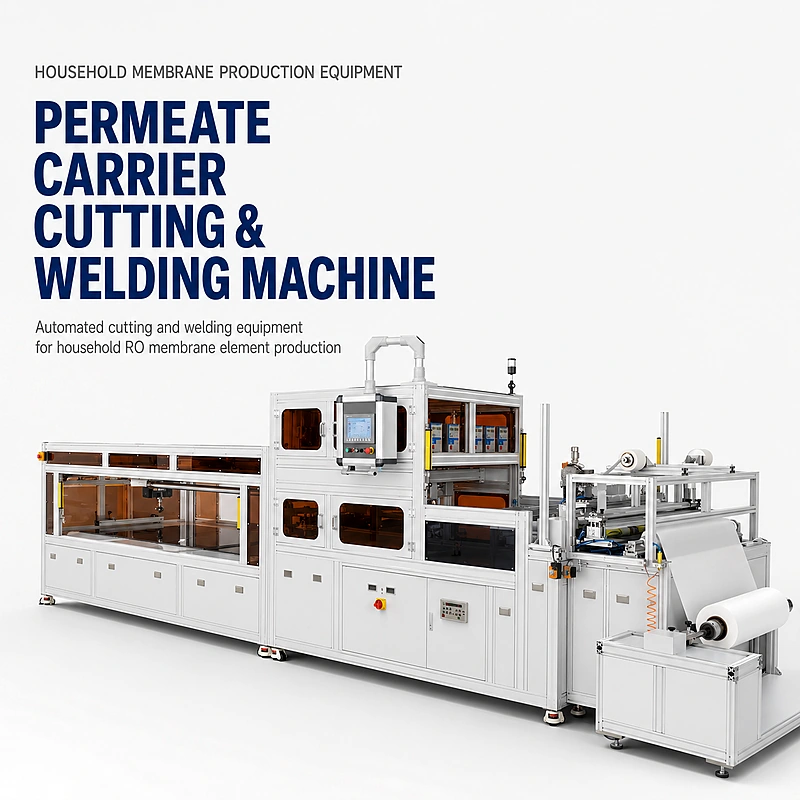
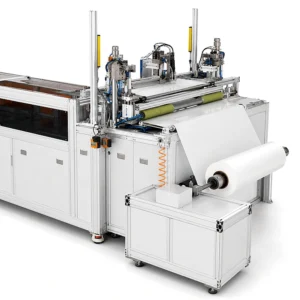
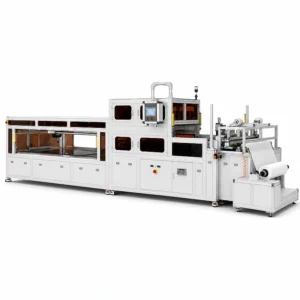
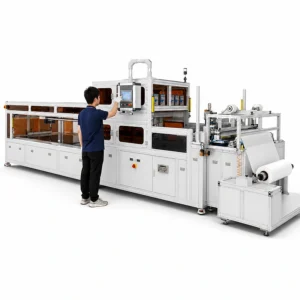
The Permeate Carrier Cutting Machine automatically unwinds, positions and cuts permeate carrier tricot for common 1812-3013 household spiral-wound RO membrane elements. After the operator loads the carrier roll and enters the required dimensions on the touchscreen, the machine completes tension-controlled feeding, fixed-length positioning, precision cutting and slanted discharge.
Siemens motor, PLC and touchscreen control support a reference output of five sheets per minute with a stated dimensional error within ±0.5 mm. The machine is designed for manufacturers that need repeatable carrier sheets without wrinkles, lateral shifting or inconsistent manual measurement.
Automatic Permeate Carrier Cutting for Household RO Production
The RO membrane permeate carrier, often called permeate carrier tricot, supports the permeate-side flow path inside a spiral-wound membrane leaf. It is not the same material as the feed spacer. The feed spacer forms the feed-water channel, while the permeate carrier supports permeate collection inside the sealed membrane envelope.
This machine converts permeate-carrier roll material into repeatable sheets for downstream leaf preparation and rolling. For a direct material comparison, see Feed Spacer vs. Permeate Carrier.
From Carrier Roll to Consistent Cut Sheets
Install the carrier roll
Load the approved permeate carrier tricot and confirm its width, thickness and roll condition.
Enter the cutting recipe
Set the required sheet length, width-related configuration and batch quantity on the touchscreen.
Unwind under constant tension
Servo feeding positions the carrier accurately before the automatic precision cutting cycle.
Discharge without stacking adhesion
The slanted outlet separates finished sheets and helps reduce unwanted surface-to-surface sticking.
Key Production Advantages
Servo-controlled cutting accuracy
The stated dimensional error is within ±0.5 mm under validated material and operating conditions.
Touchscreen recipe adjustment
Operators can modify production dimensions and batch parameters directly through the HMI.
Constant-tension unwinding
Controlled roll tension helps prevent carrier slack, wrinkles and lateral movement during feeding.
Slanted discharge design
The angled outlet improves sheet separation and helps operators collect cut material more efficiently.
Configurable sheet dimensions
Cutting length and the applicable width setup can be matched to approved household element drawings.
Compact aluminum-alloy frame
The low-profile frame reduces workshop space demand and supports installation or workstation relocation.
Permeate Carrier Cutting Machine Specifications
| Technical Item | Standard / Reference Data |
|---|---|
| Published Page Name | Permeate Carrier Cutting & Welding Machine |
| Confirmed Standard Function | Permeate carrier unwinding, fixed-length positioning, precision cutting and material discharge |
| Model No. | Project-specific; confirm before quotation |
| Applicable Element Formats | Common 1812-3013 household RO membrane production, subject to approved carrier dimensions |
| Operation | Load carrier roll, set parameters on the touchscreen and start automatic cutting |
| Reference Production Efficiency | 5 sheets per minute |
| Stated Cutting Accuracy | Dimensional error within ±0.5 mm under validated conditions |
| Cut Dimensions | Length and applicable width configuration customizable to the approved product drawing |
| Welding Function | Not confirmed in the supplied household configuration; welding method and parameters require separate technical approval |
| Motor / PLC / Touchscreen | Siemens |
| Unwinding Control | Constant-tension roll feeding |
| Discharge | Slanted sheet-discharge design |
| Frame | Compact aluminum-alloy frame |
| Operating Voltage & Power | AC 220 V / 1.5 kW |
| Air Source Pressure | 0.6-0.8 MPa, clean and dry compressed air |
| Overall Dimensions (L × W × H) | 1950 × 710 × 830 mm |
| Equipment Weight | 280 kg |
Technical data applies to the supplied cutting configuration. Final carrier width, thickness, roll diameter, cut dimensions, tolerance test method, electrical standard and acceptance criteria must be confirmed using drawings and physical material samples.
Important Scope Note About the Welding Function
Confirmed in the supplied data
- Automatic roll unwinding and constant-tension feeding
- Fixed-length positioning and precision carrier cutting
- Touchscreen production-parameter adjustment
- Slanted discharge of finished carrier sheets
Required before claiming welding
- Welding principle, such as ultrasonic or thermal welding
- Material stack, weld geometry, spacing and seam requirements
- Welding cycle, output and acceptance-test method
- Confirmed electrical and mechanical module in the final quotation
Until those details are supplied, the accurate commercial description is Permeate Carrier Cutting Machine. The existing URL may remain unchanged to avoid an unnecessary redirect, but the page should not promise an unverified welding process.
Production Capacity and Material Planning
Five sheets per minute corresponds to a nominal cutting interval of approximately 12 seconds per sheet. Practical shift output depends on carrier roll changes, recipe changes, material behavior, inspection frequency, discharge handling and planned stops.
Use approved carrier samples for the final cycle test
Tricot thickness, surface friction, elasticity, roll tension and required sheet dimensions can affect feeding and discharge. WECOME should validate both dimensional accuracy and usable output using the customer’s actual carrier roll before acceptance.
Permeate Carrier Is Not Feed Spacer
Permeate carrier tricot
- Located inside the membrane envelope on the permeate side
- Supports permeate flow toward the perforated central tube
- Selected by thickness, structure, width and rolling requirements
- Processed by this carrier cutting machine
Feed spacer mesh
- Located between membrane surfaces on the feed-water side
- Forms the feed channel and influences flow distribution
- Has different mesh geometry and material behavior
- Requires its own cutting parameters and process validation
Where This Machine Fits Best
Household RO element factories
Replace manual measurement and carrier cutting in recurring 1812-3013 production.
Small and medium manufacturers
Add controlled roll converting without a large industrial carrier-processing line.
OEM and ODM production
Store validated recipes for customer-specific carrier sizes and household element formats.
Overseas local assembly
Support membrane manufacturers building local raw-material preparation capability.
R&D and model validation
Prepare repeatable carrier sheets for new material stacks, sizes and rolling trials.
Technical training centers
Demonstrate carrier identification, recipe setup, cutting and dimensional inspection.
Carrier Quality Checks Before and After Cutting
Before cutting
- Confirm carrier material, width, thickness and roll identity
- Check the roll for edge damage, wrinkles and uneven winding
- Select the validated sheet dimensions and batch quantity
After cutting
- Measure sheet length and width using the agreed sampling plan
- Inspect cut edges, squareness, wrinkles and contamination
- Separate abnormal sheets before membrane-leaf assembly
Use the Permeate Carrier Data Sheet and Permeate Carrier Length Calculator during material and production planning.
Configuration, Acceptance and Delivery
| Project Input | What WECOME Confirms |
|---|---|
| Element Formats | Target 1812-3013 models, carrier-sheet drawing and production mix |
| Carrier Roll Samples | Material structure, width, thickness, roll diameter, tension behavior and surface friction |
| Cutting Requirements | Sheet length, width setup, dimensional tolerance, edge quality and batch quantity |
| Welding Requirement | Whether welding is needed and, if so, the welding method, material stack, weld pattern and acceptance standard |
| Production Target | Sheets per shift, roll-change plan and practical output expectation |
| Machine Acceptance | Cycle time, dimensional sampling method, cut quality and approved sample criteria |
| Packaging | Final crate dimensions, gross weight and export-protective packing after configuration approval |
| Technical Support | Installation guidance, commissioning, operator training and after-sales assistance |
Frequently Asked Questions
What does a permeate carrier cutting machine do?
It unwinds permeate carrier tricot under controlled tension, positions it to the programmed length, cuts it to the required dimensions and discharges finished sheets for downstream household RO membrane-leaf preparation.
Is permeate carrier the same as feed spacer?
No. Permeate carrier tricot is used inside the sealed membrane envelope to support permeate flow toward the central tube. Feed spacer mesh forms the feed-water channel between membrane surfaces.
Does the supplied configuration include welding?
Welding has not been technically confirmed in the supplied household-machine data. A welding claim requires the welding method, material stack, weld geometry, cycle data and confirmed module to be included in the final quotation.
Which RO membrane formats can the machine support?
It is intended for common 1812-3013 household RO membrane production. Actual compatibility depends on carrier roll dimensions, required cut-sheet size, material behavior and approved tooling.
How accurate is the cutting process?
The stated dimensional error is within ±0.5 mm under validated production conditions. The final tolerance should be confirmed with the customer’s carrier material, measurement method and acceptance sampling plan.
What does five sheets per minute mean?
It is a reference cutting output equivalent to approximately 12 seconds per sheet. Actual shift capacity is affected by roll changes, recipes, material handling, inspection and downtime.
Can cutting width and length be customized?
The cut length and applicable width configuration can be matched to approved household element drawings, subject to the machine’s final feed path, cutter and material-width limits.
What information is required before quotation?
Provide element formats, carrier-sheet drawings, carrier roll width and diameter, thickness, material samples, required tolerance, output per shift and any confirmed welding requirement.
Related Equipment and Technical Resources
Confirm the Carrier Material and Cut-Sheet Drawing
Send WECOME your carrier roll specifications, required cut dimensions, tolerance and target shift output. Welding requirements should be supplied separately for engineering review.