
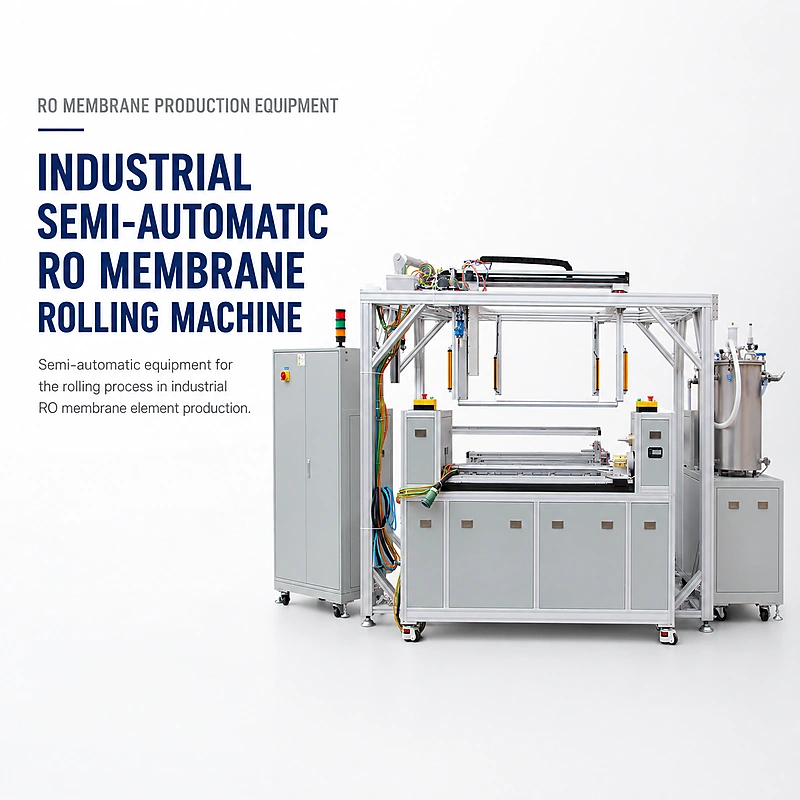
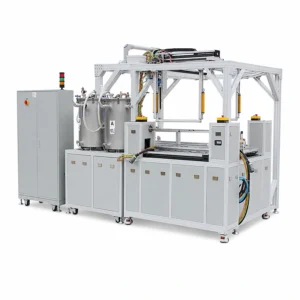
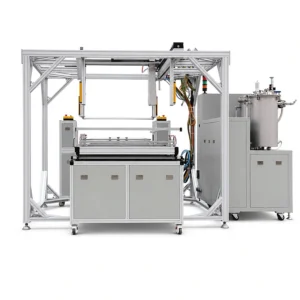

The Industrial Semi-Automatic RO Membrane Rolling Machine combines spacer-to-center-tube welding, robotic adhesive application, closed-loop tension control, membrane winding and outer-tape forming for 8040, 4040, 2540 and 4021 element programs.
Two operators manage prepared leaves, center tubes, recipes and quality checks while the servo-driven rolling platform and three-axis glue robot control the most repeatability-sensitive motions. The system is suited to industrial RO membrane manufacturers moving beyond manual winding or expanding mixed-format OEM production.
Semi-Automatic 4040 and 8040 RO Membrane Rolling
This industrial RO membrane rolling machine receives prepared membrane leaves, feed spacer, permeate carrier and the approved center tube. It fixes the center tube and spacer by the configured ultrasonic-welding sequence, applies controlled adhesive lines, regulates winding tension and forms the spiral-wound element before outer-tape completion.
The semi-automatic layout preserves operator control over leaf loading, layer sequence and visual inspection while automating glue placement and critical rolling motions. Buyers comparing automation levels can use the RO membrane rolling machine selection guide.
Three Coordinated Machine Modules
Control Unit
PLC, touchscreen HMI, recipe management, alarms, emergency stop, production display and coordinated servo/pneumatic control.
2600 × 700 × 1800 mmRolling Platform
Center-tube fixture, spacer welding, leaf staging, closed-loop tension, servo rolling, platform movement and outer-tape winding.
2800 × 1800 × 2300 mmRobotic Glue Dispenser
Three-axis programmed glue delivery with adjustable path, line width and single-shot quantity for the approved adhesive system.
1500 × 1050 × 2000 mmKey Production Advantages
Three-axis robotic glue application
Programmed motion supports a straight, continuous glue path with adjustable line width and single-shot delivery.
Closed-loop winding tension
Automatic tension adjustment helps limit wrinkles, layer deflection and unstable roll formation during winding.
Multi-format tooling
Adjustable fixtures and recipes support 8040, 4040, 2540 and 4021 center tubes and element constructions after confirmation.
Integrated welding and tape forming
Center-tube/spacer welding and automatic outer-tape winding reduce separate manual operations around the rolling step.
Operator and process protection
Infrared guarding, safety fence, mechanical limits, sensor monitoring and interlock control support safer setup and production.
Production data and alarms
Product type, output references and abnormal conditions can be shown on the HMI for operation and troubleshooting.
Industrial Semi-Automatic RO Membrane Rolling Machine Specifications
| Technical Item | Standard Reference |
|---|---|
| Product Name | Industrial Semi-Automatic RO Membrane Rolling Machine |
| Primary Function | Center-tube/spacer welding, robotic glue application, closed-loop winding tension, spiral winding and outer-tape forming |
| Compatible Element Programs | Industrial 8040, 4040, 2540 and 4021 membrane element formats |
| Operation | Two operators |
| Production Reference | 8040: approximately 10-12 minutes per element; 4040/4021: approximately 3.5-4 minutes per element |
| Leaf Staging Reference | ≥30 membrane leaves/pages; confirm terminology, maximum stack thickness and loading method for the approved element recipe |
| Glue Delivery | Automatic three-axis robot delivery with adjustable glue path, line width and single-shot quantity |
| Control Mode | PLC and touchscreen HMI with servo control, tension adjustment, alarms and safety interlocks according to approved configuration |
| Electrical Supply | AC 380 V; main machine 8 kW plus glue dispenser 4 kW |
| Air Supply | 0.5-0.7 MPa clean, dry compressed air |
| Control Unit Dimensions | 2600 × 700 × 1800 mm (L × W × H) |
| Rolling Platform Dimensions | 2800 × 1800 × 2300 mm (L × W × H) |
| Glue Dispenser Dimensions | 1500 × 1050 × 2000 mm (L × W × H) |
| Equipment Weight | Approximately 1200 kg |
| Packing – Control Unit | 2700 × 800 × 2000 mm |
| Packing – Rolling Platform | 2900 × 1900 × 2500 mm |
| Packing – Glue Dispenser | 1600 × 1150 × 2200 mm |
| Model Number | Project-specific; confirm on the signed technical specification and quotation |
The listed 8 kW and 4 kW values are connected-load references, not continuous energy consumption. Confirm frequency, phase, peak demand, cable and protection requirements, machine layout, package gross weights and final component brands in the signed technical agreement.
Rolling-Cycle and Output Planning
Approximately 5-6 elements/hour
This is the mathematical rolling-cycle reference before leaf preparation, material replenishment, glue setup, inspection, changeover, curing and downstream handling are included.
Approximately 15-17 elements/hour
Actual shift output depends on leaf count, operator coordination, adhesive recipe, changeover time and the agreed acceptance counting point.
Upstream sheet/leaf preparation, spacer staging and glue mixing must keep pace with the rolling station. Downstream curing, end trimming, integrity testing and exterior reinforcement must also have enough capacity to prevent work-in-process accumulation.
What Automation Improves – and What It Does Not Guarantee
Controlled production variables
- Programmed glue path, line width and delivery quantity
- Winding tension and roll-forming motion
- Center-tube/spacer weld and outer-tape sequence
- Repeatable recipes and process alarms
Still requires material and final testing
- Membrane flux and salt rejection are not created by the machine alone
- Adhesive ratio, cure condition and bond integrity must be verified
- Final diameter, end alignment and visual quality require inspection
- Vacuum integrity and hydraulic performance remain separate tests
Where This Rolling System Fits Best
4040 and 8040 RO manufacturers
Routine large-format spiral-wound element production with controlled tension and robot gluing.
2540 and 4021 programs
Additional formats after center-tube, leaf stack, mandrel, tape and recipe confirmation.
Manual-line upgrades
Factories replacing hand gluing and uncontrolled winding while retaining operator-guided leaf loading.
OEM and ODM production
Mixed element formats that benefit from stored recipes, tooling changeover and documented acceptance standards.
New-element validation
Production-representative trials for new leaf counts, glue paths, materials or roll-forming parameters.
Turnkey industrial lines
Central rolling station connected to leaf preparation, curing, trimming, testing and FRP reinforcement.
Quality Checks for Rolled RO Membrane Elements
In-process rolling checks
- Correct center tube, leaf sequence and spacer orientation
- Glue mixing condition, shot quantity and line continuity
- Winding tension, wrinkles, layer shift and edge alignment
- Outer-tape position, tension and finished roll stability
Release-to-curing checks
- Finished diameter, length and visible concentricity
- No broken glue line or excessive adhesive accumulation
- Element identity, recipe and production count recorded
- Controlled transfer to the specified curing process
Link the rolling record to the plant’s RO membrane element quality control checklist and the approved adhesive data sheet.
Glue System and Project Configuration
| Project Input | What WECOME Needs to Confirm |
|---|---|
| Element Construction | 8040, 4040, 2540, 4021 or project-specific drawing; center tube, leaf count, spacer sequence, target diameter and tape specification |
| Adhesive System | Resin and hardener type, approved mix ratio, viscosity, pot life, shot weight, glue-line width and cure conditions |
| Legacy Dispenser Reference | Mix-ratio range 100:10 to 100:100; delivery 21-70 g using Fuller glue as the historical example; specified delivery accuracy ±2%; static mixing. Reconfirm for the current project. |
| Robot Reference | Historical effective stroke 1500 × 1000 × 500 mm, Z-axis load 5 kg and repeat-position reference ±0.02 mm. Final robot and path depend on the approved configuration. |
| Leaf and Spacer Supply | Material dimensions, stack order, ≥30-leaf staging requirement, loading ergonomics and upstream preparation rate |
| Utilities and Layout | 380 V supply details, compressed-air capacity, operator aisles, safety zone, maintenance access and material-flow direction |
| FAT Method | Customer materials, format changeover, weld sequence, glue-path inspection, tension trial, cycle demonstration, alarms and safety-interlock checks |
| Documentation and Packing | Approved layout, BOM, manuals, electrical information, training plan and three-module export packing confirmed before shipment |
Frequently Asked Questions
What does an industrial semi-automatic RO membrane rolling machine do?
It coordinates center-tube and spacer welding, operator-guided leaf loading, robotic adhesive application, closed-loop winding tension, spiral roll forming and outer-tape completion for industrial RO membrane elements.
Which industrial RO membrane formats can the machine support?
The supplied range covers 8040, 4040, 2540 and 4021 production programs. Final compatibility depends on the center tube, leaf dimensions, layer count, finished diameter, mandrel, tape and approved tooling.
Why are two operators required?
The machine automates welding, gluing, tension control, rolling and tape forming, but operators still manage prepared leaves, material sequence, center tubes, visual checks, replenishment and safe unloading.
What is the expected output for 8040 and 4040 elements?
The supplied rolling-cycle references are 10-12 minutes for one 8040 element and 3.5-4 minutes for one 4040 or 4021 element. Shift output must include material handling, inspection, changeover, glue preparation and planned downtime.
How does the robotic glue dispenser improve production?
It follows a programmed path with adjustable line width and delivery quantity, helping reduce broken lines, heavy glue accumulation and operator-to-operator variation. Adhesive ratio, cure and bond integrity still require validation.
Does automated rolling guarantee higher membrane flow?
No. Controlled gluing and winding support geometric consistency and usable membrane area, but final flow and salt rejection depend on membrane chemistry, leaf design, adhesive cure, element integrity and hydraulic testing.
Can the rolling machine integrate with a complete production line?
Yes. It can be connected with sheet and carrier preparation, curing, industrial trimming, vacuum integrity testing and FRP winding equipment as part of a turnkey industrial RO membrane line.
What information is required for an accurate quotation?
Provide element drawings, target formats and output, center-tube data, leaf and spacer materials, adhesive technical data, glue path, tape specification, plant utilities, available layout and the required FAT criteria.
Related Equipment and Technical Resources
Confirm the Element, Glue and Line-Capacity Plan
Send the element drawing, leaf count, center tube, spacer, adhesive data, glue path, tape specification, target output and workshop layout for a project-specific rolling proposal.