

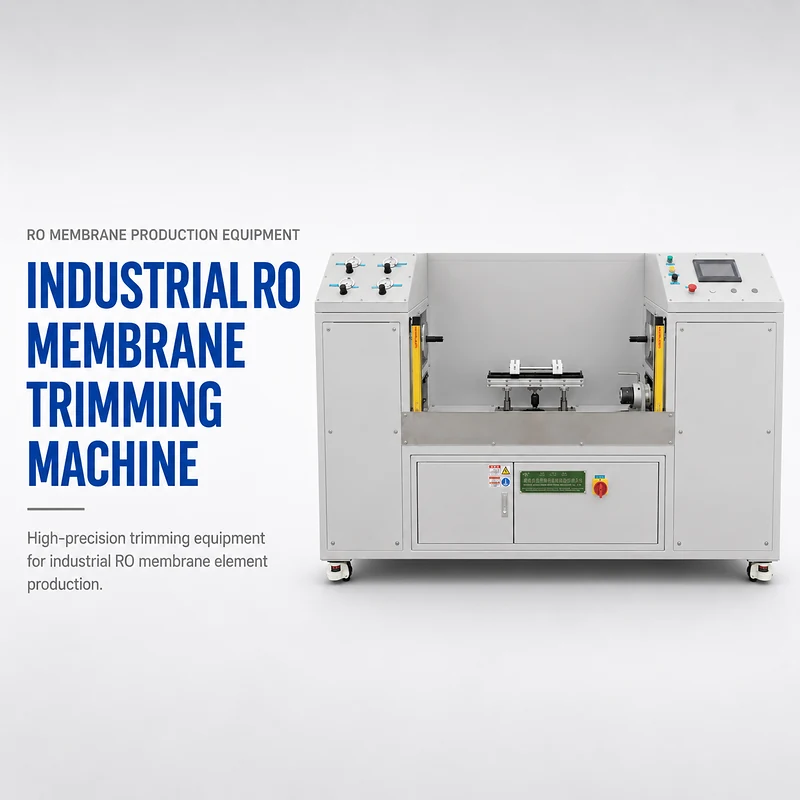
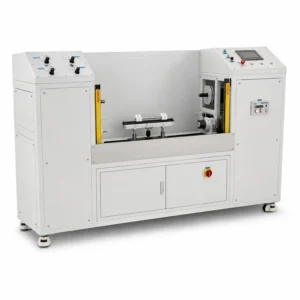
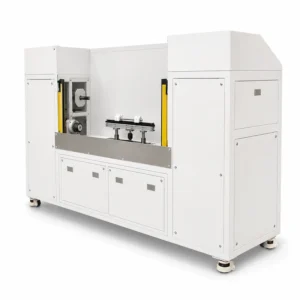

The Industrial RO Membrane Trimming Machine automatically positions, rotates and trims both ends of cured 4040, 8040, 4021 and 2540 spiral-wound membrane elements before downstream integrity testing, reinforcement and final assembly.
A 350 mm air-cooled tungsten-steel cutter, Siemens servo rotation and precision servo cutter feed support repeatable end-face preparation. One operator manages loading, recipe selection, visual checks and unloading while the PLC records production data and abnormal alarms.
Automatic End Trimming for 4040 and 8040 RO Elements
The machine is positioned after the adhesive has completed the approved cure stage following an industrial RO membrane rolling machine. It clamps and rotates the element, advances the cutter under servo control, forms clean end faces and unloads the trimmed element for the next quality-control stage.
Adjustable tooling covers industrial elements up to 200 mm in diameter and 1300 mm in total length, with a center-tube length up to 1016 mm. The 4040, 8040, 4021 and 2540 format names are useful starting points, but the finished body, tube projection and required trim allowance must be confirmed from the customer’s drawing.
Controlled Trimming Across Both Element Ends
First End
Air-cooled tungsten-steel cutter advances under servo control.
Centered Industrial Element
Servo-controlled rotation keeps the cured element centered while each end is trimmed.
Second End
Programmed cut position forms the opposite end before automatic release.
Key Production Advantages
Industrial-size adjustment range
Supports 4040, 8040, 4021 and 2540 programs within the approved diameter, body-length and center-tube limits.
Air-cooled tungsten-steel cutter
A 350 mm cutter is specified for controlled industrial end trimming, with cooling and maintenance requirements defined during commissioning.
Dual Siemens servo control
A 750 W rotation servo and 750 W cutter-feed servo independently control element speed and cutter advance.
Production and alarm data export
The HMI can display production information and abnormal alarms for troubleshooting and manufacturing records.
Automatic stop and recovery logic
When an abnormal condition occurs, the machine can pause, display the fault and resume after the cause is removed and the system is reset.
One-operator station
Automatic cutting and unloading reduce repetitive manual trimming while retaining operator inspection and safe material handling.
Industrial RO Membrane Trimming Machine Specifications
| Technical Item | Standard Reference |
|---|---|
| Product Name | Industrial RO Membrane Trimming Machine |
| Primary Function | Automatic positioning, rotation, dual-end cutting, trimming/forming and finished-element unloading after adhesive cure |
| Compatible Element Programs | Industrial 4040, 8040, 4021 and 2540 membrane elements |
| Adjustment Range | Element diameter ≤200 mm; element length ≤1300 mm; center-tube length ≤1016 mm |
| Operation | One operator |
| Production Reference | 8040: approximately 3 minutes per element; 4040: approximately 1 minute per element |
| Cutter | 350 mm diameter tungsten-steel cutter with air cooling |
| Element Rotation Drive | Siemens 750 W servo motor; adjustable 0-100 rpm |
| Cutter Feed Drive | Siemens 750 W servo motor; specified positioning reference ±0.05 mm; feed-speed range 0-8.9 mm/s |
| Control Mode | Siemens PLC and touchscreen HMI with production data, alarm information, foot-switch and recovery functions according to approved configuration |
| Electrical Components | Reference brands include Siemens, Omron, Schneider and LG; final BOM controls |
| Electrical Supply | AC 380 V / 6 kW |
| Air Supply | 0.6-0.7 MPa clean, dry compressed air |
| Machine Dimensions | 1930 × 1256 × 1920 mm (L × W × H) |
| Equipment Weight | Approximately 550 kg |
| Packing Dimensions | 2380 × 1270 × 1930 mm |
| Model Number | Project-specific; confirm on the signed technical specification and quotation |
The ±0.05 mm figure describes the supplied cutter-feed positioning reference, not a blanket guarantee for finished-element length or end-face squareness. Final tolerances require a defined measurement method, cured sample elements and FAT acceptance limits.
Trimming-Cycle and Output Planning
Approximately 20 elements/hour
This is the theoretical trimming-cycle rate before loading, recipe confirmation, cut inspection, chip removal, blade checks and planned downtime are included.
Approximately 60 elements/hour
Actual output depends on element handling, fixture changeover, cut allowance, operator inspection and the approved unloading sequence.
The trimming machine should not wait for partially cured elements, and trimmed elements should not accumulate before vacuum testing, FRP reinforcement or assembly. Plan racks, batch identity and transfer capacity around the full line.
When Is an Industrial RO Element Ready for Trimming?
Release to trimming
- Specified adhesive cure time and temperature are complete
- Element body is stable without visible deformation
- Product identity, target length and cut allowance are confirmed
- Center-tube projection and tooling recipe match the drawing
Hold for review
- Glue remains tacky, soft or outside the approved cure window
- Roll body is loose, eccentric or visibly shifted
- Tube position or finished-length requirement is unclear
- Material traceability or production recipe cannot be verified
What This Machine Does – and What It Does Not Do
Designed for post-cure end finishing
- Forms clean and controlled end faces on cured elements
- Adjusts for approved 4040, 8040, 4021 and 2540 programs
- Automates cutting, unloading and production-data recording
- Prepares elements for downstream inspection and reinforcement
Separate manufacturing and testing functions
- It does not cut membrane sheet or carrier/spacer rolls
- It does not roll, glue or cure the spiral-wound element
- It does not perform vacuum integrity or hydraulic testing
- It cannot correct internal defects or an unstable rolled body
Where This Industrial Trimming Machine Fits Best
4040 and 8040 RO factories
Routine industrial element finishing after controlled adhesive curing.
4021 and 2540 programs
Additional formats after element dimensions, center tube, cutter position and fixture are approved.
OEM and ODM production
Recipe-controlled trimming for mixed customer formats with documented dimensional requirements.
Manual trimming upgrades
Factories seeking servo positioning, faster changeover, alarm records and more consistent cutting conditions.
New-element validation
Production-representative trials for revised diameter, length, tube projection, adhesive or end construction.
Turnkey industrial lines
Post-cure station between rolling/curing and integrity testing, assembly or FRP reinforcement.
Quality Checks Before and After Trimming
Before the cutting cycle
- Cure release, element identity and recipe confirmation
- Body diameter, total length and tube projection
- Visible concentricity, looseness and end condition
- Blade condition, air cooling and fixture cleanliness
After both ends are trimmed
- Finished length and end-face squareness
- Clean tube openings without cutting damage
- No torn membrane layers, heavy burrs or adhesive smearing
- Chip removal, batch record and downstream release status
Record these checks in the RO membrane element quality control checklist before the element proceeds to integrity or performance testing.
Configuration, FAT and Delivery
| Project Input | What WECOME Needs to Confirm |
|---|---|
| Element Drawings | 4040, 8040, 4021, 2540 or project-specific body diameter, total length, center-tube length/projection and required finished dimensions |
| Cut Definition | Trim allowance at each end, reference datum, length tolerance, end-face squareness and acceptable visual condition |
| Material and Cure | Outer-wrap construction, adhesive type, cure window, hardness/stability at trimming and representative cured samples |
| Cutter Process | Blade specification, rotation speed, cutter-feed speed, cooling-air requirement, blade life and maintenance method |
| Chip Management | Required cleaning method and whether external dust/chip extraction must be included in the plant layout |
| Utilities and Safety | 380 V supply details, compressed-air capacity, guarding, foot-switch logic, emergency stop and operator access |
| FAT Method | Customer-sample trials, format changeover, cycle time, dimensional measurement, cut-face inspection, alarms, data export and safety checks |
| Documentation and Packing | Approved drawing, BOM, operation/maintenance manuals, electrical information, training plan and export packing details |
Frequently Asked Questions
What does an industrial RO membrane trimming machine do?
It automatically positions, rotates and trims both ends of a cured industrial spiral-wound membrane element, then unloads the finished part for dimensional inspection, integrity testing, assembly or reinforcement.
Which industrial membrane element formats can the machine support?
The supplied range covers 4040, 8040, 4021 and 2540 programs within an element diameter of 200 mm, total length of 1300 mm and center-tube length of 1016 mm. Final compatibility requires drawing and tooling review.
Why must the adhesive cure before trimming?
A stable cure helps the rolled body retain its shape during clamping, rotation and cutting. Premature trimming can smear adhesive, deform the element, contaminate the cutter or disturb internal layers.
What are the reference trimming cycle times?
The supplied references are approximately three minutes per 8040 element and one minute per 4040 element. Shift output must also include loading, inspection, cleaning, blade checks, changeover and planned downtime.
What does the plus or minus 0.05 mm specification mean?
It is the supplied positioning reference for the servo cutter-feed mechanism. Finished-element length and end squareness require their own measurement method, sample trial and FAT acceptance tolerance.
How are abnormal conditions handled?
The reference control system can stop the cycle, activate the three-color alarm, display abnormal information and allow the process to continue after the fault is removed and the machine is safely reset.
Does trimming replace vacuum or hydraulic testing?
No. Trimming prepares the element ends and dimensions. Vacuum testing checks air-tightness, while hydraulic testing verifies performance such as flow and salt rejection.
What should be sent for an accurate quotation?
Provide element drawings, minimum and maximum formats, cured samples, target dimensions and tolerances, center-tube data, adhesive/cure conditions, required output, plant utilities, chip-management requirements and FAT criteria.
Related Equipment and Technical Resources
Confirm the Cured Element and Finished Dimensions
Send the element drawing, center-tube projection, trim allowance, cure condition, target tolerance, sample elements and required output for a project-specific trimming proposal.