

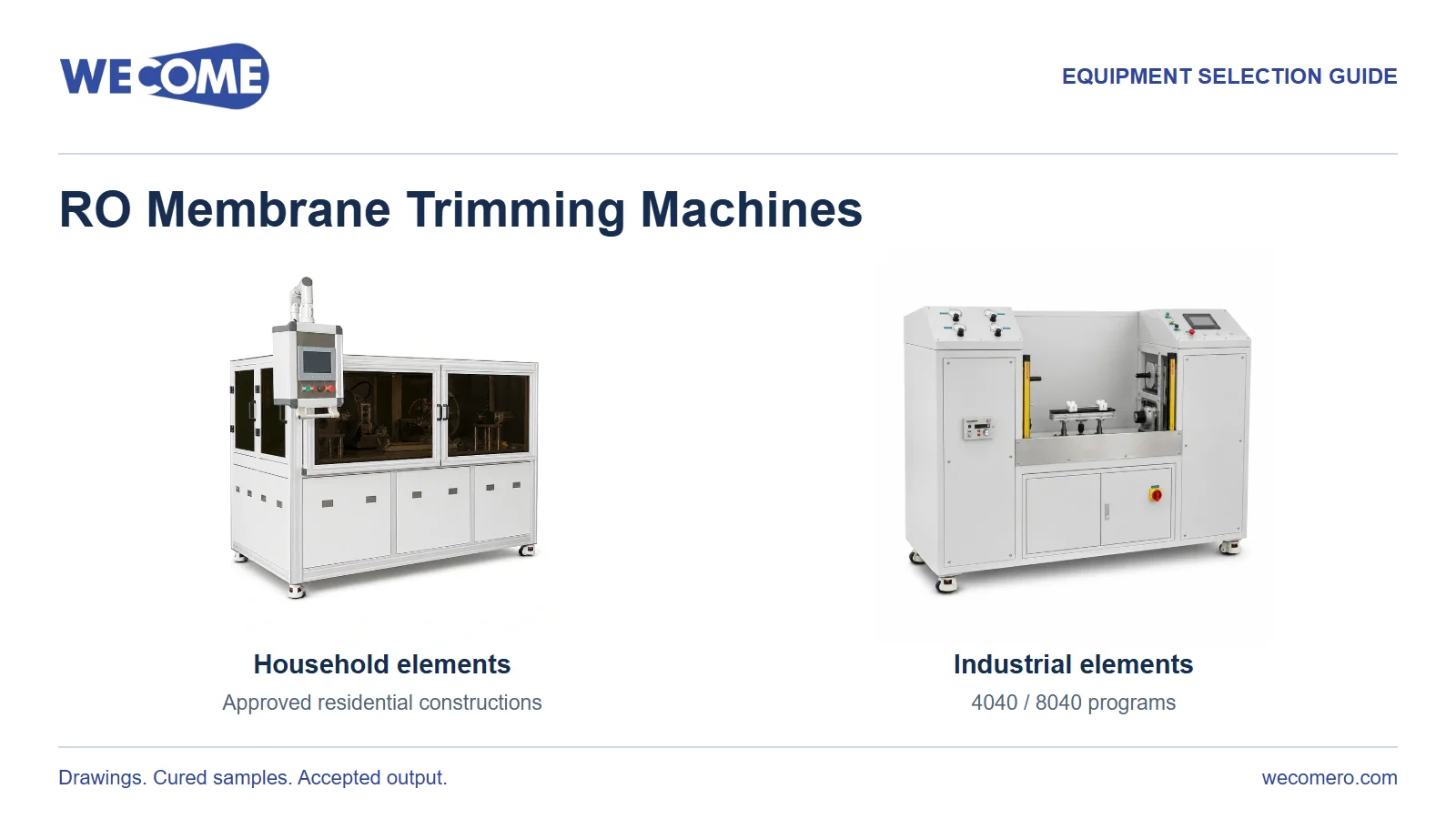
Choosing an RO membrane trimming machine starts with the cured element you need to finish, not the fastest cycle in a quotation. A household production run and a mixed 4040/8040 program place different demands on fixtures, handling, changeover and inspection.
Which machine should you choose? Use a household configuration for approved residential element constructions, and an industrial configuration for larger elements such as 4040 and 8040. Confirm the actual body dimensions, central-tube projection, adhesive cure condition and required end finish with representative samples. Then compare accepted pieces per shift, including handling and inspection, rather than nominal cutting speed alone.
First, Specify Element End Trimming
An RO membrane element trimming machine removes excess material from the ends of a rolled, cured spiral-wound element. It establishes the required end geometry before the next approved inspection or assembly step. It does not manufacture membrane sheet, cut fabric rolls into leaves, or correct a poorly assembled internal structure.
This distinction matters when searching for an automatic RO membrane trimming machine. Supplier listings may also use the words cutting, slitting or carrier trimming. A machine that cuts a flat web is not a substitute for a machine that holds and finishes a cylindrical element. Include a photograph of the workpiece entering the station in your first enquiry.

Keep these three processes separate in an equipment list: membrane-sheet preparation, permeate-carrier preparation, and post-cure element end trimming. The membrane sheet cutting and folding machine serves an earlier material-preparation step; it does not perform the end-finishing operation discussed here.
Household vs Industrial RO Membrane Trimming Machines
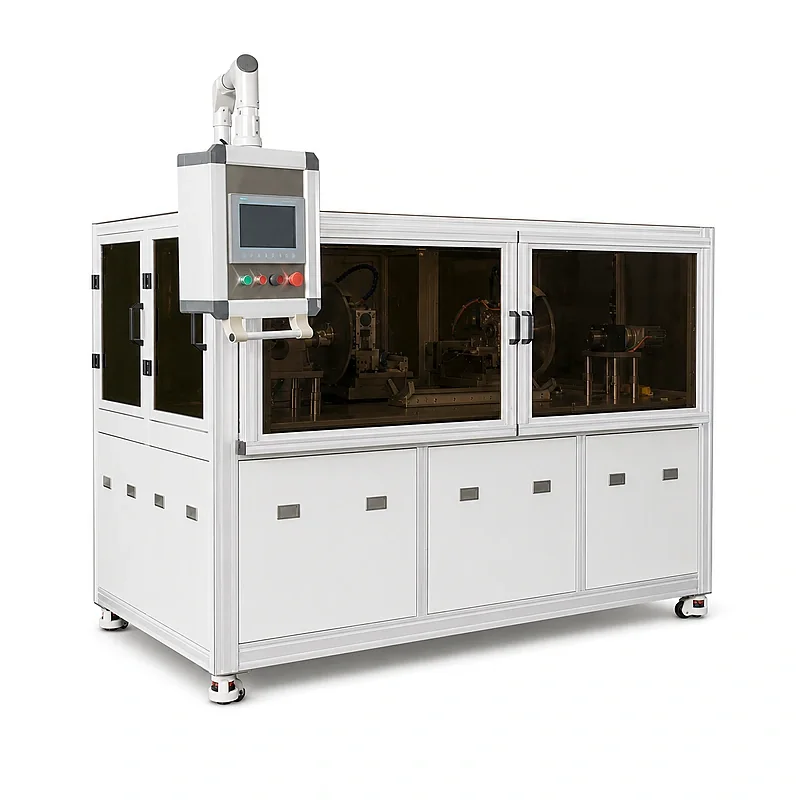
Household, domestic and residential describe the same broad application family here, not three different machine categories. Element format is a useful starting point, but the quotation must identify the approved construction and tooling. Do not assume a machine can handle every product that shares a nominal size label.
| Selection point | Household configuration | Industrial configuration |
|---|---|---|
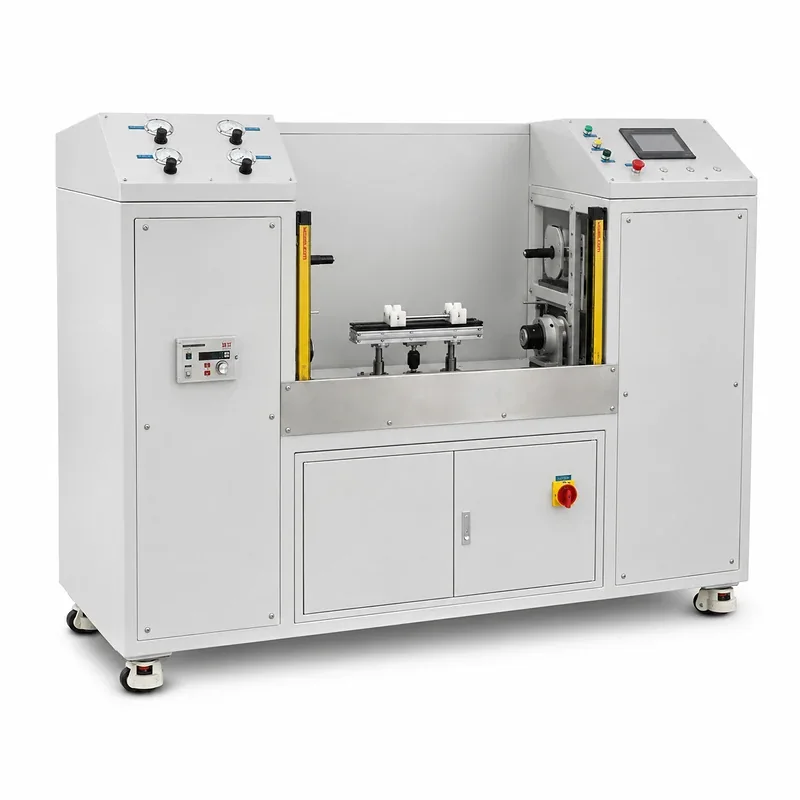
| Published program range | Common 1812 through 3013 constructions, subject to layer configuration and approved tooling. | 4040, 8040, 4021 and 2540 programs, subject to actual workpiece and fixture limits. |
| Cycle reference | 2-3 elements per minute on the published WECOME configuration. | Approximately 1 minute for 4040 and 3 minutes for 8040 on the published WECOME configuration. |
| Main selection question | Can the station accept the household construction reliably while the operator supplies and checks the output? | Can the fixture support the body and tube geometry, and maintain the required end finish across the planned formats? |
| Changeover trial | Confirm recipes and tooling for the smallest and largest approved residential constructions. | Trial both smaller and larger industrial formats, including the tube projection and handling method. |
| Published utilities | AC 220 V, 1 kW; clean, dry compressed air at 0.6-0.7 MPa. | AC 380 V, 6 kW; clean, dry compressed air at 0.6-0.7 MPa. |
| Operator role | Element supply, recipe selection, collection and quality checks. | Loading, recipe selection, supervised operation, unloading and quality checks. |
These are WECOME product-page references, not universal industry ratings or guaranteed shift outputs. Confirm supply voltage, frequency, phase, tooling and the final configuration in the signed quotation. Pressure alone does not define compressed-air consumption.
Start a residential project with the household RO membrane trimming machine. For larger formats, review the industrial RO membrane trimming machine against the actual drawing. A mixed factory may need separate configurations; do not assume an industrial station automatically replaces a household machine.
Five Details Your Element Drawing Must Define
1. Body diameter and the condition at loading
State the minimum and maximum outside diameter of the workpiece entering the trimming station. Identify its outer construction at that stage, not only the finished element sold to customers. The fixture must hold the actual incoming body without unacceptable movement or damage. Include representative samples when material stiffness or construction changes between models.
2. Finished body length and the reference datum
Mark what the length measurement includes. A body-length requirement, overall tube length and assembled-element length are not interchangeable. Identify the reference surface and measuring method so the supplier and your quality team inspect the same feature.
3. Central-tube projection at both ends
Show the tube geometry and required exposed length at each end. Ask the supplier to demonstrate fixture clearance and the cutter path on the actual tube arrangement. A correct body length does not compensate for a damaged tube or an interface that no longer fits the next assembly.
4. Trim allowance and acceptable end condition
Define the excess to remove at each end and the accepted visual condition. Agree how you will judge torn layers, adhesive smearing, burrs, debris and end-face squareness. Use photographs or approved reference samples to remove ambiguity from descriptions such as “smooth cutting.”
5. Construction, adhesive and cure release
Give the supplier the material construction and documented cure-release condition. There is no single curing time that applies to every adhesive and factory environment. Use the approved adhesive procedure and representative cured samples; do not shorten cure time merely to keep the trimming machine busy.

Compare Accepted Output, Not the Fastest Cycle
A machine-cycle reference describes only part of the production day. Ask whether it includes loading, clamping, both ends, unloading and inspection. Then allow for recipe changes, cleaning, tool checks and the supply of cured elements. Two suppliers may quote similar cycle times while measuring different start and stop points.
Accepted pieces per shift = available production minutes / complete station minutes per element x first-pass acceptance fraction.
Use this only after defining the cycle boundary. If handling is already included in the complete station time, do not add it again. If planned stops have already been removed from available minutes, do not deduct them a second time.
Illustrative example, not a machine guarantee: an eight-hour shift contains 480 minutes. Subtract 60 minutes for planned stops to leave 420. Assume an 8040 complete station cycle of 4 minutes, including a 3-minute trimming reference plus 1 minute of sequential handling and checks. At an assumed 95% first-pass acceptance rate, 420 / 4 x 0.95 gives approximately 100 accepted elements. All three operating assumptions must be replaced with trial data before purchase.
This is very different from multiplying 20 nominal trimming cycles per hour by eight hours. Neither calculation predicts your factory output without an agreed timing boundary. For mixed 4040 and 8040 batches, calculate each format separately and include the actual number of changeovers.
Look upstream and downstream as well. If cured elements are released in large batches, the trimming station may alternate between waiting and queueing. If inspection cannot keep up, increasing cutter speed only moves the queue. Review the full RO membrane production-line cost and capacity assumptions before adding another station.
What to Verify During a Factory Acceptance Test
Agree a factory acceptance test (FAT) before ordering. The purpose is to check the quoted configuration against your workpieces and acceptance criteria, not simply to watch the machine run. Record the sample construction, cure condition, recipe, tooling and measurement method so the result can be repeated after installation.
| Test | Evidence to request | Decision it supports |
|---|---|---|
| Representative samples | Approved cured elements from the intended construction, including relevant size extremes. | Does the trial represent what you will manufacture? |
| Dimensional repeatability | Recorded finished dimensions across an agreed sample set, with identified measurement points and instruments. | Does the output meet your drawing, rather than only a servo specification? |
| End-face and tube condition | Close-up records of both ends, tube openings and any rejected pieces. | Are cut quality and interfaces acceptable for the next operation? |
| Complete station timing | Timing from the agreed loading start to the agreed release point; separate changeover records. | Is the quotation based on comparable output? |
| Controls and changeover | Recipe selection, format changes, alarm explanation and documented recovery sequence. | Can trained operators repeat the setup without relying on undocumented adjustments? |
| Maintenance and handover | Tool and spare-parts list, cleaning instructions, guarding requirements and operator training scope. | Can the station be maintained and operated as supplied? |
Do not accept a single good-looking sample as proof of consistent output. Agree the sample quantity and acceptance rules before the test, include a relevant format change, and retain both accepted and rejected measurements. Blade life and consumable cost should be discussed using the intended materials rather than a generic promise.
Guarding, emergency stops and safe maintenance arrangements belong in the signed scope and commissioning review. Never bypass guards to reproduce a photograph or achieve a quoted speed. Use the supplier’s operating instructions and your site’s safety procedures.
Trimming acceptance also does not prove membrane performance. Route the element to the approved integrity and performance checks. The guide to dry-vacuum and water-immersion leak testing explains why the test method and its limits need separate consideration.
Send These Inputs Before Requesting a Quote
A useful RFQ lets two suppliers quote the same workpiece, output boundary and acceptance scope. Send the following as one package rather than asking only for an “8040 trimming machine price.”
- Element drawings: body diameter, target body length, tube geometry and projection, trim allowance and required finished dimensions.
- Product mix: target formats, construction differences, batch sizes and expected changeover frequency.
- Cured samples: representative construction, adhesive identification and approved cure-release information.
- Production target: accepted pieces per shift, working hours, operator allocation and upstream curing release.
- Site conditions: power specification, compressed-air supply, installation space, access and chip-management requirements.
- Acceptance scope: measurement method, visual limits, trial quantity, cycle boundary, training, spares and documentation.
Request a written list of inclusions and exclusions: fixtures for each format, additional tooling, chip extraction if required, commissioning support and replacement cutting tools. The RO membrane production equipment supplier comparison helps separate station supply from broader production-line responsibilities.
RO Membrane Trimming Machine FAQ
Can one machine trim household and industrial elements?
Do not assume so. Diameter, length, tube projection, fixture design and handling differ. Ask for drawing approval and trials covering every required format. The two WECOME configurations discussed here serve different application ranges.
Does automatic trimming mean no operator is needed?
No. The published configurations still require operator involvement for supply or loading, recipe selection, monitoring and quality checks. Ask which movements are automatic and which tasks remain manual.
Can an element be trimmed immediately after rolling?
Only if it has already met the validated cure-release condition, which should not be assumed immediately after rolling. Uncertain or incomplete curing is a reason to hold the element, not compensate by changing cutting speed.
Is finished length controlled only by servo accuracy?
No. The part condition, fixture reference, tooling and measurement method also matter. A positioning specification describes the mechanism; finished-part acceptance must be demonstrated separately.
Does a clean end face prove that the element will not leak?
No. Visual end finishing cannot establish internal bond integrity, salt rejection or permeate flow. Follow the approved integrity and hydraulic performance testing procedures.
What determines the price of an RO membrane trimming machine?
The approved size range, fixtures, automation boundary, control package, acceptance tests, documentation and support scope affect the quotation. Compare these on the same basis instead of treating a generic machine price as a complete installed cost.
Match the Trimming Station to Your Element
Send WECOME your drawing, cured-sample details and required accepted output. We can review household or industrial trimming requirements and identify the tooling, trial and line-integration questions to resolve before quotation.
Request a trimming configuration reviewTechnical Basis and Scope
This WECOME buyer’s guide uses the published household and industrial trimming-machine specifications checked on 9 October 2026. They are configuration references; the signed technical specification and sample acceptance criteria control the supply.
For wider membrane-element terminology and dimensional context, consult the DuPont FilmTec RO/NF technical manual. It is not a trimming-machine acceptance standard and does not certify WECOME equipment. The capacity example and diagrams in this article are explanatory, not measured customer production results.

Bessie has 10+ years of experience in RO membrane materials and water treatment supply chains. At WECOME, she helps manufacturers and system integrators worldwide source the right membrane components — from feed spacers and permeate carriers to NSF-certified adhesives — backed by hands-on technical support.