

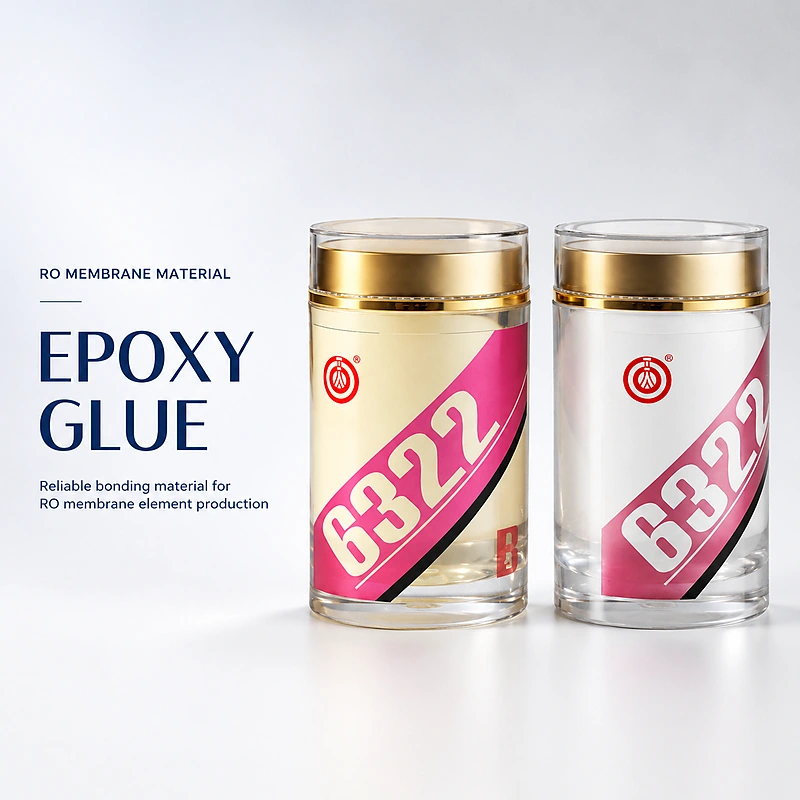


RO membrane epoxy glue is a two-component structural adhesive used in reverse osmosis membrane element assembly where rigid bonding, potting or reinforcement is required. Typical production uses include end-cap potting, component sealing and selected fiberglass-reinforced outer-structure processes, subject to the approved technical data sheet for the exact adhesive model.
WECOME supplies two HUITIAN epoxy adhesive models with different mix ratios and working times. HUITIAN 6322AB uses a 2:1 ratio by weight with a listed 60-minute working time, while HUITIAN 6321G uses a 5:2 ratio by weight with a listed 30-minute working time. Buyers should select by application, dispensing method, batch size, ambient conditions and required cure profile rather than by working time alone.
Available RO Membrane Epoxy Glue Models
Longer working window
A two-component epoxy option with a listed 60-minute working time for production steps that require more time for weighing, mixing, dispensing and component positioning.
Shorter working window
A two-component epoxy option with a listed 30-minute working time for controlled production cells prepared for faster mixing, dispensing and assembly.
Technical and Packing Specifications
| Part Number | Mix Ratio by Weight | Working Time | Component Packaging | Drums / Pallet | CBM / Pallet |
|---|---|---|---|---|---|
| HUITIAN 6322AB | 2:1 (A:B) | 60 minutes | Component A: 200 kg/drum Component B: 200 kg/drum | 3 | 1.8 m³ |
| HUITIAN 6321G | 5:2 (A:B) | 30 minutes | Component A: 225 kg/drum Component B: 180 kg/drum | 3 | 1.8 m³ |
Mix ratios are by weight. Working time is not the same as demoulding time, handling strength or full cure time. Confirm the applicable temperature, batch mass, cure schedule, shelf life and storage conditions in the latest model-specific TDS and SDS.
Recommended Mixing and Application Workflow
Prepare materials
Bring sealed components and the workpiece into the approved temperature range, then verify model and lot identity.
Control the weight ratio
Weigh Components A and B accurately. A ratio error can change viscosity, cure response and finished bond performance.
Achieve uniform blending
Mix with suitable equipment and a controlled method that limits unmixed zones, scraping errors and unnecessary air entrapment.
Dispense and cure
Complete dispensing and assembly within the validated working window, then hold the component through the specified cure cycle.
Key Production Benefits
Two working-time options
Choose a 30- or 60-minute listed window to suit batch size, staffing, dispensing method and assembly complexity.
Structural bonding support
A cured epoxy system can support rigid bonding, potting and reinforcement tasks when approved for the specific element design.
Water-treatment positioning
The product range is intended for water-treatment manufacturing, with application suitability confirmed by the relevant technical documentation.
Factory-scale packaging
Drum packaging supports repeat production and integration with controlled weighing, mixing or adhesive-dispensing systems.
Process consistency
Documented ratios, lot control and standard work instructions help reduce variation between production batches.
Application validation
Bond strength, water resistance and chemical compatibility can be verified using the buyer’s actual substrates and service conditions.
How to Specify Epoxy Glue for RO Element Production
Define the bonding location
Identify whether the adhesive is for end-cap potting, component sealing, fiberglass reinforcement or another approved structural joint.
List all substrates
Provide the end-cap polymer, central tube, fiberglass, coating and any other surface that will contact the mixed adhesive.
State the required output
Share batch size, daily production volume, dispensing quantity and available labour or automation.
Define the time window
Separate mixing time, working time, fixture time, handling time and full cure time in the process specification.
Provide service conditions
Include water chemistry, pressure, temperature, cleaning chemicals and expected product life for compatibility review.
Confirm compliance scope
Request the current TDS, SDS and any model-specific certification required by the target market and final water application.
Incoming Inspection and Process Control
Control the ratio, not only the clock
A successful epoxy process depends on component identity, storage history, accurate weighing, uniform mixing, substrate preparation and cure conditions. Working time alone is not an acceptance criterion.
Typical Applications
End-cap potting and component sealing
Structural adhesive use for compact membrane-element assemblies after model and substrate compatibility are approved.
4040 and 8040 assembly
Potting, sealing or reinforcement processes for large-format elements according to the manufacturer’s drawing and cure specification.
Membrane component manufacturing
Assembly of RO elements for controlled water-treatment systems where documentation and material compatibility are verified.
Application-specific membrane production
Adhesive selection for seawater or brackish-water elements after pressure, chemistry and cleaning-cycle validation.
Chemical-exposure review
Production use where feedwater chemistry and cleaning agents are included in the adhesive qualification plan.
Repeat drum supply
Bulk supply for documented manual, semi-automatic or metered two-component adhesive processes.
Frequently Asked Questions
What is RO membrane epoxy glue used for?
It is a two-component structural adhesive used for approved potting, sealing, component bonding or reinforcement operations in spiral-wound RO membrane element production.
How is epoxy glue different from RO membrane PU glue?
Epoxy systems are generally selected for more rigid structural joints or potting, while PU glue is commonly used for flexible membrane-leaf sealing during rolling. The correct location depends on the element design and approved production process.
What are the mixing ratios for 6322AB and 6321G?
HUITIAN 6322AB is listed at 2:1 by weight and HUITIAN 6321G at 5:2 by weight. Always verify the latest TDS before production.
Does a 30- or 60-minute working time mean the epoxy is fully cured?
No. Working time describes the usable application window under defined conditions. Handling strength and full cure normally require a separate cure period stated in the model-specific TDS.
Are 6322AB and 6321G NSF-certified?
Certification must be verified from a current document that explicitly names the exact trade designation and approved end use. Do not infer NSF or potable-water approval from the supplier name or from certification held by a different adhesive model.
Can this epoxy glue be used for 4040 and 8040 RO elements?
It may be evaluated for large industrial element assembly, but approval depends on the bonding location, substrates, pressure, water chemistry, cleaning agents and cure process.
What information should be included in an epoxy glue enquiry?
Provide the element size, joint drawing, substrates, application quantity, batch output, dispensing method, ambient conditions, service water chemistry, cure target, certification requirement and annual demand.
Related Products and Technical Resources
Match the Epoxy to Your Element Process
Send the element drawing, bonding location, substrates, batch output, dispensing method and required certification for model review.