



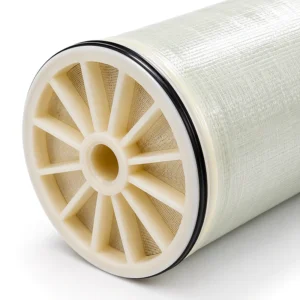
ECT-300 fiberglass roving is a continuous glass-fiber reinforcement for epoxy-resin filament winding around industrial spiral-wound membrane elements. In 4040 and 8040 production, controlled roving tension and resin wet-out help form a consistent FRP exterior layer that protects the element body and maintains finished dimensions.
The silane-sized grade is specified at 600 ± 24 tex with 17 ± 1 µm filaments, low moisture and controlled loss on ignition. It should be qualified together with the exact epoxy system, winding pattern, cure schedule and final element design before production release.
Fiberglass roving becomes the reinforcing phase of the cured FRP outer wrap. Fast, complete resin wet-out, stable linear density, low fuzz and controlled moisture are important because dry fiber, uneven tension or resin-starved areas can create inconsistent winding buildup. The outer wrap reinforces the membrane element, but it is not a substitute for the RO system pressure vessel.
From Roving Package to Cured FRP Outer Wrap
Fiberglass performance must be evaluated as part of the complete material and winding recipe.
Primary category: Industrial
Silane-sized fiberglass roving for industrial filament-winding programmes, supplied only after resin and process compatibility review.
ECT-300 Fiberglass Roving Specifications
General Control Requirements
| Parameter | Standard Requirement |
|---|---|
| Sizing Agent | Silane type |
| Linear Density Tolerance | Nominal value ±4% |
| Filament Diameter | Nominal value ±1 µm |
| Loss on Ignition, ≤4800 tex | Nominal value ±0.10% |
| Loss on Ignition, >4800 tex | Nominal value ±0.20% |
| Moisture Content | ≤0.10% |
| Tensile Strength, <4800 tex | ≥0.35 N/tex |
| Tensile Strength, ≥4800 tex | ≥0.30 N/tex |
ECT-300 Nominal Grade Values
| Test Item | Standard Value |
|---|---|
| Appearance | Clean, free of contamination |
| Filament Diameter | 17 ± 1 µm |
| Breaking Strength | ≥0.35 N/tex |
| Roving Linear Density | 600 ± 24 tex |
| Loss on Ignition | 0.45 ± 0.10% |
| Moisture Content | ≤0.10% |
Values describe the supplied ECT-300 grade and its stated acceptance requirements. Approve the current technical data sheet and certificate of analysis before volume production.
Why Roving Consistency Matters in FRP Winding
Low fuzz and stable unwinding
Reduced fuzz balls and strand breakage support consistent feeding through the creel, guides and resin path.
Controlled tensile performance
Stable strand strength supports repeatable reinforcement when tension and winding parameters are correctly set.
Fast, thorough resin wet-out
Complete impregnation helps reduce dry fiber and promotes a more uniform glass-to-resin composite layer.
Silane-sized interface
The sizing system is intended to support fiber-resin bonding, but compatibility must be validated with the actual epoxy formula.
Consistent finished buildup
Linear density, tension, winding path and resin pickup together influence wall thickness and final element diameter.
Matched production package
WECOME can coordinate the roving with epoxy materials and FRP winding equipment for production trials and FAT criteria.
Confirm These Four Interfaces Before Ordering
Finished element design
Provide 4040 or 8040 dimensions, target exterior buildup, final diameter and required reinforcement pattern.
Epoxy compatibility
Share resin chemistry, mixed viscosity, working time, cure schedule and required fiber-resin adhesion.
Winding parameters
Define creel arrangement, tension range, impregnation method, winding angle, traverse and production speed.
Composite QC criteria
Agree appearance, wet-out, diameter, layer thickness, cure, adhesion and mechanical validation methods.
Industrial Filament Winding Is the Primary Use
The product page is intentionally focused on industrial membrane manufacturing. Broader composite uses require separate grade and resin approval.
Core search intent: RO membrane FRP winding
Protect the Roving Before It Reaches the Creel
Moisture pickup, damaged packaging and contamination can affect resin wet-out and winding stability. Keep every pallet identifiable and protected until use.
Fiberglass Roving Pallet Options
| Packing Type | Pallet Dimensions | Gross Weight / Pallet |
|---|---|---|
| Pallet packing | 1140 × 1140 × 940 mm | 720 to 960 kg |
| Pallet packing | 850 × 500 × 1200 mm | 960 to 1280 kg |
Confirm package count, net weight, gross weight and final pallet dimensions on the commercial invoice and packing list before shipment.
Control the Fiber, Resin and Winding Recipe Together
Roving inspection alone cannot release the final composite. Production trials must connect incoming material data with real wet-out, winding and cure results.
Frequently Asked Questions
What is fiberglass roving used for in industrial RO membrane production?
It is impregnated with an approved epoxy system and filament-wound around compatible 4040 or 8040 spiral-wound membrane elements to form a cured FRP exterior reinforcement layer.
Is ECT-300 intended for household RO membrane elements?
No. This product page is assigned to the Industrial category and focuses on 4040 and 8040 industrial element programmes. Household 1812, 2012 and 3012 elements normally use different exterior finishing methods.
What does 600 tex mean?
Tex expresses linear density in grams per 1,000 metres of roving. ECT-300 is specified at 600 ± 24 tex, matching the stated ±4% tolerance.
Why does silane sizing matter?
Sizing protects the strand during handling and influences wet-out and bonding at the glass-resin interface. The actual silane-sized roving must still be validated with the buyer’s epoxy formulation and cure system.
Does fiberglass roving alone determine element pressure performance?
No. Roving contributes reinforcement after resin impregnation and curing, but performance also depends on resin chemistry, fiber content, winding pattern, thickness, cure, element construction and the external pressure vessel.
What should be checked before changing resin or winding speed?
Revalidate wet-out, tension, fuzz, fiber placement, resin pickup, working time, cure, finished diameter and mechanical acceptance before releasing the revised production recipe.
Can WECOME supply the matching epoxy and winding equipment?
Yes. WECOME can coordinate fiberglass roving with RO membrane epoxy materials and FRP winding equipment, subject to production trials and an approved material-process specification.
Related Materials, Equipment and Applications
Confirm the Roving, Epoxy and Winding Recipe
Send the element format, target FRP buildup, epoxy data, winding parameters, required output and acceptance criteria.