

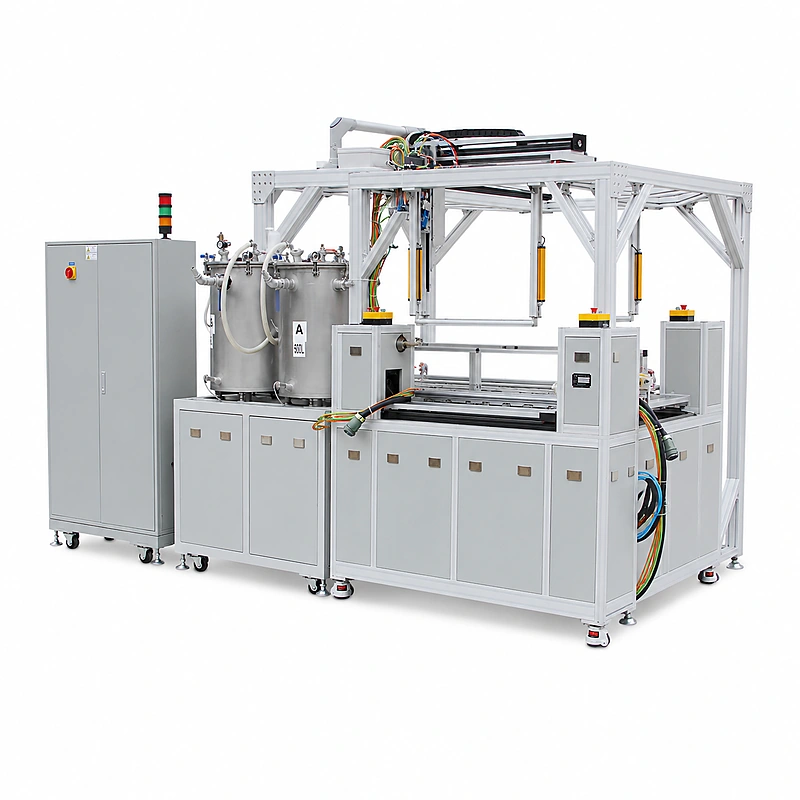
An 8040 label on a quotation does not prove that a rolling machine can process your membrane leaves, adhesive system and central tube. Before buying, ask a more useful question: can the supplier demonstrate your construction, record the complete working cycle and deliver evidence that you can repeat?
How should you evaluate an 8040 RO membrane rolling machine before purchase? Agree a representative material set, a controlled trial recipe, the start and finish of the measured cycle, and written acceptance criteria. Then follow identified trial elements through the relevant downstream inspections and tests. Separate what the rolling station demonstrates from what curing, finishing and element-performance testing must establish.
This guide is for manufacturers buying equipment to assemble spiral-wound RO elements. It is not a guide to selecting an 8040 replacement membrane for a water-treatment plant. For a broad comparison of automation levels, start with the RO membrane rolling machine selection guide; here, the focus is the evidence to request before accepting a machine.
What Does an “8040-Compatible” Claim Actually Prove?
At most, a format claim is a starting point for a dimensional and process review. Two 8040 element designs can use different leaf dimensions, leaf counts, membrane grades, feed spacers, permeate carriers, tubes and adhesive systems. A successful demonstration with the supplier’s usual materials is useful, but it does not automatically qualify a different construction.
Separate the buying decision into three questions: does the equipment accommodate the actual parts; can the agreed process be repeated; and do the resulting elements meet the separately defined release requirements? These are related questions, but they require different records. A short winding video cannot answer all three.
For the equipment itself, consult the industrial semi-automatic RO membrane rolling machine product page. Use the trial agreement to confirm the configuration and scope for your project rather than treating every catalogue statement as an acceptance condition.
Will the Trial Use Your Materials or Just a Convenient Sample?
The most useful trial starts with a controlled material list and a drawing revision. Supply your production materials where practical. If substitutes are necessary, identify each substitution and agree what the result can and cannot establish. “Equivalent spacer” is not a complete specification.
| Trial input | Information to record | Why it changes the buying decision |
|---|---|---|
| Membrane sheet | Grade, lot, cut dimensions and material condition | Connects the trial to a defined material instead of an unidentified sample. |
| Feed spacer and permeate carrier | Material identification, thickness, cut dimensions and quantity in the approved construction | Changes the stack being handled and the material set used to evaluate rolling. |
| Leaf assembly | Leaf count, assembly drawing, preparation steps and preparation responsibility | Prevents prepared-leaf work from disappearing from staffing and capacity discussions. |
| Central tube | Drawing revision, relevant dimensions, connection features and fixture arrangement | Checks actual tooling fit rather than relying only on the 8040 designation. |
| Adhesive system | Product identification, supplier instructions, dispensing scope and approved working conditions | Defines the material and application conditions for the demonstration. |
| Target element | Approved dimensions, finishing route and applicable acceptance requirements | States what the sample is intended to become after rolling and downstream processing. |
Label the trial material lots and keep the recipe revision with the resulting sample IDs. If the supplier changes a material or setting during the run, record the change and identify which samples it affects. Otherwise, a good final sample may be impossible to connect to a repeatable recipe.
For a mixed 4040/8040 project, do not use the smaller format as the sole proof of the larger one. Agree the format-specific trial work and tooling changes. The existing 4040 versus 8040 material-stack comparison explains why the construction deserves its own review.
Which Settings and Operator Tasks Must Be Visible?
A trial record should make the work sequence understandable without exposing proprietary control software. Ask the supplier to identify the recipe or program revision, relevant setup settings, tools, material-loading sequence and adjustments made between samples. The objective is traceability, not a demand for source code.
Confirm who prepares and positions materials, initiates each stage, replenishes supplies, removes the wound element and checks it. Record the operator arrangement for the rolling station separately from staffing for preparation, curing, finishing and testing. A station-level staffing statement is not a promise that the entire production line runs with the same headcount.
For adhesive application, ask what the quoted machine controls and what remains an operator or upstream preparation task. Define the relevant checks for the approved adhesive and construction. Do not substitute a generic glue ratio, pot life or cure time for the adhesive manufacturer’s technical instructions.
Does the Quoted Cycle Include the Work You Will Actually Pay For?
“Minutes per element” is incomplete unless the start point, end point and excluded work are stated. Ask whether timing covers material loading, the included dispensing and rolling stages, operator interventions, unloading and readiness for the next element. Preparation or replenishment may occur outside the cycle; that is acceptable only when the boundary is explicit.
During the trial, record individual cycles and explain stoppages. A continuous, time-stamped run is more informative than an edited clip of the fastest movement. Keep normal operation, setup, changeover, cleaning and abnormal interruptions distinguishable so that the same time is not excluded twice or counted twice.
Compare supplier claims using the same boundary
Suppose one proposal reports rolling motion only and another reports a complete load-to-next-ready cycle. The lower number does not prove higher usable output. Ask both suppliers to restate their figures against the same trial conditions, staffing and task boundary before using them in an investment calculation.
An illustrative capacity calculation, not a machine specification
Assume 420 available station minutes after planned non-cycle work and a measured complete cycle of 12 minutes. The arithmetic is 420 / 12 = 35 station cycles. Applying an assumed 90% eventual acceptance rate gives 31.5 accepted elements as a planning average, not a promise of a fractional element or a measured WECOME result.
Every number in this example is hypothetical. Curing and downstream processing may delay release beyond that shift. Use observed project data, account for losses once, and check the capacity of the rest of the line before treating rolling output as shipment capacity.
Ask the supplier to state how the trial estimate will be checked again at your site. Different material preparation, utilities, operator experience or downstream availability may change what the factory demonstration predicts. The trial should leave a reusable measurement method, not just a sales number.
What Should You Measure Beyond a Neatly Wound Sample?
Agree acceptance criteria before the trial, including who measures each item and which drawing or method supplies the limit. Inspect the agreed dimensional and visual characteristics at the appropriate process stages. Possible record items include wound-body geometry, visible alignment, surface condition and handling damage, but the approved construction determines what is relevant.
Assess a sequence of identified samples rather than choosing only the best-looking one. Keep nonconforming samples and their records in the review. The number of samples and the length of the run should reflect the project risk, product variation and agreement between buyer and supplier. This article does not prescribe a universal sample count or acceptance tolerance.
| Evidence stage | What to document | What it does not establish alone |
|---|---|---|
| Rolling trial | Materials, settings, task sequence, cycle records and agreed wound-sample checks | Final membrane flow, salt rejection or long-term service performance |
| Curing and finishing | Approved material instructions, release decision, finishing route and dimensional results | A complete diagnosis of any subsequent hydraulic-test failure |
| Integrity screening | Applicable test method, conditions, sample IDs and results | Equivalent results from every other leak-test method |
| Performance verification | Agreed element test method, controlled conditions, results and acceptance decision | That the rolling machine alone caused either success or failure |
Use the membrane element quality-control checklist for the broader inspection route. Keep its product-release checks separate from the equipment purchase agreement so that neither team assumes the other is performing a missing test.
Compare performance results under defined conditions
If wet testing is part of the agreement, document feed composition, pressure, temperature, pH, recovery or flow arrangement, stabilization procedure and the applicable test method. DuPont’s published element data illustrate why performance figures are tied to stated test conditions; those conditions are not automatically the correct acceptance specification for your own element design. See DuPont’s BWRO performance-condition reference.
A result outside the agreed range requires an investigation, not an immediate conclusion that the machine is defective. Preserve the sample history and examine materials, preparation, adhesive handling, cure, finishing and the test setup. The existing salt-rejection test failure guide covers that diagnostic discussion in more detail.
Can You Trace Each Sample from Materials to Acceptance?
Use the following structure as a starting point for a joint trial record. Replace the acceptance-reference fields with approved documents before testing. An empty requirement is an unresolved item, not an automatic pass.
| Record group | Required entry | Review question |
|---|---|---|
| Identity | Project, machine/configuration ID, date, location, attendees | Was this the proposed configuration? |
| Inputs | Material lots, drawing revision, recipe revision and substitutions | Does this represent the intended construction? |
| Working cycle | Start/finish definition, operator arrangement, cycle times and interruptions | Is the output claim based on the agreed work? |
| Samples | Sample IDs, inspection results, instruments and acceptance references | Are all agreed samples accounted for? |
| Downstream evidence | Cure/finishing records, applicable integrity and performance reports | Are these results linked to the same samples? |
| Disposition | Pass, hold or fail against agreed criteria; deviation owner and retest plan | Which issues remain open before release? |
Ask for the record, relevant raw results and agreed evidence files, not just a summary stating “trial passed.” Give the document a revision and have the responsible buyer and supplier representatives review the result. Keep commercial approval and technical acceptance responsibilities clear.
What Should the Purchase Agreement Say If the Trial Finds a Gap?
Decide in advance how a deviation will be handled. A useful technical agreement identifies the acceptance documents, unresolved items, corrective-action responsibility and the evidence required for retesting. Do not leave the release decision dependent on an informal promise made during the demonstration.
- Trial scope: material supply, sample preparation, formats, tools, included process stages and test responsibilities.
- Evidence package: sample identification, settings or recipe references, timing records, inspections and applicable downstream results.
- Delivery scope: approved tooling, manuals, training, agreed spare parts and installation requirements.
- Open issues: the owner, completion condition and agreed retest for each deviation.
- Site confirmation: what must be checked after installation and which site conditions the buyer must provide.
This is an equipment-trial checklist, not a replacement for the full RFQ or a contract template. Use the rolling machine RFQ checklist to prepare the broader enquiry. A strong quotation and a strong trial record should reference the same proposed construction and responsibilities.
Questions Buyers Ask Before an 8040 Machine Trial
Can a 4040 demonstration prove that the machine is ready for 8040?
Not by itself. It can demonstrate some equipment functions, but an 8040 purchasing decision needs evidence relevant to the actual 8040 construction, fixtures, handling and agreed output boundary. State any missing format-specific work as an open item.
Is a video enough if we cannot attend the factory trial?
A video can support a remote review, especially when it shows an uninterrupted agreed sequence with identifiable samples. It should accompany the material list, settings, timing records and inspection results. It is not a substitute for every measurement or a reason to omit an independent witness when the project requires one.
Can the rolling machine guarantee the finished element’s salt rejection?
A rolling demonstration alone cannot establish that guarantee. Finished-element results also depend on the selected materials, approved assembly process, cure, downstream work and test conditions. Define any contractual performance commitment together with its method, conditions and responsibilities.
How many trial samples should we request?
Agree a run that addresses the relevant formats, materials, setup risks and repeatability questions. There is no universal sample quantity in this guide. Do not describe a short successful demonstration as statistical proof of a long-term production yield.
Should the trial include adhesive preparation and changeovers?
Include them when they are part of the proposed scope or separately measure and document them when they affect staffing and available production time. Clearly separate routine cycle work from periodic work so the capacity calculation remains auditable.
Want to Check Your 8040 Construction Before Ordering?
Send WECOME your element drawing, material list, target output and the process stages you want included. We can discuss the proposed rolling configuration and the trial evidence to agree before purchase.
Start with the drawing revision, membrane/spacer/carrier specifications, central tube and adhesive identification. Clearly mark any information that is still provisional.
Technical Scope and References
This article provides a proposed buyer-side evaluation framework, not a certified acceptance standard, a completed WECOME trial report or a guaranteed production specification. Project drawings, material suppliers’ instructions and the mutually approved trial agreement govern actual work.
References: WECOME’s equipment and technical resources linked above; DuPont’s BWRO performance-condition reference for the importance of stated test conditions. No universal adhesive recipe, dimensional tolerance, cycle time or sample count is prescribed.

Bessie has 10+ years of experience in RO membrane materials and water treatment supply chains. At WECOME, she helps manufacturers and system integrators worldwide source the right membrane components — from feed spacers and permeate carriers to NSF-certified adhesives — backed by hands-on technical support.