

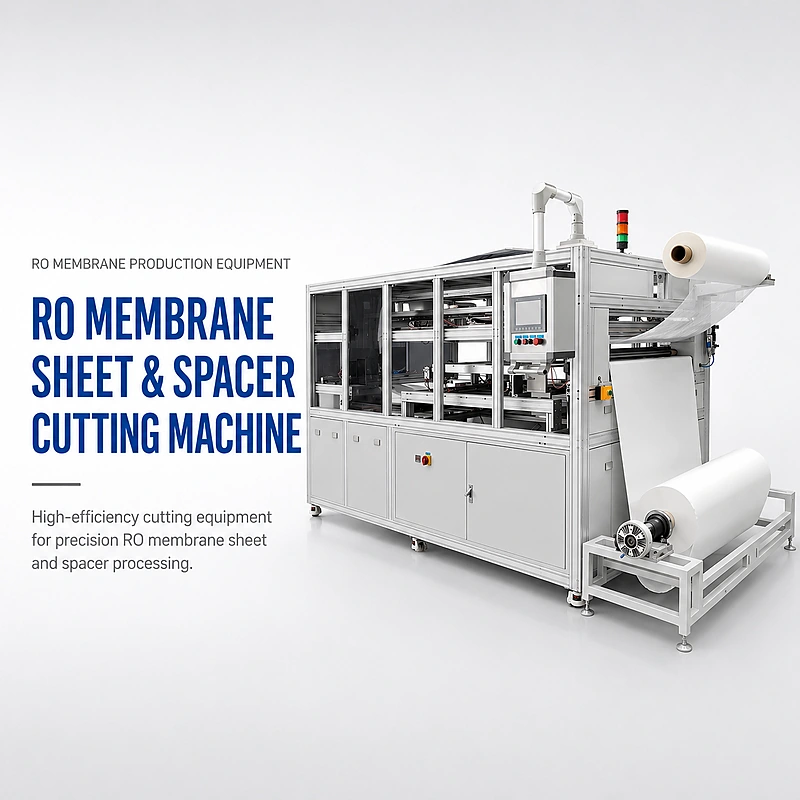


The Automatic Industrial Membrane Sheet Cutting and Folding Machine coordinates wide membrane-sheet feeding, net-material cutting, membrane folding, ultrasonic joining and finished-leaf unloading for industrial spiral-wound membrane production.
Designed around 4040, 8040, 2540 and 4021 production programs, the line replaces separate manual measuring, cross-cutting and folding steps with servo-controlled recipes and PLC supervision. It can be configured for dry or wet membrane sheet and the specified net or carrier material used in the customer’s element construction.
Automatic Leaf Preparation for Industrial RO Membrane Production
This industrial RO membrane sheet cutting and folding machine sits before the industrial membrane rolling station. One material path feeds and cuts the flat-sheet membrane; a second path feeds and cuts the specified net material. The machine then positions the materials, folds the membrane, performs the configured ultrasonic joining step and transfers completed leaves to the unloading platform.
Servo feeding and dedicated tooling improve cut repeatability and fold alignment across multi-leaf industrial recipes. PLC and touchscreen control allow operators to select approved programs, monitor the process and stop the line when material, sensor or safety conditions are outside the validated range.
Two Material Streams, One Prepared Membrane Leaf
Key Production Advantages
Integrated sheet and net processing
Automatic feeding, cutting, folding, ultrasonic joining and unloading consolidate several manual leaf-preparation steps.
Multi-format industrial recipes
Adjustable programs support 8040, 4040, 2540 and 4021 production after material dimensions and tooling are confirmed.
Servo-controlled repeatability
Precision motion and combination tooling help reduce sheet run-off, uneven folds and avoidable material waste.
Material and process monitoring
Light-box inspection, monitoring points and material sensors can support defect detection and controlled line stops.
Safety-focused automation
Safety fencing, mechanical limits, sensor monitoring and interlock control protect operators during production and setup.
Lower repetitive labor demand
Operators supervise loading, recipes, inspection and replenishment instead of manually measuring and folding every leaf.
Industrial Membrane Sheet Cutting and Folding Machine Specifications
| Technical Item | Standard Reference |
|---|---|
| Product Name | Automatic Industrial Membrane Sheet Cutting and Folding Machine |
| Primary Function | Automatic membrane-sheet cutting, specified net-material cutting, membrane folding, ultrasonic joining and finished-leaf unloading |
| Compatible Element Programs | Industrial 8040, 4040, 2540 and 4021 membrane element formats |
| Operation | Automatic operation with an assigned operator for loading, monitoring, inspection and replenishment |
| Membrane Material Reference | Dry or wet membrane sheet; supplied roll reference diameter ≥600 mm and width 1100 mm. Confirm roll OD, core ID, weight and loading method. |
| Net Material Reference | Supplied roll reference diameter ≥600 mm and width 1100 mm. Confirm whether the project material is permeate carrier or feed spacer. |
| Cutting Length | 600-1200 mm, adjustable within the approved tooling and recipe range |
| Nominal Production Reference | 2 leaves per minute; supplied eight-hour planning estimate approximately 1000 leaves |
| Format References | 8040: 25 layers in approximately 7.5 minutes; 4040: 5 layers in approximately 1.5 minutes. Counting method must be defined during FAT. |
| Control Mode | PLC and touchscreen HMI; foot-switch, monitoring and safety-interlock functions according to approved configuration |
| Electrical Supply | AC 220 V / 9 kW |
| Air Supply | 0.6-0.8 MPa clean, dry compressed air |
| Main Machine Dimensions | 6200 × 2000 × 2450 mm (L × W × H) |
| Light-Box Module Dimensions | 751 × 1643 × 1317 mm (L × W × H) |
| Membrane-Sheet Frame Dimensions | 1244 × 580 × 636 mm (L × W × H) |
| Equipment Weight | Approximately 1100 kg |
| Packing Reference | Three listed package envelopes: 2170 × 1370 × 1570 mm; 3100 × 2070 × 2200 mm; and 3600 × 2120 × 2200 mm |
| Model Number | Project-specific; confirm on the signed technical specification and quotation |
Roll diameter shown as ≥600 mm is retained from the supplied reference and must be confirmed as the required or allowable roll OD before manufacture. Power, module layout, packing split, component brands, exact cycle and material compatibility are controlled by the signed technical agreement.
Production Timing and Capacity Planning
Nominal complete-line reference
At uninterrupted operation, this equals 960 leaves in eight hours. The supplied estimate of approximately 1000 leaves is a rounded planning figure and should be replaced by the FAT result for the approved recipe.
Multi-layer batch reference
The corresponding 4040 reference is five layers in approximately 1.5 minutes. Both figures depend on how “layer” and “leaf” are defined in the customer’s process.
The legacy performance description lists an adjustable 2-30 second folding process. It should be treated as a machine sub-cycle, not a guaranteed finished-leaf rate, until feeding, cutting, alignment, joining, inspection and unloading are included in one acceptance test.
What This Machine Does – and What It Does Not Do
Designed for industrial leaf preparation
- Feeds and cross-cuts wide RO membrane sheet
- Cuts the specified internal net or carrier material
- Positions, folds and ultrasonically joins the assembly
- Releases prepared leaves for downstream rolling
Separate production processes
- It does not roll or glue the spiral-wound element
- It does not trim cured element ends after rolling
- It does not perform vacuum or hydraulic performance testing
- It is not a sorting or rework station for finished cartridges
Where This Industrial Machine Fits Best
4040 and 8040 RO factories
Repeatable preparation of large-format membrane leaves before industrial spiral winding.
2540 and 4021 programs
Additional element formats after cut length, material width, fold geometry and tooling approval.
Dry and wet sheet production
Configured material handling based on membrane condition, backing, roll construction and contamination controls.
OEM and ODM manufacturing
Recipe-driven changeover for factories producing several industrial element constructions.
New-element validation
Production-representative trials for revised leaf dimensions, net materials, fold positions or joining patterns.
Turnkey line integration
Installed ahead of industrial rolling, curing, end trimming, integrity testing and exterior reinforcement.
Quality Checks Before Membrane Rolling
Material and dimensional checks
- Correct membrane and net material identity
- Sheet width, cut length and edge squareness
- Surface cleanliness, creases and visible defects
- Roll tension, tracking and splice condition
Fold, weld and release checks
- Fold position and layer alignment
- Ultrasonic join position and continuity
- No membrane damage from tooling or welding
- Accepted leaf count and unloading condition
Use the RO membrane element quality control checklist to connect leaf-preparation records with rolling, curing, trimming and final testing.
Configuration, FAT and Delivery
| Project Input | What WECOME Needs to Confirm |
|---|---|
| Element Program | 8040, 4040, 2540, 4021 or project-specific format; leaf dimensions, layers per element and target shift output |
| Membrane Sheet | Dry or wet condition, width, thickness, backing, roll OD, core ID, roll weight, handling and cleanliness requirements |
| Net / Carrier Material | Material name, function, construction, thickness, width, roll dimensions, cut size and representative sample |
| Fold and Join Recipe | Fold geometry, material orientation, welding positions, tape-on-crease option and visual acceptance standard |
| Inspection Functions | Light-box defect criteria, monitoring points, material alarms, full-platform stop and production-count requirements |
| Utilities and Layout | Plant voltage/frequency, air capacity, loading access, operator aisle, maintenance clearance and line interfaces |
| FAT Method | Customer-material trial, dimensions, fold alignment, weld inspection, alarm/interlock checks, recipe changeover and output demonstration |
| Packaging and Shipping | Modular export packing based on the approved layout; package quantity, dimensions and gross weight confirmed before shipment |
Frequently Asked Questions
What does an industrial membrane sheet cutting and folding machine do?
It automatically feeds and cuts wide RO membrane sheet, cuts the specified net or carrier material, positions and folds the membrane, performs the configured ultrasonic joining step and unloads prepared leaves for downstream industrial element rolling.
Which industrial RO membrane formats can the machine support?
The supplied range covers 8040, 4040, 2540 and 4021 production programs. Final compatibility depends on membrane width, cut length, leaf construction, fold geometry, net material and approved tooling.
Can the machine process both dry and wet membrane sheet?
Yes, the supplied specification lists dry and wet membrane compatibility. The actual handling path must be confirmed from the sheet sample, backing, surface condition, roll dimensions and contamination-control requirements.
Does the machine cut feed spacer or permeate carrier?
The customer’s element drawing must define the net material used in this leaf-preparation step. Feed spacer and permeate carrier are different materials, so WECOME confirms the material sample, orientation, cut size and joining position before tooling approval.
What production output should a buyer use for planning?
The nominal reference is two completed leaves per minute, equivalent to 960 leaves in an uninterrupted eight-hour period. The supplied estimate of about 1000 leaves and the separate 8040 and 4040 layer references must be verified using the agreed counting method during FAT.
What is the 2-30 second folding figure?
It is best treated as an adjustable folding sub-cycle rather than total finished-leaf throughput. Complete output also includes feeding, cutting, positioning, joining, inspection and unloading.
What safety and inspection functions are available?
The reference configuration includes safety fencing, mechanical limits, sensor monitoring, interlock control, light-box inspection and monitoring-point detection. Final functions and component brands are listed in the approved BOM.
What should be sent for an accurate machine quotation?
Provide the element formats, leaf drawing, membrane and net samples, roll dimensions, cut lengths, fold and weld positions, target capacity, required inspection functions, plant utilities and available installation layout.
Related Equipment and Technical Resources
Confirm the Leaf Construction Before Quotation
Send the membrane sheet and net samples, roll data, finished leaf drawing, fold and weld positions, target output and workshop layout. WECOME will review the tooling, inspection and FAT plan.