
RO Membrane Materials for Cooling Tower Blowdown Reuse
Cooling tower blowdown reverse osmosis recovers water that would otherwise leave the cooling loop. Because blowdown concentrates hardness, silica, salts and treatment chemicals, dependable recovery starts with appropriate pretreatment and an RO element build selected for scaling-sensitive duty.
Recover Cooling Water Without Moving Scale Downstream
Cooling towers purge part of the circulating water to control dissolved solids. Recovering a portion of that blowdown can lower freshwater use and wastewater discharge, but the feed is more concentrated than make-up water. Pretreatment, recovery, spacer geometry, membrane selection and cleaning strategy must therefore be considered together.
Concentrated feed
Cycles of concentration increase conductivity, hardness, alkalinity and silica.
Variable chemistry
Season, make-up source and tower operation can change the blowdown profile.
Scaling boundary
Recovery must stay inside the limits set by concentrate saturation and pretreatment.
Defined reuse
Permeate quality should match cooling make-up or another identified plant demand.

Where RO Fits in Cooling Tower Water Reuse
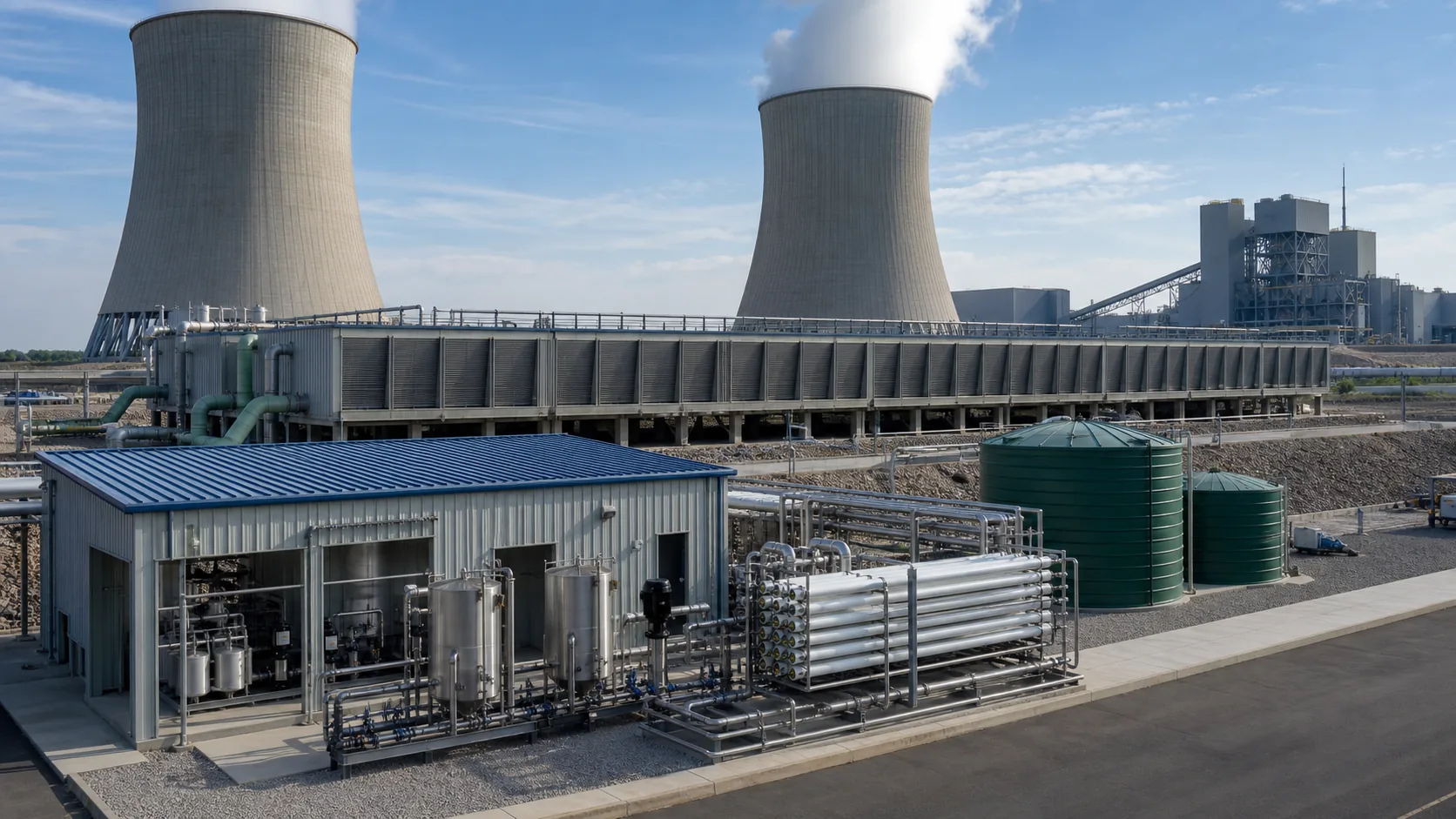
RO normally follows clarification or filtration, scale control and cartridge filtration. The permeate can return to a suitable utility demand, while concentrate management remains a separate site decision. The element specification starts with blowdown analysis, pretreatment performance and the intended recovery.
- Characterise the blowdownMeasure conductivity, hardness, alkalinity, silica, organics and treatment residuals.
- Confirm pretreatmentControl suspended solids and the species most likely to scale or foul the element.
- Set realistic recoveryUse concentrate chemistry, cleaning frequency and discharge options to define the limit.
- Specify the element buildMatch membrane sheet, feed spacer, carrier, adhesive and components to the duty.
- Verify production and QCControl rolling, curing, leak testing and performance checks across every batch.
Three Questions Shape a Blowdown-Reuse Element
The cooling tower is only the source. The element duty is defined by what has concentrated in the loop, where the recovered water will be used and how concentrate will be managed.
What limits recovery?
Hardness salts, silica, alkalinity and organics determine the safe operating window.
Where will permeate go?
Reuse quality should fit cooling make-up, utility water or another defined plant demand.
How will concentrate leave?
RO recovery must align with discharge, further treatment or site ZLD strategy.
Six Material Decisions for Scaling-Sensitive RO Duty
No single component makes an element suitable for cooling water recovery. Stable performance comes from matching the separation layer, hydraulic channel, permeate path and structural materials as one production specification.
Membrane Sheet
Select the RO membrane sheet from feed salinity, rejection target, operating pressure and cleaning conditions.
Feed Spacer
The feed spacer affects pressure drop, mixing, deposition behavior and access during cleaning.
Permeate Carrier
A matched permeate carrier supports the leaf and moves product water toward the central tube.
Adhesive & Wrap
PU adhesive and fiberglass wrap support leak integrity and structural consistency in 8040 production.
Seals & Connectors
Brine seals, end caps and interconnectors complete the fit and flow path inside multi-element pressure vessels.

A Scaling-Aware Specification Still Needs Repeatable Production
Material selection defines the design; manufacturing control determines whether each element matches it. WECOME supplies industrial element-production equipment and supports the workflow from incoming inspection through final testing.
- Incoming inspection — verify sheet, spacer, carrier, tube and adhesive before release.
- Controlled leaf preparation — maintain cutting dimensions, welding quality and clean bond areas.
- Repeatable 8040 rolling — control alignment and winding tension across the element.
- Leak and performance checks — verify build integrity before elements enter a customer program.

Specify the Element From Chemistry, Not the Industry Label
?Cooling tower blowdown? is not one fixed water quality. A useful request for quotation includes the source-water and blowdown analysis, tower concentration cycles, pretreatment, operating targets, cleaning plan and element format.
- Feed profile — conductivity, pH, hardness, alkalinity, silica, organics and suspended solids.
- Treatment residuals — identify oxidants, biocides and other chemicals that can affect compatibility.
- Hydraulic target — define recovery, flux, pressure and expected temperature range.
- Acceptance criteria — agree element dimensions, flow, rejection and leak-test requirements.
Translate Blowdown Risk Into Element Decisions
| Feed condition | Primary concern | Element consideration | System boundary |
|---|---|---|---|
| High hardness / alkalinity | Carbonate scale as recovery rises | Spacer and membrane matched to realistic flux and cleaning | Softening or antiscalant remains a system decision |
| Elevated silica | Silica concentration in reject | Conservative loading and consistent flow channels | Recovery must respect silica limits |
| Suspended solids | Deposition and pressure-drop increase | Appropriate spacer geometry and repeatable leaf construction | Filtration performance must be verified |
| Variable seasonal feed | Changing conductivity and temperature | Materials and QC based on the operating envelope | Controls must respond to feed changes |
Indicative guidance only. Final recovery and pretreatment require project-specific water analysis. WECOME supplies element materials and manufacturing equipment, not the complete cooling-tower recovery system.
Materials, Components & Equipment for Industrial RO Elements
Support one element specification with compatible materials, industrial production equipment and practical quality references.
 Inside the plant
Materials & Components
- Industrial RO membrane sheet
- Feed spacer & permeate carrier
- 8040 central tubes
- Brine seals & connectors
- PU / epoxy adhesive
- Fiberglass outer wrap
Production Equipment
- Sheet & spacer cutting
- Carrier welding
- 8040 rolling
- Trimming equipment
- FRP winding
- Vacuum leak testing
Cooling Tower Blowdown RO Questions
Can reverse osmosis recover cooling tower blowdown?
Yes, when pretreatment and recovery are designed from the actual blowdown chemistry. RO can produce reusable permeate, but concentrated hardness, silica, suspended solids and treatment residuals must be controlled before the membrane stage.
What limits recovery in cooling tower blowdown RO?
The limiting factor is usually the first species to reach an unacceptable scaling or fouling condition in the concentrate. Hardness salts, alkalinity, silica, organics, temperature and pretreatment performance all influence the practical recovery.
Which feed spacer is suitable for blowdown recovery?
There is no universal spacer for every tower. Spacer thickness and geometry should be evaluated with flux, pressure drop, solids loading and cleaning requirements. WECOME helps element manufacturers match spacer and membrane materials to the stated duty.
Does WECOME supply complete cooling tower reuse systems?
No. WECOME supplies RO membrane raw materials, components and production equipment used by element manufacturers. System pretreatment, recovery, concentrate disposal and operating controls remain with the water-treatment system designer.
What information is needed for material selection?
Provide blowdown analysis, tower concentration cycles, pretreatment details, target permeate and recovery, operating pressure and temperature, cleaning conditions, element size and expected production volume.
Building RO elements for cooling-water recovery?
Send the blowdown analysis, pretreatment, recovery target, element size and production volume. We will help match the membrane sheet, feed spacer, components and manufacturing equipment to your program.