

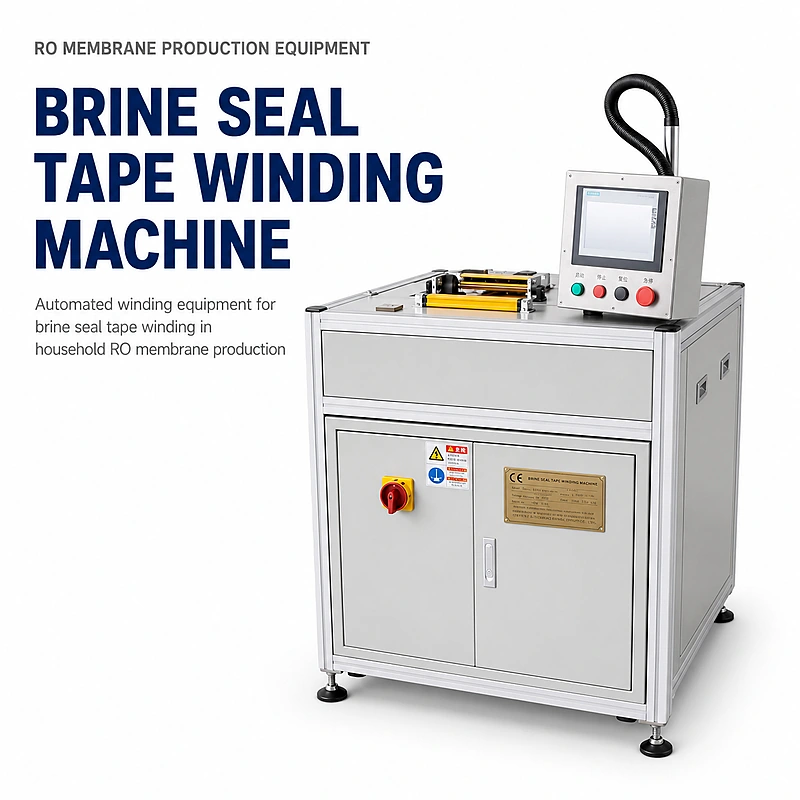
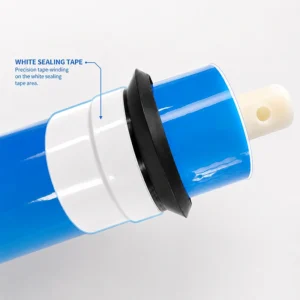
The Brine Seal Tape Winding Machine automatically wraps and cuts white retention tape around the brine-seal area of household spiral-wound RO membrane elements. It is designed for common 1812 two-layer through 3013 seven-layer formats with a maximum finished-element diameter of 100 mm.
The operator loads and unloads each membrane element manually. Once the element is positioned, the Siemens-controlled system feeds the tape, winds it at the configured position and tension, and cuts it to the programmed length. This controlled process helps hold the installed brine seal securely and reduces variation compared with fully manual tape wrapping.
Automatic Tape Wrapping Around the Brine Seal Area
This RO membrane brine seal tape wrapping machine secures an already positioned RO membrane brine seal with the specified retention tape. It controls tape feeding, winding tension and cut length while the membrane element is held in the working fixture.
The machine wraps tape around the outside of the membrane element at the brine-seal location. It does not apply tape to the permeate tube. Tube-end protection before membrane rolling is handled by the separate Household Membrane Central Tube Taping Machine.
How the Brine Seal Tape Winding Cycle Works
Confirm seal and tape
Verify that the correct brine seal is installed and load the approved white retention tape.
Position the membrane element
The operator manually places the compatible 1812-3013 element into the winding fixture.
Feed and wind automatically
The machine feeds the tape and wraps it around the configured brine-seal region under controlled tension.
Cut, unload and inspect
The tape is cut automatically; the operator removes the element and checks position, tightness and finish.
Key Production Advantages
Controlled automatic tape feed
The tape is presented consistently to the winding position while the operator handles the membrane element.
Repeatable wrapping position
Recipe and fixture settings help place retention tape around the specified brine-seal area on each element.
Real-time tension control
Controlled winding tension helps reduce loose wraps, uneven tightness and inconsistent finished appearance.
Automatic tape cutting
The machine cuts tape to the programmed length, reducing repetitive manual cutting and end-position variation.
Siemens control platform
Siemens motor, PLC and touchscreen coordinate the winding sequence and provide a consistent operator interface.
Compact export-ready station
The 1160 × 900 mm floor footprint, 200 kg net weight and defined packing size support straightforward line planning and shipment.
Brine Seal Tape Winding Machine Specifications
| Technical Item | Standard / Reference Data |
|---|---|
| Product Name | Brine Seal Tape Winding Machine for RO Membrane Elements |
| Model No. | Project-specific; confirm before quotation |
| Primary Function | Automatic white retention-tape wrapping and cutting around the installed brine-seal area |
| Applicable Element Formats | 1812 two-layer through 3013 seven-layer household membrane constructions, subject to sample approval |
| Maximum Element Diameter | 100 mm |
| Operation | Manual membrane-element loading and unloading; automatic tape feeding, winding and cutting |
| Reference Cycle Time | Approximately 10-15 seconds per piece under validated production conditions |
| Reference 12-Hour Output | Approximately 3000-4000 pieces with stable material supply and experienced operation |
| Motor / PLC / Touchscreen | Siemens |
| Operating Voltage & Power | AC 220 V / 1 kW instantaneous maximum power |
| Air Source Pressure | 0.5-0.7 MPa, clean and dry compressed air |
| Overall Dimensions (L × W × H) | 1160 × 900 × 1550 mm |
| Equipment Weight | 200 kg |
| Packing Size | 1200 × 1000 × 1600 mm |
Technical values apply to the supplied reference configuration. Final element fixtures, tape specifications, winding position, tension range, electrical standard, safety arrangement and acceptance criteria must be confirmed from customer drawings, physical samples and the signed technical agreement.
Production Capacity and Operator Planning
A 10-15 second cycle corresponds to a theoretical range of approximately 2880-4320 pieces over 12 continuous hours before accounting for tape replenishment, loading, inspection, changeovers and planned stops. The stated 3000-4000 pieces per 12-hour shift is therefore a reasonable production reference when the element, seal, tape, fixture and operator workflow are properly matched.
Shift output depends on the complete workstation
Practical capacity is affected by element handling, tape-roll changes, size changeovers, inspection frequency, compressed-air stability and upstream brine-seal supply. WECOME should verify station quantity and buffer requirements from the customer’s actual shift plan.
Brine Seal Assembly vs. Tape Winding
Brine seal assembly machine
- Installs or sets the brine seal onto the membrane element
- Controls seal placement using the matched fixture and recipe
- Prepares the element for any required tape-retention step
- Available as the separate Household Brine Seal Assembly Machine
Brine seal tape winding machine
- Receives an element with the brine seal already positioned
- Wraps retention tape around the external seal area
- Controls winding tension and cuts the tape automatically
- Does not install central tube tape or roll the membrane leaf
Element, Seal and Tape Compatibility
The nominal 1812-3013 range is only the first compatibility check. Stable winding also depends on element outside diameter, seal profile, tape construction, target wrap position and required overlap. WECOME should test representative samples before final fixture approval.
Element and seal information
- Element model, length and outside diameter
- Brine-seal profile, width, material and installed position
- Required tape location relative to the seal and element end
Tape information
- Tape material, width, thickness and roll dimensions
- Adhesion, stretch behavior, target overlap and number of wraps
- Required winding tension, cut length and finished appearance
Use the RO Membrane Tape Material Data Sheet and RO Membrane Tape Length Calculator as planning references, then validate the actual tape on the configured machine.
Where This Machine Fits Best
Household RO element factories
Standardize brine-seal tape retention for recurring 1812-3013 residential membrane production.
Overseas local assembly
Support membrane manufacturers and water-treatment factories establishing local finishing operations.
OEM and ODM production
Store validated settings for different customer element, brine-seal and tape combinations.
New-model validation
Evaluate tape position, tension and seal retention before a new household element enters regular production.
R&D and pilot batches
Prepare controlled small batches for component, tape and process-development trials.
Technical training centers
Demonstrate seal handling, tape-winding setup and finished-element inspection under supervision.
Quality Checks Before and After Tape Winding
Before winding
- Confirm the correct brine seal is fully seated and correctly oriented
- Verify element diameter and selected winding recipe
- Check tape identity, roll condition and threading path
After winding
- Inspect tape position, overlap, tightness and cut end
- Check that the seal remains correctly seated without twisting or damage
- Route abnormal elements to rework before downstream release
For the component’s purpose and dimensional planning, see Why RO Membrane Elements Need a Brine Seal and RO Membrane Brine Seal Dimensions.
Configuration, Acceptance and Delivery
| Project Input | What WECOME Confirms |
|---|---|
| Element Models | Target 1812-3013 formats, outside diameter and production mix |
| Brine Seal Samples | Seal profile, installed position and tape-retention requirements |
| Tape Samples | Tape material, width, thickness, roll dimensions, overlap and winding behavior |
| Production Target | Required pieces per shift, operator plan, buffer quantity and recommended station count |
| Machine Acceptance | Cycle time, winding position, overlap, cut quality and approved sample criteria |
| Electrical and Air Supply | Regional voltage standard and clean, dry compressed-air interface |
| Packaging | 1200 × 1000 × 1600 mm reference packing size and export-protective packing |
| Technical Support | Installation guidance, commissioning, operator training and after-sales assistance |
Frequently Asked Questions
What does a brine seal tape winding machine do?
It automatically feeds, winds and cuts retention tape around the external brine-seal area of a household RO membrane element. The tape helps hold the previously installed seal in its specified position.
Is this the same as a brine seal assembly machine?
No. The assembly machine installs the brine seal onto the element. The tape winding machine performs the separate retention-wrapping step after the seal has been positioned.
Does this machine wind tape around the central tube?
No. It wraps tape around the outside of the membrane element at the brine-seal location. Central tube tape is applied before membrane rolling by a dedicated central tube taping machine.
Which membrane element sizes can the machine process?
The stated configuration supports common household formats from 1812 two-layer through 3013 seven-layer constructions, with a maximum element diameter of 100 mm. Final compatibility requires samples and fixture confirmation.
Is membrane-element loading automatic?
No. The operator loads and unloads the membrane element manually. Tape feeding, tension-controlled winding and cutting are automatic after the element is positioned.
Can it produce 3000-4000 pieces in 12 hours?
That is a reference output based on a 10-15 second cycle under stable production conditions. Practical capacity depends on operator handling, tape changes, size changeovers, inspection and planned downtime.
Can different tape materials and widths be used?
They can be evaluated, but the tape material, width, thickness, roll size, stretch behavior and adhesion must match the feeding, tension and cutting configuration. Physical tape trials are recommended before approval.
What information is required before quotation?
Provide target element models, outside diameter, installed brine-seal samples, tape specifications and samples, required wrap position and overlap, shift output, electrical standard and compressed-air conditions.
Related Equipment and Technical Resources
Confirm the Element, Seal and Tape Combination
Send WECOME your element drawing, installed brine-seal sample, tape sample and target shift output. Our engineers will review fixture compatibility, winding settings and expected capacity.