

RO Membrane Brine Seal Dimensions and O-Ring Specifications
Confirmed models, dimensions, materials and packaging for WECOME black silicone V-rings and black EPDM connector O-rings. Compatibility must be checked against the actual sealing interface and approved drawing.
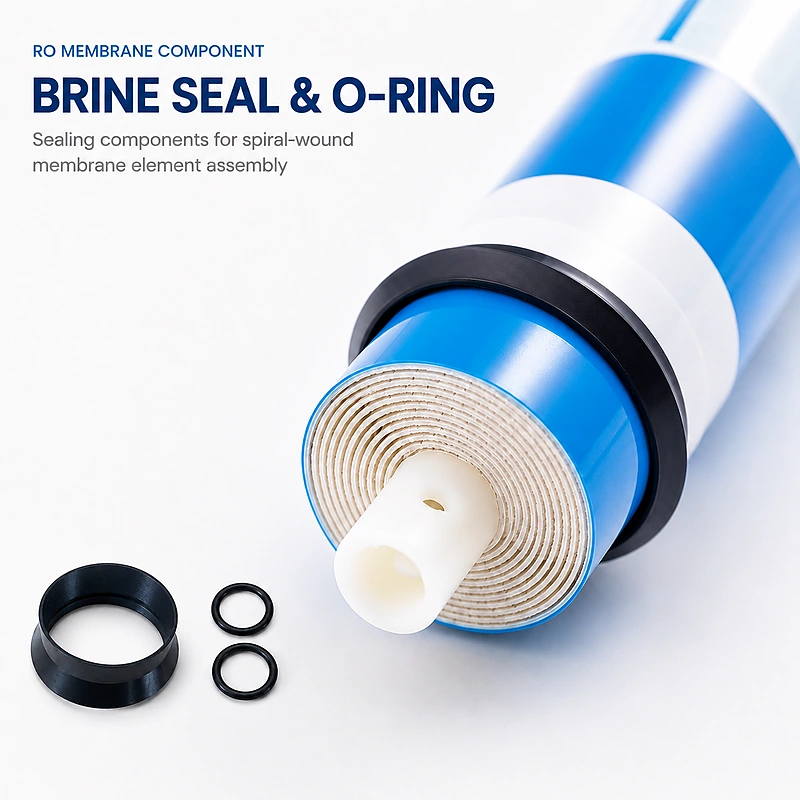
This reference reproduces WECOME's confirmed product schedule. The five listed V-rings are black silicone components; the two listed O-rings are black EPDM components. A model number, drawing and real interface dimensions are required before compatibility is approved.
Two Seal Types, Two Different Functions
External brine-seal interface
Designed for an approved element-to-housing sealing interface. It helps control external feed bypass when its dimensions, groove and installation direction match the assembly drawing.
Connector or adapter interface
Designed for a circular permeate connector, adapter or related joint defined by the assembly drawing. It is not a replacement for the external V-ring.
RO Membrane Brine Seal and O-Ring Dimensions
| Model No. | Product Size | Material | Appearance | Qty / Box | Boxes / Pallet | Box Size | G.W. / Box |
|---|---|---|---|---|---|---|---|
| VR-3955S | 39 × 55 × 24 mm | Silicone | Black V-ring | 2,000 | 20 | 500 × 500 × 300 mm | 13 kg |
| VR-4155S | 41 × 55 × 24 mm | Silicone | Black V-ring | 2,000 | 20 | 500 × 500 × 300 mm | 13 kg |
| VR-4255S | 42 × 55 × 24 mm | Silicone | Black V-ring | 2,000 | 20 | 500 × 500 × 300 mm | 14 kg |
| VR-4455S | 44 × 55 × 24 mm | Silicone | Black V-ring | 2,000 | 20 | 500 × 500 × 300 mm | 14 kg |
| VR-4655S | 46 × 55 × 24 mm | Silicone | Black V-ring | 2,000 | 20 | 500 × 500 × 300 mm | 15 kg |
| OR-13265 | 13 × 2.65 mm | EPDM | Black O-ring | 100,000 | 20 | 460 × 460 × 300 mm | 10 kg |
| OR-1325 | 13 × 2.5 mm | EPDM | Black O-ring | 100,000 | 20 | 460 × 460 × 300 mm | 10 kg |
Dimensions and packaging are reproduced from the confirmed product schedule. Before ordering, confirm which value represents ID, OD, height or cross-section against a dimensioned drawing.
What the Listed RO Membrane Seal Dimensions Mean
The schedule is a model-level purchasing reference. It records the confirmed product-size string and logistics data, but it does not assign every number to ID, OD, lip height or cross-section. Those definitions must come from the approved part drawing.
The three-value size identifies the listed V-ring model. Do not treat the first or second number as a standard membrane-element diameter without the corresponding drawing.
The two-value size is normally read in the context of a circular seal, but the drawing must confirm which value is the nominal inside diameter and which is the cross-section.
Quantity per box, boxes per pallet, carton dimensions and gross weight support purchasing and freight planning. They do not establish dimensional compatibility.
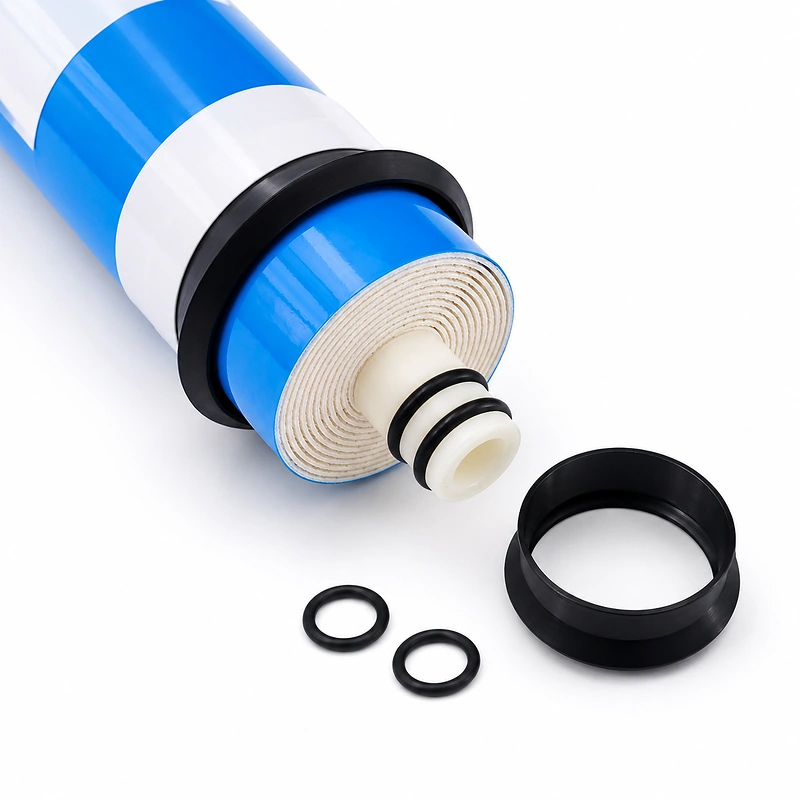
Do Not Select by a Single Diameter
The product size alone does not explain the complete sealing interface. A correct match also depends on the seal profile, groove geometry, housing or connector dimensions, tolerance stack, compression and installation direction.
From Nominal Element Size to an Approved Seal Model
A useful selection process starts with the membrane format but does not stop there. The sealing interface, real dimensions, service conditions and assembly trial all have to agree.
Identify the seal location
Separate the external element-to-vessel V-ring from connector, adapter and permeate-tube O-rings.
Confirm the geometry
Compare the relevant bore, shell, groove, connector and seal-profile dimensions with tolerances.
Review service conditions
Check elastomer requirements against temperature, water chemistry, pressure and cleaning agents.
Approve on the assembly
Validate insertion, seating, orientation and sealing function before committing to volume supply.
Incoming Inspection and Assembly Checks
Model and material
Verify part number, silicone or EPDM designation, appearance, quantity and lot information.
Critical dimensions
Measure the drawing-defined ID, OD, height, cross-section and interface dimensions.
Moulded surface
Check flash, cuts, voids, inclusions, deformation, contamination and damaged sealing edges.
Elastic condition
Use the agreed inspection method to confirm hardness, recovery and storage condition.
Assembly trial
Check fit, direction, lubricant compatibility, twisting, pinching and insertion damage.
Functional approval
Approve the part through the required bypass, leakage or completed-assembly performance test.
Information Required for Model Confirmation
Specification FAQ
What materials are used in the listed WECOME seal models?
The five listed V-ring models are black silicone. The two listed connector O-ring models are black EPDM.
Are the listed O-rings external brine seals?
No. The listed EPDM O-rings are separate circular sealing components for an approved connector, adapter or permeate-tube interface.
Do these model dimensions prove compatibility with 4040 or 8040 elements?
No. The supplied dimensions do not by themselves establish standard 4040 or 8040 fit. Industrial seal compatibility requires separate drawing and model confirmation.
Which value is the inside or outside diameter?
The schedule lists product sizes but does not define every value as ID, OD, height or cross-section. Confirm the dimensional meaning against the approved drawing before ordering.
Can silicone and EPDM be exchanged?
Not automatically. Use the elastomer specified for the real interface, compression conditions, water chemistry, temperature, cleaning agents and compliance requirements.
How should the V-ring be installed?
Installation direction must follow the approved drawing. For a pressure-assisted V-ring design, the open lip commonly faces the incoming feed, but the model-specific instruction remains authoritative.
What is the difference between a brine seal and a connector O-ring?
A V-ring brine seal controls the external bypass path between the membrane element and the pressure vessel. A connector O-ring seals a circular product-water connection such as a permeate connector or adapter interface.
What should be inspected when the seals arrive?
Verify the model, material, quantity and lot identification, then inspect drawing-defined dimensions, sealing edges, flash, cuts, voids, deformation and contamination. Complete an assembly trial when required by the quality plan.
What information should be sent before requesting a quotation?
Send the seal location, element and housing or connector model, dimensioned drawing, operating temperature and pressure, water chemistry, cleaning agents, required material, annual demand and documentation requirements.
Continue from Specifications to Selection
Request the Correct Seal Model
Send the interface drawing, required elastomer, operating conditions and annual quantity for confirmation against the WECOME product schedule.