

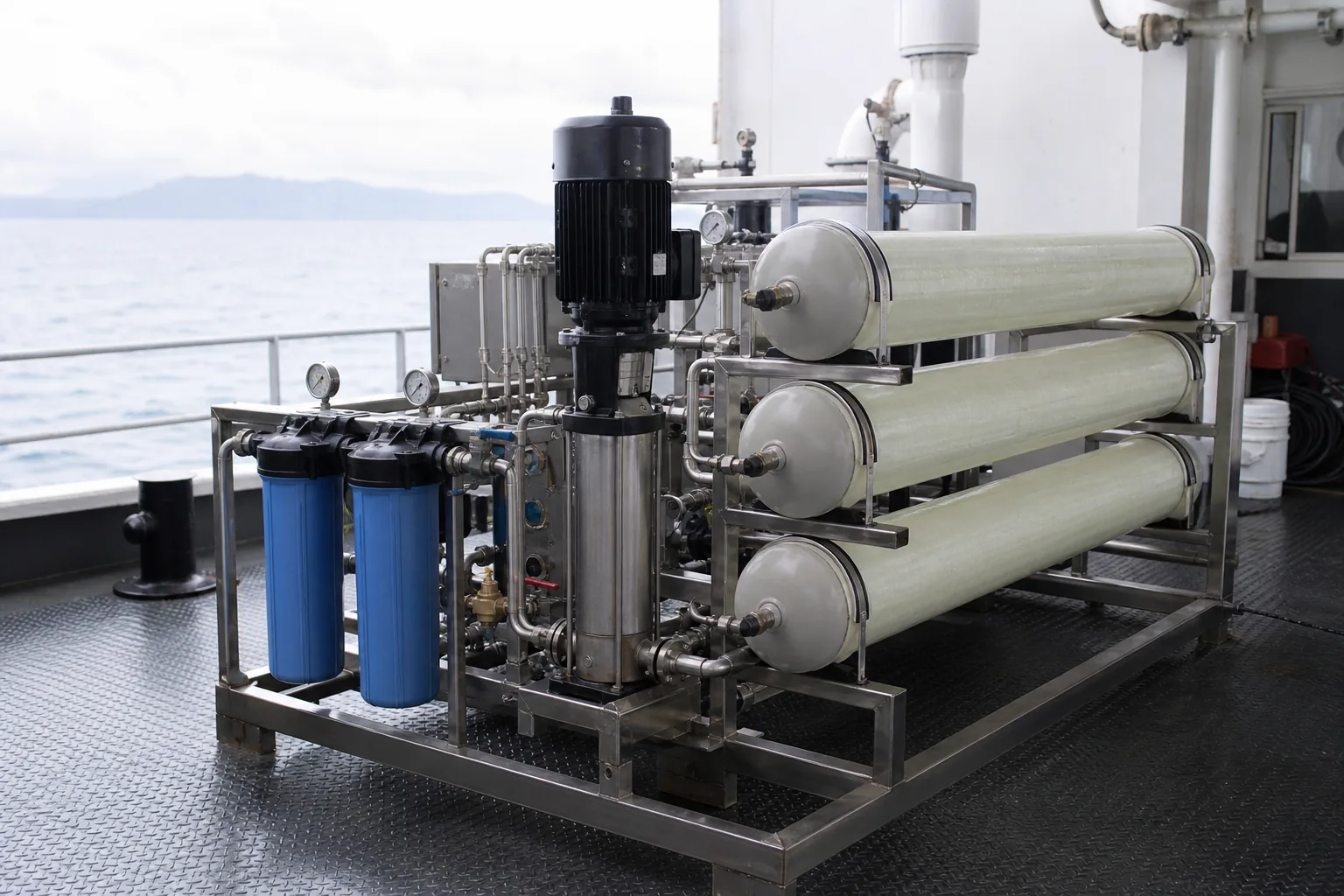
RO Membrane Materials for Marine and Offshore Desalination
Marine RO systems live in a tougher world than shore-based plants — tight footprint, constant vibration, salt-air corrosion and long service intervals at sea. WECOME supplies the membrane materials, components and production equipment element manufacturers use to build compact, dependable watermaker elements for vessels and offshore platforms.
A Watermaker Is Not a Shrunken SWRO Plant
Marine reverse osmosis has the same salinity challenge as a land-based plant, but everything else changes. A shipboard or offshore watermaker fights for space, rides constant motion and vibration, sits in corrosive salt air, and may run for weeks between service visits. Those constraints — not just rejection — decide how the element is built.
Limited footprint
Compact 4040-class formats fit the tight machinery spaces of vessels and platforms.
Vibration & motion
Continuous movement rewards stable rolling and secure sealing that will not loosen at sea.
Corrosion exposure
Salt air and spray attack weak materials — components and wrap have to endure it.
Service at sea
Long intervals between service mean traceable, dependable elements are essential.
Where RO Sits in a Marine System
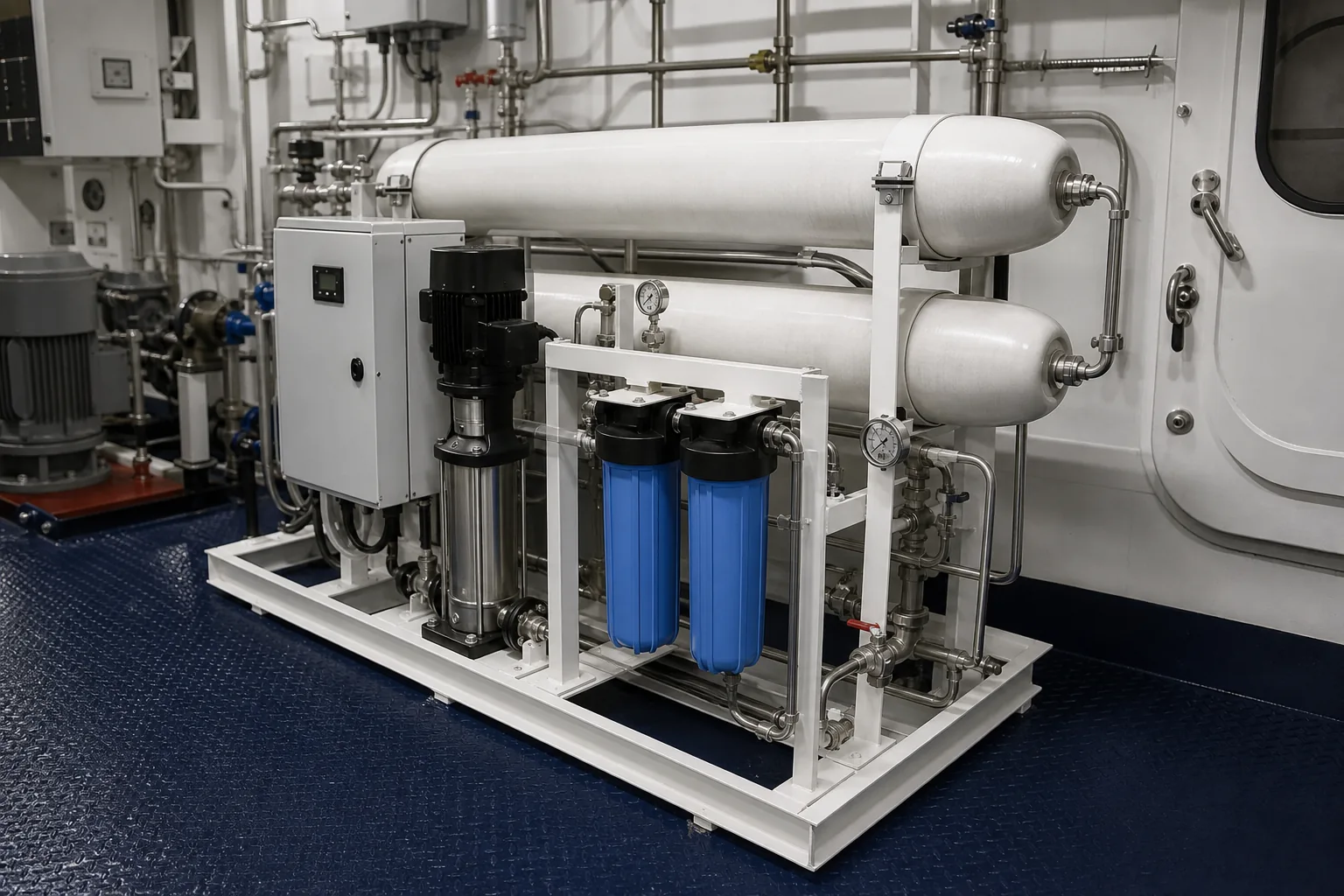
In marine RO systems the membrane stage follows a compact intake and pre-filter, then feeds the vessel’s fresh-water service. Specifying the element starts from the platform’s space, motion and service reality, not just the water target.
- Define the platformVessel or offshore platform, available space and duty cycle set the element format.
- Confirm seawater dutyFull seawater salinity calls for a high-rejection seawater membrane grade.
- Design for motionVibration and movement drive stable rolling, secure sealing and robust parts.
- Specify the elementCompact size, membrane, spacer, carrier, tube, glue and wrap chosen for marine duty.
- Plan production & traceabilityConsistent rolling, leak testing and records keep every element serviceable.
Large shore-based plant instead? See seawater desalination (SWRO).
Different Marine Platforms, Different Element Builds
“Marine and offshore” covers very different platforms. Each one points to a different compact element construction — which is exactly where material and format choice matter.
Shipboard Watermakers
Vessels and yachts needing compact elements that hold up to motion, vibration and long runs between service.
Offshore Platforms
Rigs and offshore installations where corrosion exposure and reliability drive durable component and wrap choices.
Compact / Portable Units
Small watermakers and lifeboat units built on 4040-class formats with secure sealing for portability.
Six Material Decisions That Act as One Element
Marine reverse osmosis shows up in every part of the element. Each material below is chosen for compact, high-vibration, corrosion-exposed duty, and they only perform when matched to each other.
Membrane Sheet
Full seawater duty needs a high-rejection seawater-grade flat sheet membrane — the same rejection as a big plant, in a compact element.
Feed Spacer
Feed spacer choice balances compact packed area against fouling resistance on variable marine intake.
Permeate Carrier
The permeate carrier carries product water reliably despite motion and continuous vibration.
Central Tube
The central tube takes seawater pressure in a compact 4040-class element without distortion.
Adhesive & Sealing
The glue lines and brine seals must stay tight through vibration — the decisive factor for marine elements.
Wrap & Parts
Fiberglass wrap, end caps and connectors give corrosion resistance and clean joins in the watermaker vessel.
Compact Elements, Uncompromised Build Quality
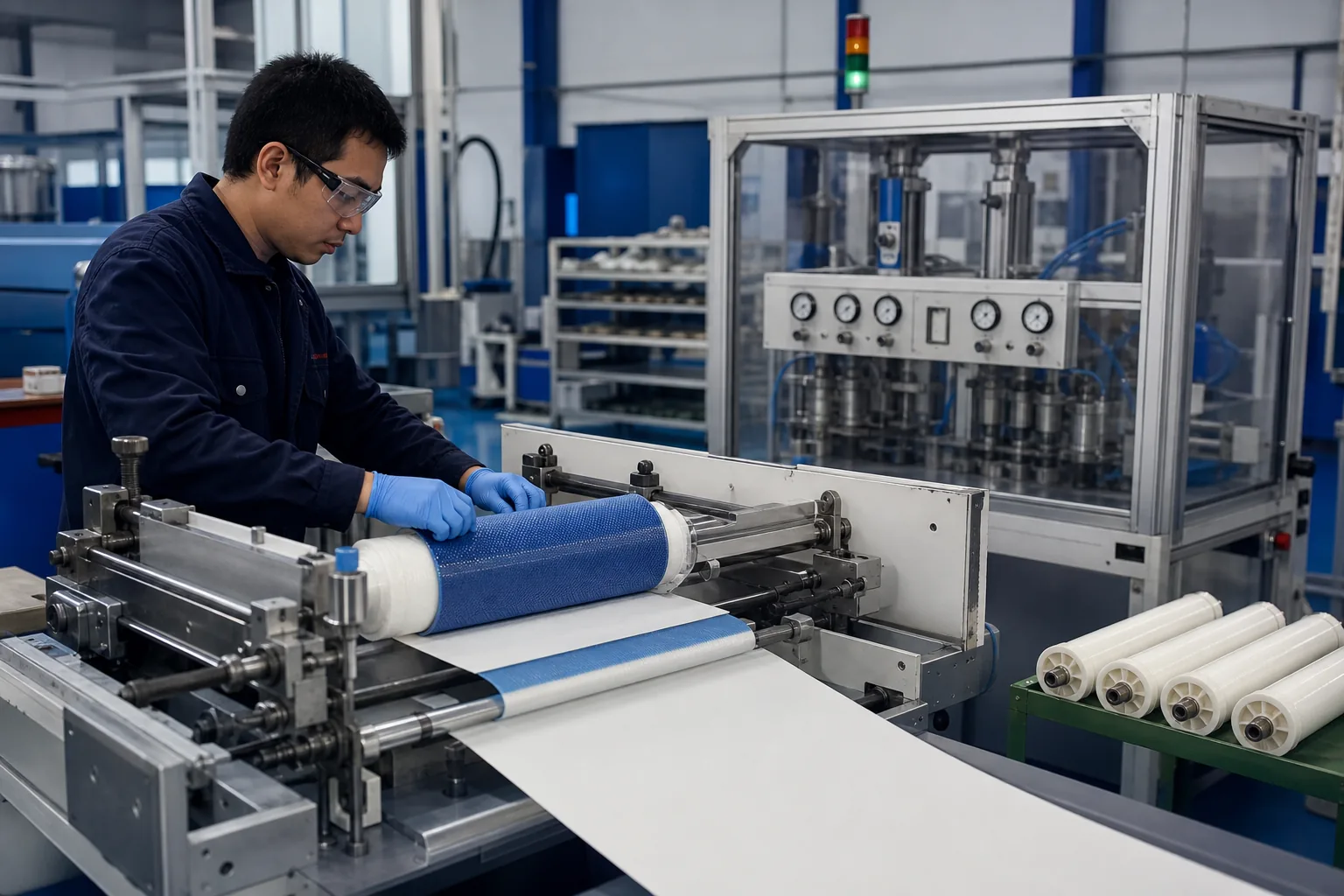
A watermaker element that loosens or leaks at sea is a serious problem. Stable rolling, secure sealing and full leak testing are non-negotiable — and we supply the machines for it.
- Incoming material checks — verify seawater membrane, spacer and components before rolling.
- Stable rolling — controlled winding tension for tight, vibration-ready rolls.
- Secure sealing — accurate gluing, welding and seal fitting for motion service.
- Leak & performance testing — vacuum, flow and rejection checks with records on every element.
Specify for the Sea, Then Build It the Same Every Time
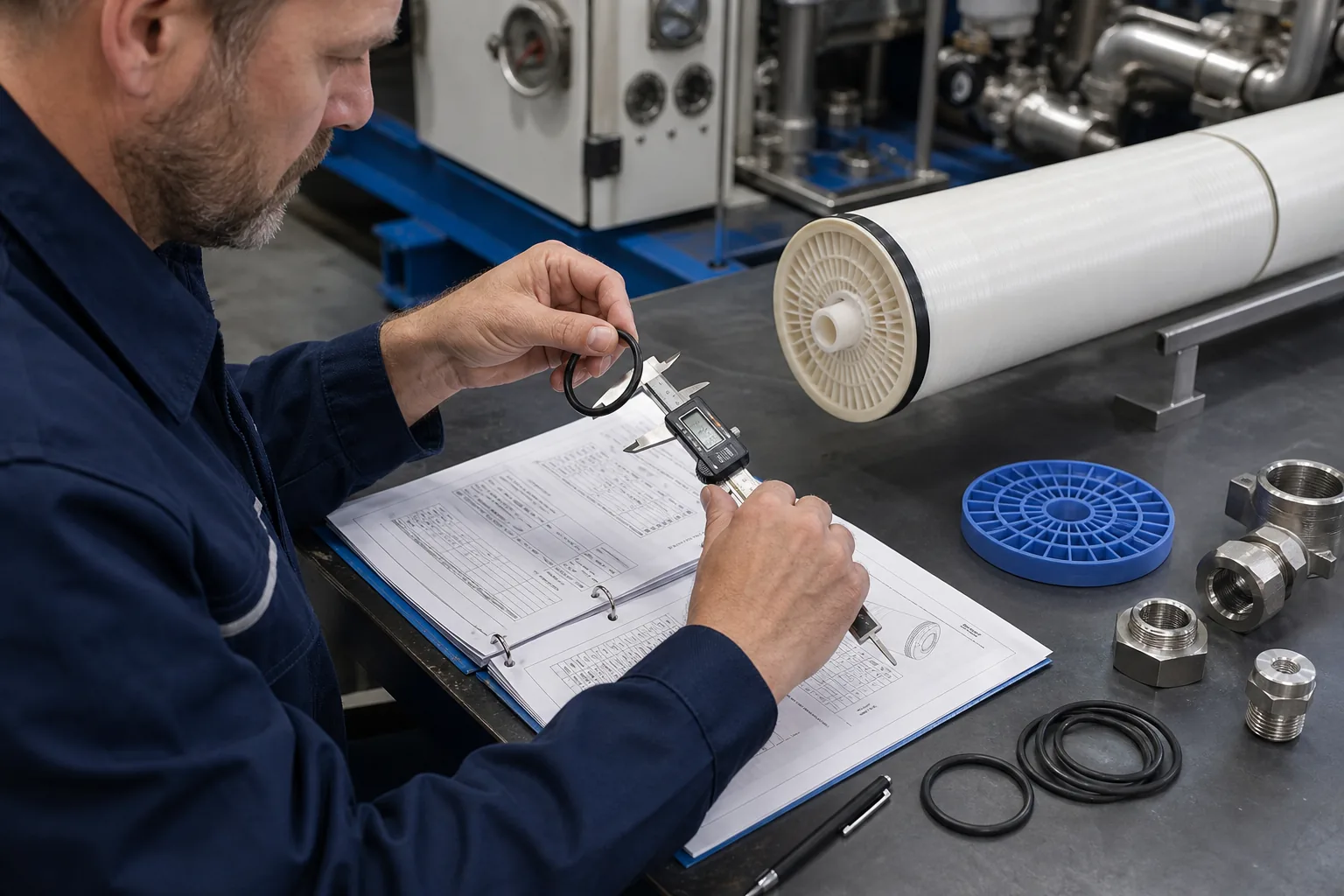
The safest marine programs start from a documented element specification that accounts for space, motion, corrosion and service intervals — then hold it across every production run.
- Document the element specification — compact size, seawater membrane, spacer, carrier, tube, glue and wrap in writing.
- Design for motion & corrosion — secure sealing and durable, corrosion-resistant parts.
- Plan for service at sea — traceable construction that is dependable between service visits.
- Compact 4040-class formats — matched to the platform’s space and output.
Match Materials to Platform and Format
| Platform / duty | Typical constraint | Membrane | Build notes |
|---|---|---|---|
| Shipboard watermaker | Motion, vibration, tight space | Seawater-grade sheet | Compact 4040; secure sealing |
| Offshore platform | Corrosion, high reliability | High-rejection seawater | Durable wrap & parts; traceable build |
| Compact / portable unit | Portability, small footprint | Seawater-grade sheet | 4040-class; robust brine seals |
| Larger vessel array | Higher output on board | High-rejection seawater | Multiple elements; consistent QC |
Indicative only — the exact build is confirmed from your platform, feed and service reality. Size it with the element size reference.
Materials, Components & Production Equipment
Everything an RO element manufacturer needs to serve marine and offshore watermaker programs — not finished watermakers or systems.
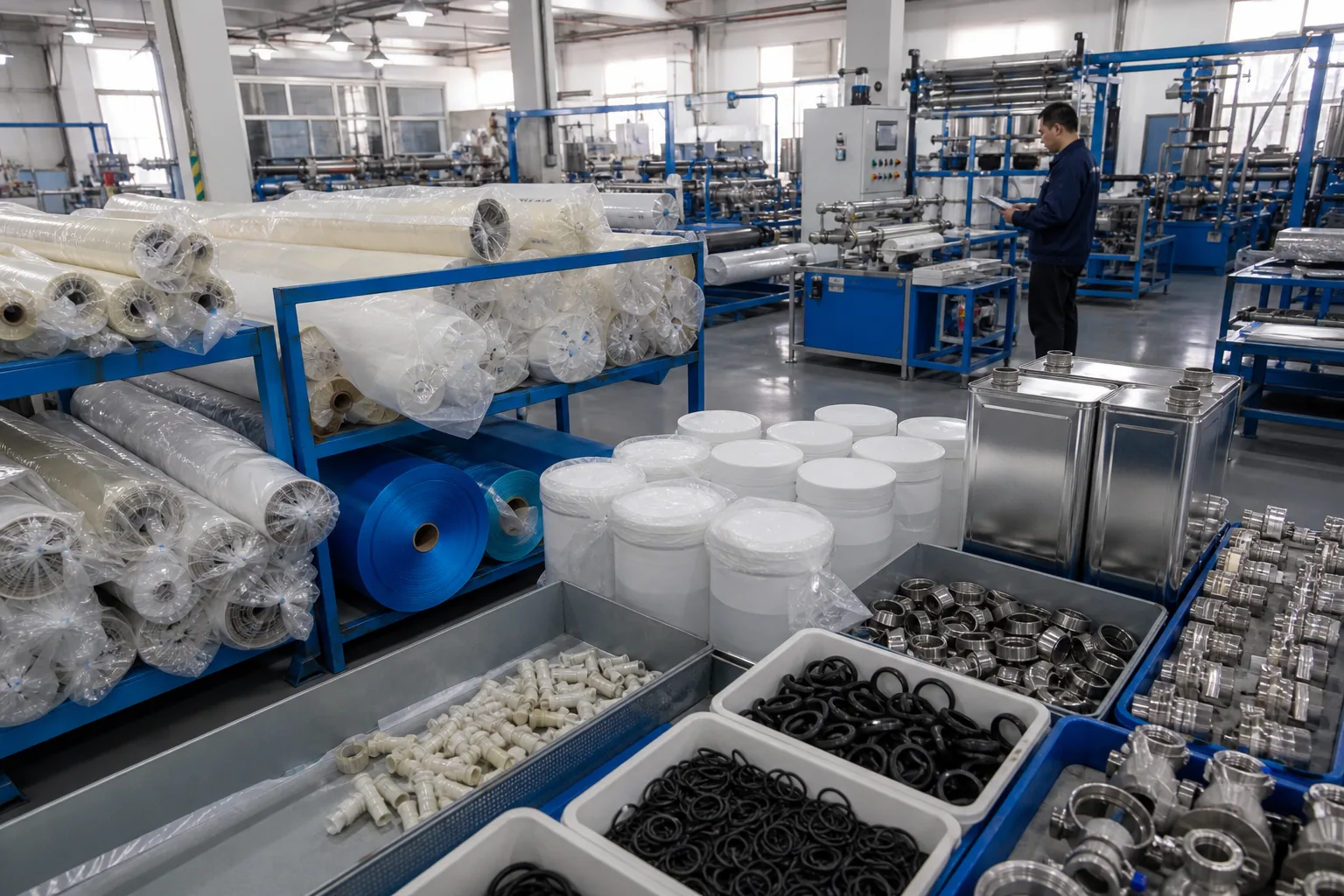 Inside the plant
Materials & Components
- Seawater-grade flat sheet
- Feed spacer & permeate carrier
- Compact 4040 central tubes
- Brine seals & end caps
- PU / epoxy glue & tape
- Fiberglass outer wrap
Production Equipment
- Compact 4040 rolling machine
- Cutting & folding
- Ultrasonic welding
- Trimming & FRP winding
- Vacuum leak testing
- Performance testing
Planning Questions for Marine RO Elements
What does WECOME supply for marine RO systems?
We supply the RO membrane materials, components and production equipment used to manufacture marine and offshore watermaker elements — seawater-grade flat sheet membrane, feed spacer, permeate carrier, compact 4040 central tubes, brine seals, end caps, glue, tape and fiberglass wrap, plus compact rolling, FRP winding and leak-testing machines. We do not sell finished watermakers or systems.
How is a marine element different from a large SWRO element?
The membrane grade is the same seawater class, but the format and build differ: compact 4040-class sizes, secure sealing for vibration and motion, and corrosion-resistant parts for salt-air exposure. This page focuses on those marine constraints; for large shore plants see the SWRO page.
Which element size suits a shipboard watermaker?
Compact 4040-class formats are the marine workhorse, fitting tight machinery spaces while holding seawater rejection. We supply the materials and rolling / testing equipment for them and help size to your platform.
How do you handle vibration and corrosion in the build?
Through stable rolling, secure gluing and seal fitting, and corrosion-resistant components and wrap. Adhesive and seal integrity is the decisive factor for elements that run under constant motion at sea.
Do you provide traceability and QC support?
Yes. We supply the rolling and leak-testing equipment and advise on incoming checks, rolling consistency, leak / performance testing and record-keeping so every marine element is traceable and dependable between service visits.
Building watermaker elements for marine or offshore use?
Send your platform, seawater duty and element size — we’ll recommend the seawater membrane, compact components and machines to build dependable marine RO elements, and send a quote.