

MATERIALS & COMPONENTS / SUPPLIER CHANGE VALIDATION
Your new RO membrane sheet meets the supplier’s specification. Does that mean you can load the roll, keep the old production settings and release the next batch? Not yet. A material qualification and a production-recipe qualification answer different questions.
Possibly, but only after a controlled comparison shows that the candidate sheet works with the existing construction, process and release requirements. First establish material performance on a comparable test basis. Then compare current and candidate sheets under the approved recipe. If adjustments are needed, validate the revised recipe separately and record the exact grade, lots and element formats covered.
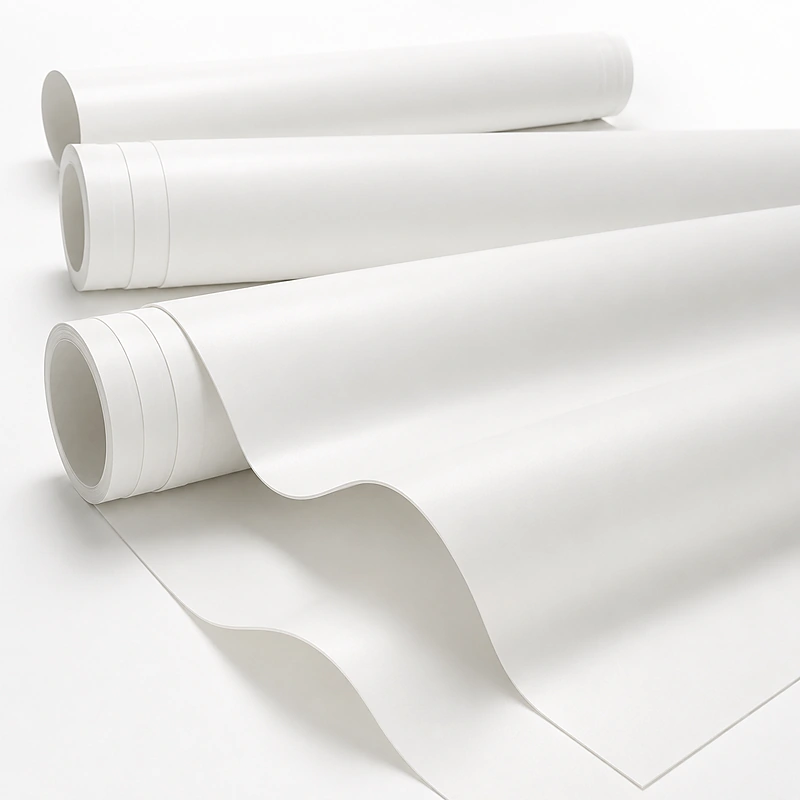
What exactly are you changing: the supplier, the grade or the construction?
Write a one-sentence change request before cutting samples: “Replace current sheet grade A with candidate grade B in element model X, using recipe revision Y.” Add the reason, such as a second source, supply continuity or a revised performance target. Without that boundary, a successful experiment can be mistaken for approval of every model made on the line.
Separate a nominally equivalent replacement from a redesign. If you also want a different leaf count, spacer, membrane area or operating duty, you are evaluating a changed construction, not simply qualifying another supplier. Keep those objectives visible so the purchasing comparison does not conceal engineering work.
This guide starts after you have shortlisted a candidate. For commercial screening and the documents to request before selecting one, see how to evaluate RO membrane sheet suppliers. Here, the question is whether that candidate can be released into your production.
What does “production recipe” include?
It includes more than winding speed. Record membrane orientation, cut and fold geometry, leaf count, spacer and permeate-carrier specifications, tube interface, adhesive system, dispensing pattern, assembly sequence, rolling settings, curing conditions and final test method. Identify which settings are fixed design requirements and which have an approved adjustment range.
Check the candidate’s handling, storage and preparation instructions before testing. An unchanged recipe is not a reason to disregard material-specific requirements. If the current procedure is outside the candidate’s permitted conditions, stop the direct substitution trial and obtain an approved revised procedure first.
What should your existing material prove before you test the replacement?
Keep an identified quantity of the currently approved material for the comparison. Record grade, lot, roll identification, storage history and age. Use representative, acceptable material rather than a damaged remnant. The reference tells you whether the test station and production process are behaving normally during the candidate trial.
A historical average is useful context, but it cannot show whether today’s fixture leaks, the adhesive batch changed or a sensor drifted. Where practical, run the reference near the candidate in time and under the same documented conditions. If the reference no longer meets its expected result, investigate that before blaming the new sheet.
| Baseline record | What to identify | Why it matters |
|---|---|---|
| Material identity | Current and candidate grade, lot, roll and sample position | Separates an individual sample from a supplier-wide claim |
| Construction | Element format, leaf geometry, area convention and component revisions | Avoids comparing two different element designs as if only the sheet changed |
| Process | Recipe revision, equipment, operator, adhesive lot, timing and ambient conditions | Makes deviations visible rather than relying on “same machine” |
| Measurement | Fixture, instruments, calibration status, preparation and acceptance method | Helps distinguish material variation from test variation |
| Decision limits | Product limits, trial goals and engineering approval owner | Prevents moving the pass criteria after seeing the result |
Why can two data sheets look equivalent but produce different trial results?
Performance values are meaningful only with their conditions. Pressure, temperature, feed composition and recovery affect RO results; a nominal rejection percentage is not a complete comparison. DuPont discusses these dependencies in its reverse osmosis technology reference. Do not rank candidate sheets by two headline numbers tested on different bases.
Separate supplier specification verification from your own side-by-side comparison. One test asks whether the supplied grade meets its stated acceptance method. Another asks how the current and candidate materials behave under a common, technically appropriate protocol. A difference between these results is not automatically a supplier nonconformance.
Which coupon-test conditions need to travel with the result?
At minimum, identify the active test area, feed composition and concentration, pH, temperature, pressure measurement locations, permeate-side conditions, flow arrangement, preparation and stabilization criteria, collection interval and calculation method. Record the relevant test-cell configuration and sample orientation. Do not infer active-side orientation from a generic photograph.
Aquaporin’s flat-sheet coupon test guide illustrates why station condition, sample preparation and measurement control matter. Its numerical protocol applies to its own defined testing context; it is not a universal recipe for every WECOME or third-party sheet.
WORKED EXAMPLE / NOT PRODUCT DATA
Are you comparing flow or flux?
Suppose a coupon produces 1.2 L in 30 minutes through an active test area of 0.040 m².
Flux = 1.2 ÷ (0.5 × 0.040) = 60 L/m²/h
The raw collection rate is 2.4 L/h. That is not 2.4 L/m²/h, and the exposed test area is not necessarily the total cut coupon area. Neither number predicts finished-element output without the element design and test conditions.
If conditions cannot be matched, use an applicable, validated correction method and report both raw and corrected results. Do not invent a temperature multiplier or apply a whole-plant normalization method to a coupon comparison without confirming its suitability.
How do you separate material compatibility from recipe adjustment?
Use a staged comparison with clearly named groups. The following is a suggested engineering trial structure, not a fixed sample-size standard. Your responsible engineer should define replicate counts, permitted adjustments and stop criteria for the application.
Current sheet
Approved recipe R0
Does the reference still meet the baseline?
Establish the controlCandidate sheet
Same recipe R0
Can the new sheet work without an unrecorded adjustment?
Test substitutionCandidate sheet
Revised recipe R1
If needed, does an approved change resolve the issue?
Qualify the revisionA0: Does the approved sheet still work with the approved recipe?
Build the reference group with current sheet A and recipe R0. Keep the other component identities and relevant process conditions recorded. Confirm that assembly observations and finished-element results are consistent with the approved baseline. A failing reference makes the comparison inconclusive until the cause is understood.
B0: Does the candidate work without changing that recipe?
After the candidate passes the agreed material screening and compatibility review, build sheet B with R0. Record deviations as they happen. Do not quietly increase tension, change adhesive timing or reduce the leaf count to obtain an acceptable element and still label the result an unchanged-recipe pass.
Inspect cutting and folding, leaf alignment, adhesive application, rolling behaviour, final geometry and the specified release tests. Passing coupon results do not demonstrate those manufacturing steps. Conversely, a failed finished element does not alone prove that the sheet’s separation layer was defective.
B1: If changes are needed, what exactly made the result acceptable?
Investigate the B0 result before adjusting settings. Create recipe R1 with explicit changes and engineering justification, then run a separate B1 group. Start with the most plausible variable or a planned experiment; changing several factors without a design makes it difficult to attribute an improvement.
If R1 changes a safety limit, adhesive manufacturer’s instruction or product design requirement, obtain the necessary approval before running it. An improved trial result is not permission to exceed those boundaries. If B1 passes, the conclusion is “candidate B is qualified with R1 for the tested scope,” not “B is a drop-in replacement.”
Which material-to-process interfaces deserve closer attention?
Can the new roll be cut and folded consistently?
Compare usable width, relevant thickness measurements, winding condition, marked splices and observed surface or edge defects against the agreed specification. Record where each sample came from across the web and along the roll. A selected coupon cannot represent every location without an appropriate sampling plan.
During conversion, record tracking, edge alignment, fold location and visible damage using the actual equipment. Use the supplier’s handling requirements. Do not introduce a new cleaning solvent or surface treatment simply to make the trial easier; that would create another material/process change requiring review.
Do the adhesive and membrane backing still work together?
Identify the adhesive grade, batch, component ratio, mixing method, application time and cure conditions. Compare the actual bonded construction rather than assuming that similar-looking backing materials will give identical results. Ask the responsible technical team to define suitable bond and integrity checks for the intended design.
Do not use a convenient hand-peel impression as the sole evidence of a durable, sealed membrane leaf. A coupon-performance pass and a bond-compatibility pass are separate records. If bonding changes are required, record them in R1 and reassess the resulting element rather than attributing every change to membrane performance.
Will the stack still roll to the intended geometry?
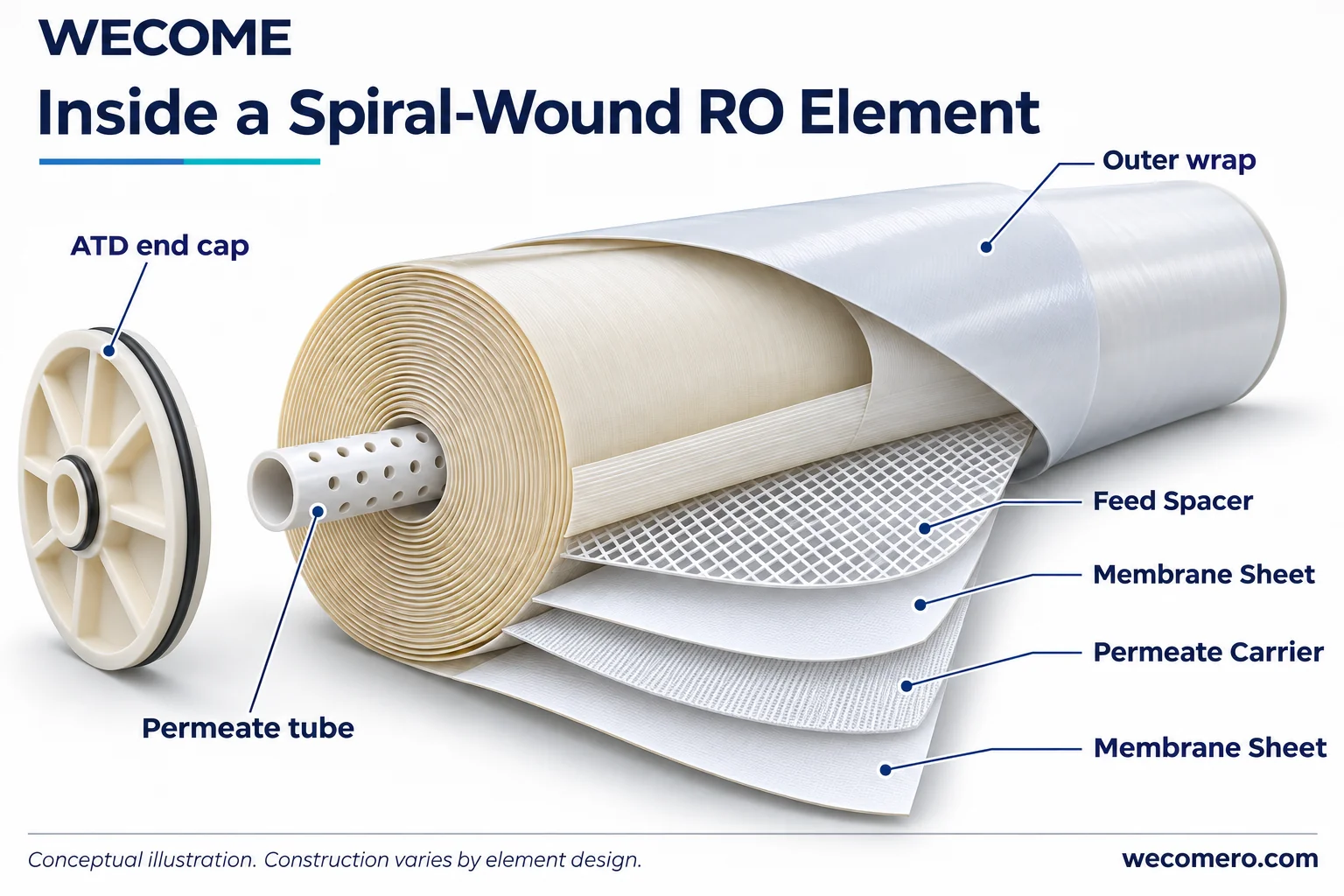
The sheet works with the feed spacer, permeate carrier, glue lines, tube and assembly process. A new material may require a review of that combination even if its nominal width matches. Check finished diameter, alignment and other drawing requirements at the defined process stage and measurement locations.
Do not compensate for a dimensional problem by increasing tension without an approved basis. That may change the assembly rather than establish compatibility. For the material interaction behind the permeate-side stack, see our permeate-carrier selection guide.
How should you read the results without choosing a misleading winner?
Review individual results and their spread, not only the mean. Show sample count, excluded observations and the reason for each exclusion. A high average can conceal units below the product limit. Do not remove a failed result merely because the remaining figures look more consistent.
Distinguish instrument resolution and repeatability from meaningful differences. If the apparent improvement is within the uncertainty of the method, label it inconclusive rather than announcing a better membrane. Repeat or improve the measurement according to the agreed plan.
Why can a small rejection change deserve attention?
For a consistently defined concentration basis, rejection is R = (1 − Cp/Cf) × 100%, where Cp and Cf are permeate and feed concentrations. Salt passage on that same basis is 100% − R. In an illustrative comparison, 99.5% and 99.2% rejection correspond to 0.5% and 0.8% salt passage: a 0.3-percentage-point rejection difference, but 60% higher passage relative to 0.5%.
This arithmetic is not a product comparison or a failure limit. It explains why the acceptance specification should state what is being measured. If conductivity is used as a proxy, document the method and its applicability; do not silently mix a conductivity ratio with concentration-based data under a different water composition.
What does each result pattern actually tell you?
| Observed pattern | What you can conclude | Next decision |
|---|---|---|
| A0 fails and B0 fails | The comparison has not established a reliable baseline | Investigate common test or process causes; do not rank the suppliers yet |
| Candidate coupons pass; B0 elements fail | Material screening did not establish conversion and element compatibility | Review construction, process, bonding and test evidence |
| A0 and B0 pass | Unchanged-recipe use is supported within the tested scope | Complete lot/scale confirmation and controlled release |
| B0 fails; B1 passes | The candidate may be usable with the documented revised recipe | Qualify R1 and its implementation; do not claim drop-in equivalence |
| One candidate lot passes; another does not | Repeatability across the sampled supply is not established | Hold affected lots and review variation with the supplier |
These patterns direct investigation; they do not diagnose a root cause by themselves. Maintain links between coupon IDs, production records and finished-element IDs so that an abnormal result can be traced back to the roll and process history.
When is a successful trial ready for production release?
Define the release scope explicitly: candidate grade, supplier, approved specification, recipe revision, element models and applicable test conditions. Include any unresolved restrictions. Approval for one household element does not automatically qualify an industrial element, a new duty or an untested cleaning regime.
Confirm repeatability on the sampling and lot plan appropriate to the risk. One demonstration roll does not establish long-term lot consistency. Also distinguish short-term release testing from evidence of service durability; do not turn a brief trial into a lifetime or fouling-resistance claim.
What should be ready before the first production batch?
- Controlled documents: approved material specification, bill of materials, recipe and test instructions with matching revisions.
- Traceability: a way to connect supplier lot and roll to production batch and finished elements.
- Segregation: clear identification of trial, approved and held stock so they cannot be mixed unintentionally.
- People and equipment: trained operators, confirmed settings and required inspection resources.
- Containment: a plan to hold affected output and return to an approved source or recipe when the agreed trigger occurs.
- Change notification: an agreement covering relevant future material, specification or supply changes.
Use a monitored introduction rather than discarding the reference material immediately. Review the initial batches against the agreed acceptance plan and document any deviations. The size and duration of that monitored stage should be determined by your engineering and quality team, not a universal number in a Blog article.
What information makes a material trial enquiry useful?
Send the current and candidate grade details, intended element formats, application, relevant drawings and target performance with test conditions. Add the trial objective: unchanged-recipe replacement or a separately approved redesign. Describe any current conversion problem and provide records rather than only the final rejection percentage.
For candidate supply, review WECOME RO membrane sheet options. If your application is specifically LP or ULP, use the low-pressure membrane-sheet selection page to frame the grade discussion. Neither page replaces qualification on your own construction.
Minimum trial-record fields
Trial ID; objective; sheet grade/lot/roll; sample location; group A0/B0/B1; recipe revision; component lots; preparation and process deviations; coupon method and raw readings; element ID and release-test results; acceptance decision; reviewer; next action.
Use these fields to prepare a shared trial log before testing. Enter actual methods and limits approved for your product; a record template does not prescribe them.
Questions manufacturers ask before switching membrane sheets
Does a higher coupon flux mean a higher-output finished element?
Not necessarily. Coupon flux is measured on a defined exposed area and test configuration. Finished-element output also depends on its construction and operating/test conditions. Verify the completed element instead of multiplying a headline coupon value into a sales claim.
Can I mix the new and old sheets during qualification?
A mixed construction introduces another variable. Keep the comparison groups identifiable. If mixed use is an intended production design, define and qualify it as a separate construction rather than treating it as evidence for either single-sheet design.
How many samples or lots are enough?
There is no universal count that establishes every application’s suitability. Set the plan from product risk, expected variability, test capability and customer requirements. Record the scope supported by the evidence and the limitations that remain.
Should I reject the supplier if the old recipe does not work?
Not automatically. First determine whether the material meets its agreed specification and whether a justified process revision can meet your requirements. Then compare the engineering effort and operational consequences. A qualified alternate recipe may be useful, but it is not the same as an interchangeable material.
Planning a membrane-sheet change?
Share your element format, current construction and trial objective. Ask for grade information and a sample discussion before committing the new material to production.
Discuss a Membrane Sheet TrialEvidence and scope: linked manufacturer references support the test-condition discussion. The A0/B0/B1 trial structure, decision table and release checklist are proposed change-control tools, not a published test standard or WECOME customer results. All numerical examples are illustrative. Actual acceptance limits must come from your approved product specification and applicable supplier instructions.

Bessie has 10+ years of experience in RO membrane materials and water treatment supply chains. At WECOME, she helps manufacturers and system integrators worldwide source the right membrane components — from feed spacers and permeate carriers to NSF-certified adhesives — backed by hands-on technical support.