

MATERIALS & COMPONENTS / BUYER CHECKLIST
A replacement seal can look right, carry the same nominal membrane size and still be the wrong part. Before ordering, connect the seal drawing to the actual element, housing and service conditions. Then approve a sample on that assembly, not just on a supplier’s photograph.
Confirm the sealing interface, drawing-defined dimensions and tolerances, mating groove and housing bore, specified elastomer, and an agreed assembly and functional trial. A “4040” or “8040” label identifies an element family; it does not establish seal interchangeability. Keep the approved drawing revision and sample result with the purchase order.
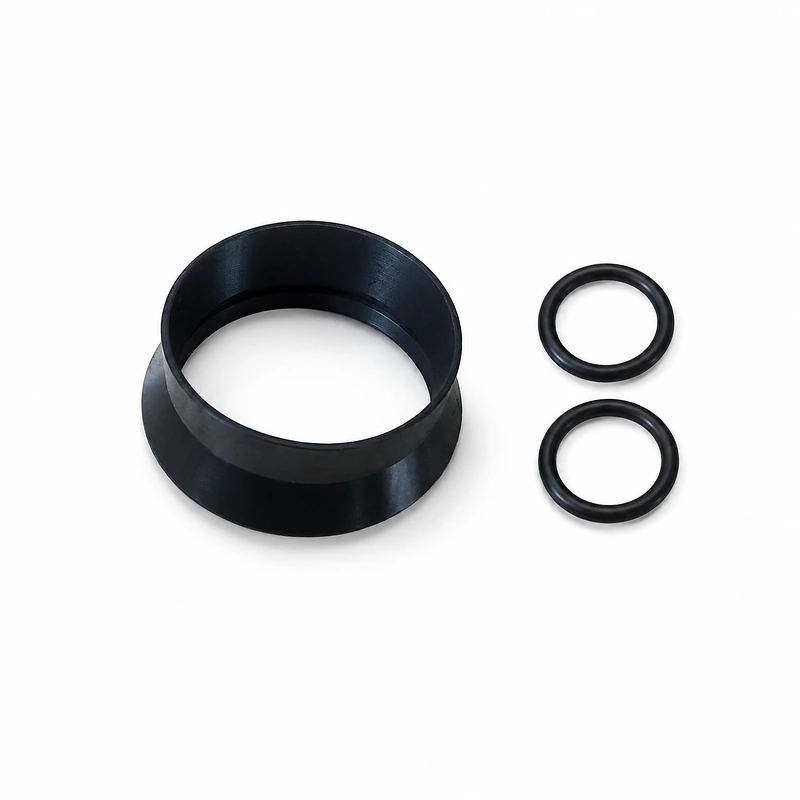
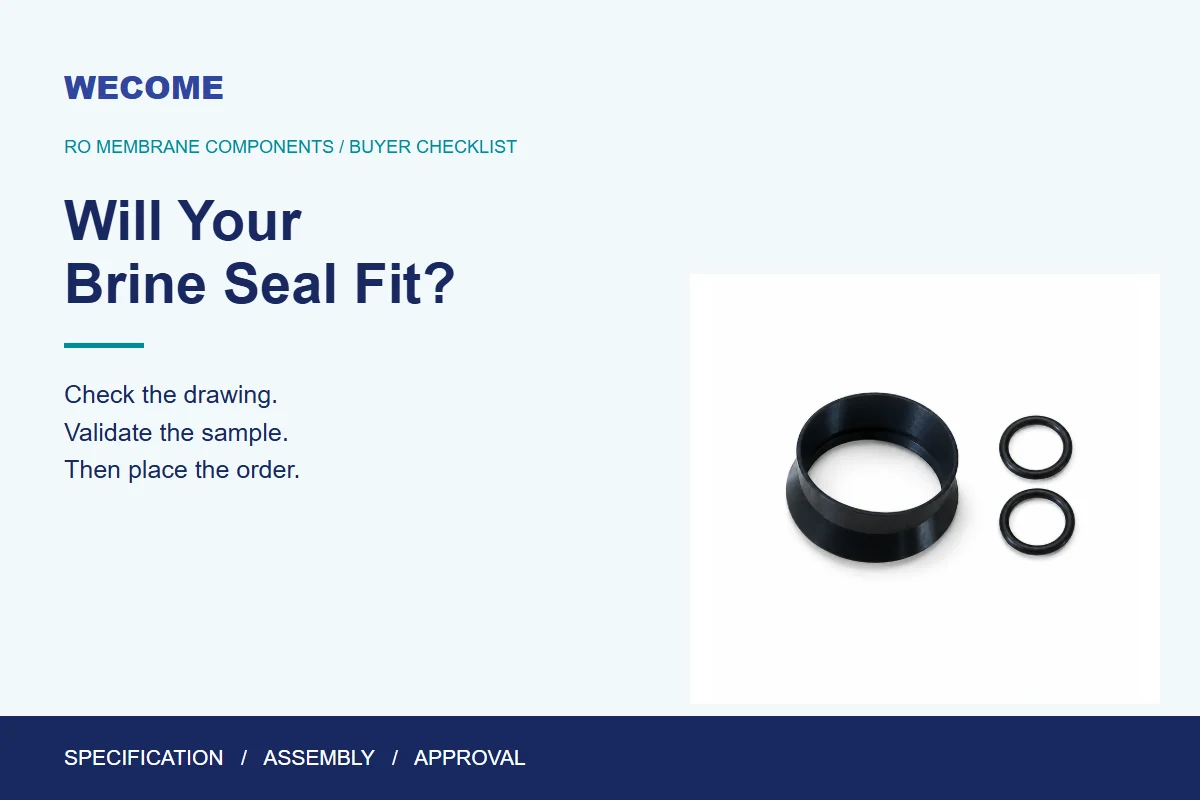
Are you ordering a brine seal or a connector O-ring?
Start the enquiry with a marked-up photograph showing where the part sits. An external brine seal controls feedwater bypass around the membrane element. An O-ring at a permeate connector or adapter seals a different interface. Asking only for an “RO membrane seal ring” leaves room for the wrong quotation.
If your concern is product-water leakage at a connector, selecting an external brine seal will not address that joint. If your concern is external feed bypass, an O-ring catalogue entry is not a substitute for the correct brine-seal profile. For the underlying function, use our existing guide to why RO elements need a brine seal.
What does WECOME’s current product schedule actually cover?
The WECOME brine-seal product page lists compact silicone V-rings and separate EPDM O-rings. Those listed compact V-rings must not be presented as ready-made 4040 or 8040 industrial seals. For an industrial enquiry, submit the exact element and housing drawings for a separate compatibility review.
This article is an ordering and sample-approval checklist, not a second catalogue. Current model dimensions and packaging remain in the brine-seal dimensions reference.
Which dimensions should you confirm before requesting a quote?
Do not send three measurements without identifying their meaning. A size string can be copied correctly while its interpretation is wrong. Ask for a section drawing with dimension arrows, units, tolerances and revision identification. Distinguish the relaxed, uninstalled part from its fitted shape: a flexible lip is not a rigid cylinder.
| Check | Evidence to provide | Question it resolves |
|---|---|---|
| Part identity | Element and vessel manufacturer/model; seal location; existing part number | Are both parties discussing the same interface? |
| Seal geometry | Dimensioned profile with drawing-defined diameters, axial width and lip features | What does each catalogue dimension mean? |
| Mating features | Relevant groove, seating surface and housing-bore drawing | What supports the seal and what surface does it contact? |
| Tolerances | Permitted variation for seal and mating parts; agreed inspection method | Will fit remain acceptable beyond one sample? |
| Assembly conditions | Approved orientation, loading method and lubricant specification, where applicable | Can it be assembled without damage under the intended procedure? |
| Service conditions | Water chemistry, temperature, pressure and cleaning exposure | Is the proposed compound suitable for this application? |
Can you simply measure the old seal?
An old seal is useful evidence, but it is not automatically a manufacturing master. Service exposure, deformation and damage may have changed its dimensions. Identify whether the sample is unused, used, swollen, cut or permanently distorted. Keep photographs of its original location and any markings.
When no drawing exists, ask the supplier to propose a drawing from the available evidence and have the assembly owner review it. Do not turn an unverified caliper reading into a production tolerance. Agree how flexible features will be measured, including part condition and contact method, so your inspection and the supplier’s inspection are comparable.
Does “fits 8040” settle the compatibility question?
No. Ask which exact element and vessel combinations were evaluated and what evidence supports the claim. A familiar size designation is a search starting point, not approval of the groove, sealing lip or bore relationship. Treat a change of end-cap design or housing series as a reason to review compatibility again.
Is the material name enough to approve a substitute?
No. “Silicone,” “EPDM” and a matching colour do not identify every property of a finished seal. Request the specified compound designation and hardness requirement where applicable, together with the supplier’s relevant documentation. Do not substitute an elastomer merely because the replacement is black and feels similar.
Send the actual cleaning conditions, including chemical identity, concentration, temperature and exposure duration. “Suitable for water” is not a complete answer for a part that also encounters cleaning agents. If potable-water or other application approval is required, request documentation covering the supplied part or compound and its relevant scope; do not infer certification from the polymer family.
For repeat purchases, agree whether material, tooling or process changes require notification and renewed approval. This makes the accepted sample useful as a controlled reference rather than a one-time demonstration with no connection to future supply.
How should you approve samples before a bulk order?
Separate three questions: does the part match the specification, can it be assembled as intended, and does the assembled interface meet the agreed functional requirement? A successful visual check answers only part of the first question.
1. Record what arrived, before installing anything
Assign sample identifiers and record the supplier, part number, lot identification where available, quantity and drawing revision. Photograph the packaging and uninstalled parts. Keep a record of agreed dimensions, material documentation and visible condition. Note cuts, flash at critical surfaces, contamination or distortion rather than writing only “looks good.”
Agree the sampling plan before testing. The appropriate sample quantity depends on the purchase risk, assembly variation and qualification requirements; there is no universal number that proves every batch acceptable. Retain an identified reference sample where your quality procedure permits.
2. Use the intended mating components
A loose seal displayed beside a membrane is not a fit trial. Record the actual element, end-cap or seating feature, and housing used. When more than one assembly variant will be supplied, list which combinations were tested and which remain unapproved. Passing one combination should not silently approve the entire product family.
Qualified personnel should follow the applicable assembly instructions. Record seating, orientation, loading behaviour and any observed lip rollover, pinching or damage. Stop and investigate abnormal resistance rather than forcing the assembly or changing lubrication without approval.
3. Agree the functional test and pass criteria first
Ask the assembly designer or responsible engineer to define a suitable test for the interface and application. Record the method, conditions, acceptance criteria and actual result. Do not replace that decision with a generic pressure value from an unrelated membrane system.
A completed element performance test may be part of the agreed validation, but a performance change alone does not isolate the brine seal as the cause. If salt rejection is abnormal, investigate the relevant product-water seals, element integrity, operating conditions and measurements as well. Our salt-rejection test failure guide addresses that broader diagnostic task.
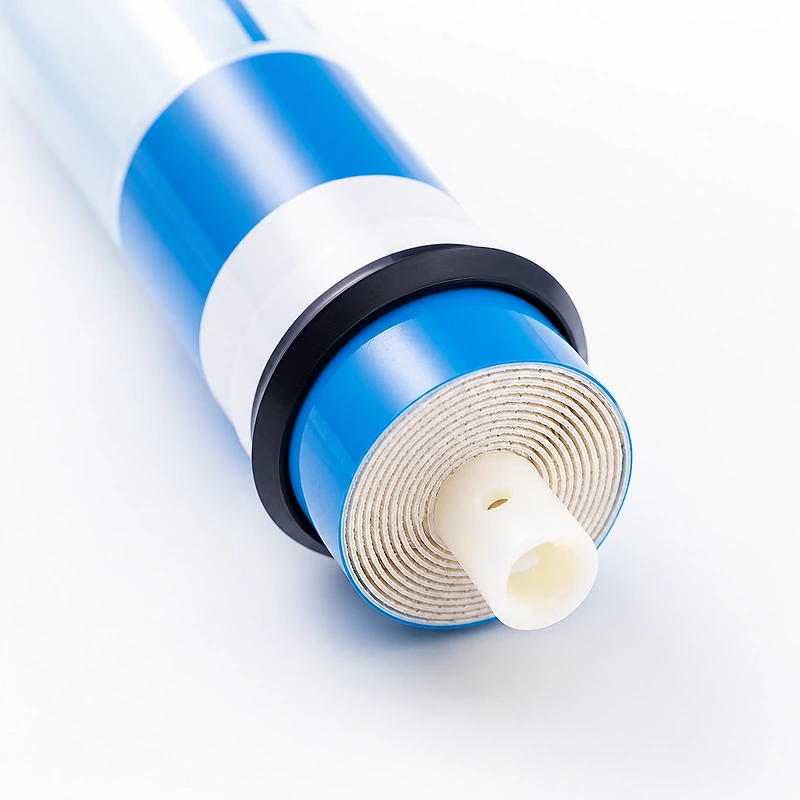
Should the sealing lip face the incoming water?
For the FilmTec U-cup arrangement described in DuPont’s loading instructions, the seal opens upstream and must sit correctly in the end-cap groove. That is a useful design-specific reference, not permission to assume every seal has the same profile or installation method. See DuPont’s pressure-vessel loading manual excerpt.
For purchasing, request an orientation drawing that matches the supplied part and identifies feed direction. Include it in the sample-approval file. When the proposed seal differs from the original profile, obtain engineering approval rather than relying on a generic arrow in a sales image.
When should you pause the order instead of accepting the sample?
| What you find | Next action | Evidence needed to proceed |
|---|---|---|
| Quote says only “4040 seal” or “8040 seal” | Request an exact part and interface definition | Matched model, drawing and revision |
| Only a used, distorted sample is available | Keep the dimensional conclusion provisional | Reviewed drawing and trial on the intended assembly |
| Material is described only by colour | Request the specified compound documentation | Material identification and application review |
| Seal seats but is damaged during approved loading | Hold approval; review the assembly and part together | Documented cause, correction and repeat trial |
| Sample passes but the bulk specification differs | Resolve the difference before order release | Purchase order aligned with the approved sample specification |
| A result is recorded as “OK” without test conditions | Complete the validation record | Identifiable method, conditions, criteria and result |
A hold is not necessarily a rejection of the supplier. It means a specific question remains unanswered. Stating that question precisely helps both parties resolve it without repeatedly sending samples that cannot be compared.
What should you send with a brine-seal enquiry?
Use the following brief to reduce back-and-forth. Mark unknown information as “to confirm”; a visible gap is more useful than a guessed value. Attach drawings through the agreed sales communication channel and identify their revision.
Copy-ready procurement brief
- Part required: external brine seal or connector/adapter O-ring; marked location photo.
- Assembly: exact element and housing models; existing seal part number if known.
- Drawing: number, revision, units, profile, critical dimensions and tolerances.
- Mating features: groove or seating detail and relevant housing/connector dimensions.
- Material: specified compound and hardness where defined; required documentation.
- Exposure: water chemistry, operating conditions and cleaning chemicals with conditions.
- Samples: requested quantity, assembly combinations and proposed approval method.
- Supply: initial order, expected repeat quantity, destination and delivery requirement.
- Release: acceptance criteria, lot identification and change-notification requirements.
What should remain in the file after approval?
Keep the accepted drawing, relevant material documents, sample identifiers, assembly details and test result together. Record who approved the application and which combinations were covered. Link the purchase order to that specification so purchasing, incoming inspection and production are working from the same revision.
At repeat delivery, check conformity against the agreed order and inspection plan. Do not assume a previous sample approval eliminates incoming checks. A change in part number, material designation, drawing revision or packaging identification should trigger a review of the agreed change-control requirements.
Questions buyers ask before ordering
Can I approve a seal from photographs alone?
No. Photographs help identify the part and visible defects, but cannot establish dimensional tolerances, compound identity or assembly performance. Use them alongside the drawing and sample record.
Can one approved sample cover all our membrane models?
Only if the responsible engineering review explicitly establishes that scope. Record the actual combinations covered; do not automatically extend approval to other grooves, housings or element series.
Should I request the cheapest seal first and validate later?
Compare quotations against the same specification and approval requirements. An inexpensive sample with an undefined material or profile may not represent a usable production offer. Clarify those gaps before comparing unit price.
Can WECOME confirm fit from a nominal membrane size?
A nominal size helps route the enquiry, but an exact match needs the sealing location and drawing or suitable sample evidence. The published compact V-ring schedule does not by itself confirm industrial 4040/8040 compatibility.
Have a seal drawing or an existing sample?
Send the part location, element and housing details, drawing revision and order quantity. Start with a specification review before committing to bulk supply.
Discuss Your Seal RequirementTechnical basis: WECOME’s linked product schedule and dimensions reference define its published range. DuPont’s linked manual provides the cited FilmTec orientation example. The sample records and purchasing checklists here are suggested buyer controls, not a certification standard or a universal installation procedure.

Bessie has 10+ years of experience in RO membrane materials and water treatment supply chains. At WECOME, she helps manufacturers and system integrators worldwide source the right membrane components — from feed spacers and permeate carriers to NSF-certified adhesives — backed by hands-on technical support.