
RO Membrane Materials for Biopharmaceutical Process Water
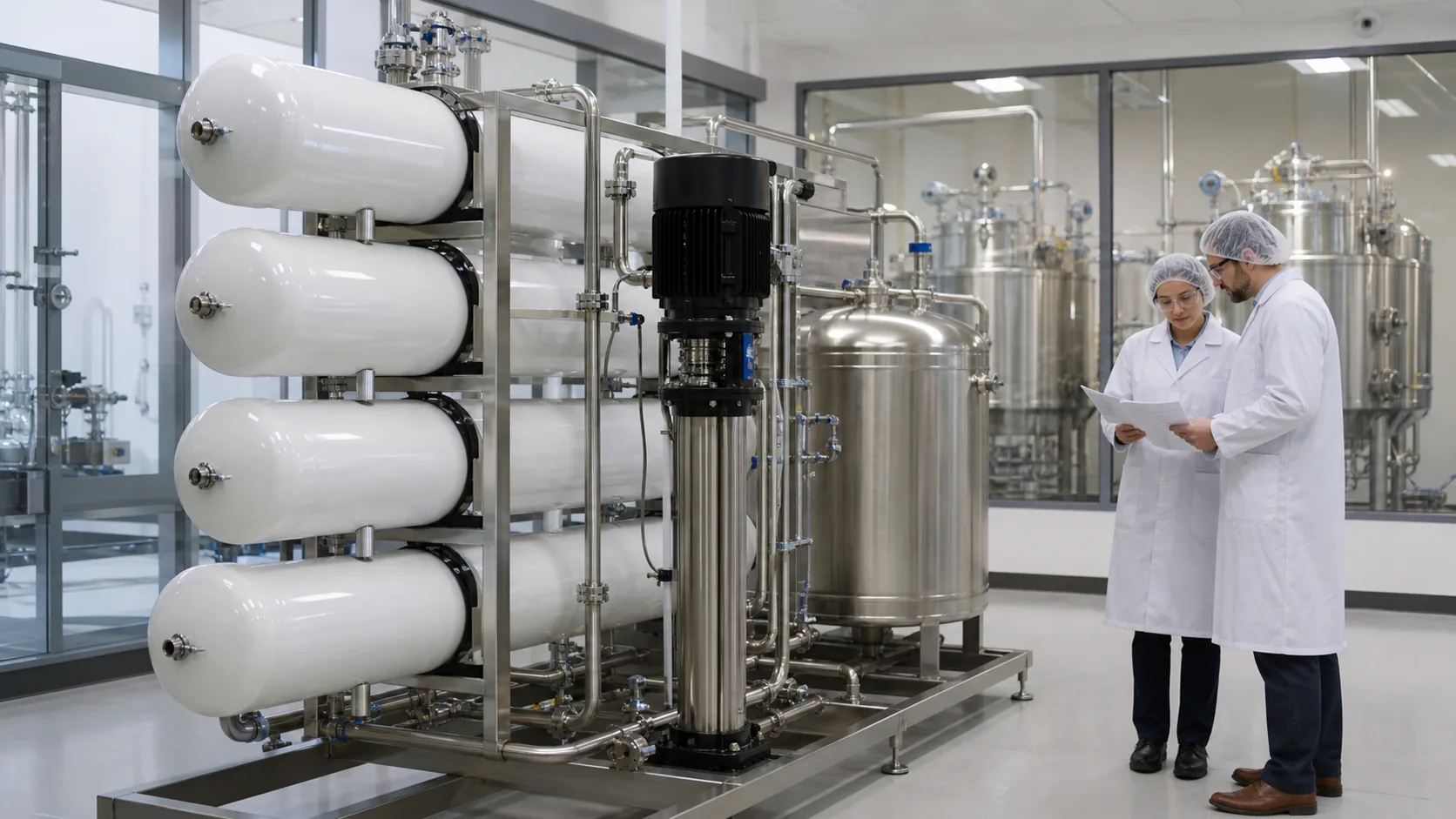
Biopharmaceutical process water reverse osmosis supports life-science facilities where water quality, contamination control and supply consistency all carry process risk. WECOME provides RO membrane materials, documented components and precision production equipment for element manufacturers serving biotech water programs.
Water Risk Is Connected to the Process It Supports
Life-science process water may support buffer and media preparation, equipment rinsing, utility generation or other site-defined activities. The required quality is therefore set by the use point and process-risk assessment, not by a generic ?biotech? label. RO is one barrier within that controlled water train.
Use-point context
Water requirements change with direct, indirect and utility-supporting process uses.
Contamination control
Pretreatment, operation, sanitization and distribution shape the complete risk strategy.
Material consistency
Stable inputs help reduce unexplained differences between element production batches.
Documented change
Material substitutions and specification revisions should be communicated, not hidden.

Define RO From the Feed to the Process Boundary
An RO stage may sit after carbon, softening or membrane pretreatment and before a second pass, EDI, UV, ultrafiltration, storage or distribution. The exact sequence belongs to the facility design. Element selection should begin with feed quality, operating conditions, cleaning exposure and the quality needed at the next stage.
- Map the process useIdentify where the water goes and what risk controls the facility applies there.
- Define the incoming challengeReview oxidants, hardness, organics, particles, temperature and variability.
- Place the RO boundaryConfirm pretreatment upstream and polishing, storage or distribution downstream.
- Approve materials and partsReview sheet, spacer, carrier, adhesive, seals and component specifications.
- Connect recordsLink material identification, production parameters and final element tests.
Biotech Buyers Evaluate Process Risk, Not Only Nominal Rejection
This page deliberately extends beyond the broader pharmaceutical purified-water topic. It focuses on how element manufacturers support biologics and life-science customers through consistency and evidence.
Use-Specific Water Quality
Translate the intended bioprocess use into a defined RO duty and acceptance criteria.
Contamination-Control Context
Keep membrane selection aligned with pretreatment, cleaning and the downstream water strategy.
Supplier Evidence
Review material data, identification, consistency and agreed change communication.
Six Inputs That Need a Controlled Specification
A reliable OEM program identifies what each material is, why it was selected and how production verifies it. Unsupported ?sanitary? labels are not a substitute for that review.
Membrane Sheet
Match the RO membrane sheet to rejection, flow, operating pressure and cleaning exposure.
Feed Spacer
Control feed spacer geometry because it defines the channel, pressure drop and cleanability.
Permeate Carrier
Verify the permeate carrier for leaf support, dimensions and product-water transport.
Adhesive System
Review PU adhesive identity, application, cure controls and operating compatibility.
Seals & Components
Confirm material, dimensions and batch identification for brine seals, end caps and connectors.
Control the Build Before You Rely on the Test Result
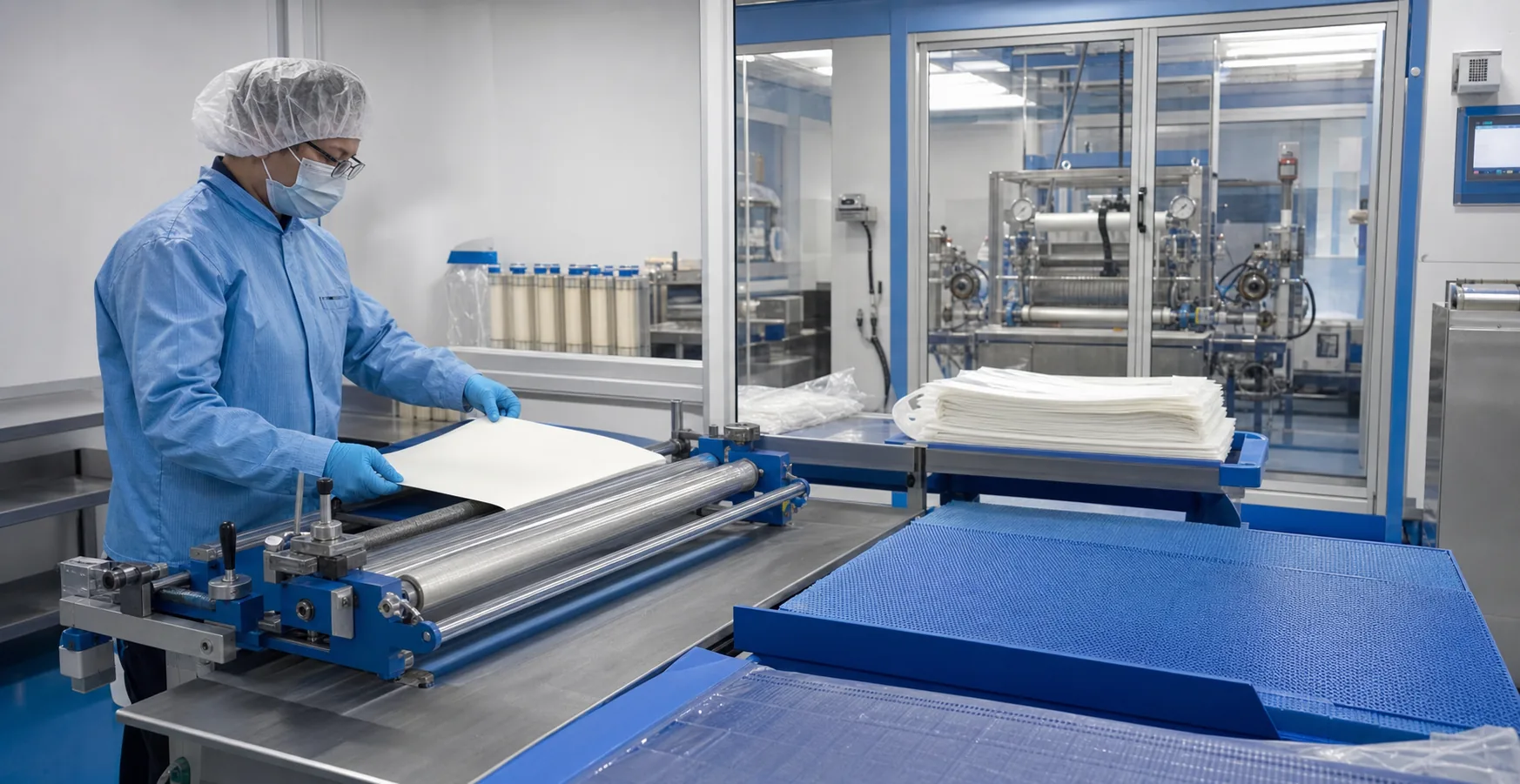
Final testing matters, but it cannot replace disciplined handling and production. Clean preparation, stable equipment settings and segregated batches reduce variation before the element reaches QC.
- Released materials only — keep incoming status and batch identity visible through production.
- Protected leaf preparation — reduce contamination and damage during cutting and assembly.
- Repeatable rolling and curing — control alignment, tension, adhesive delivery and cure conditions.
- Recorded verification — connect visual, dimensional, leak and performance checks to the batch.

Agree the Evidence Package Before Production Starts
Documentation expectations vary by customer. A workable supply program defines the material data, batch identifiers, inspection records and change notifications that WECOME can provide, then defines the production records owned by the element manufacturer.
- Approved specification — lock material versions, dimensions and acceptance criteria.
- Batch linkage — connect received materials to the element production order.
- Supplier change review — communicate relevant substitutions and revisions through the agreed process.
- Customer-ready records — organize evidence so an OEM can support its own qualification package.
Separate Element Evidence From Facility Validation
| Control area | Element-manufacturer evidence | Facility responsibility | Claim boundary |
|---|---|---|---|
| Material inputs | Specifications, identification and incoming status | Approve suitability for the intended process | Documents support review; they do not prove system validation |
| Element production | Assembly parameters, dimensions and leak integrity | Qualify the supplier and element in the water train | Clean handling is not an unsupported sanitary certification |
| RO operation | Defined element performance criteria | Set pretreatment, recovery, cleaning and monitoring | Performance depends on the complete operating system |
| Process use | Supply agreed technical records | Own contamination control and process-risk decisions | RO permeate is not automatically suitable for every bioprocess use |
Controlled Materials and Precision Element Equipment
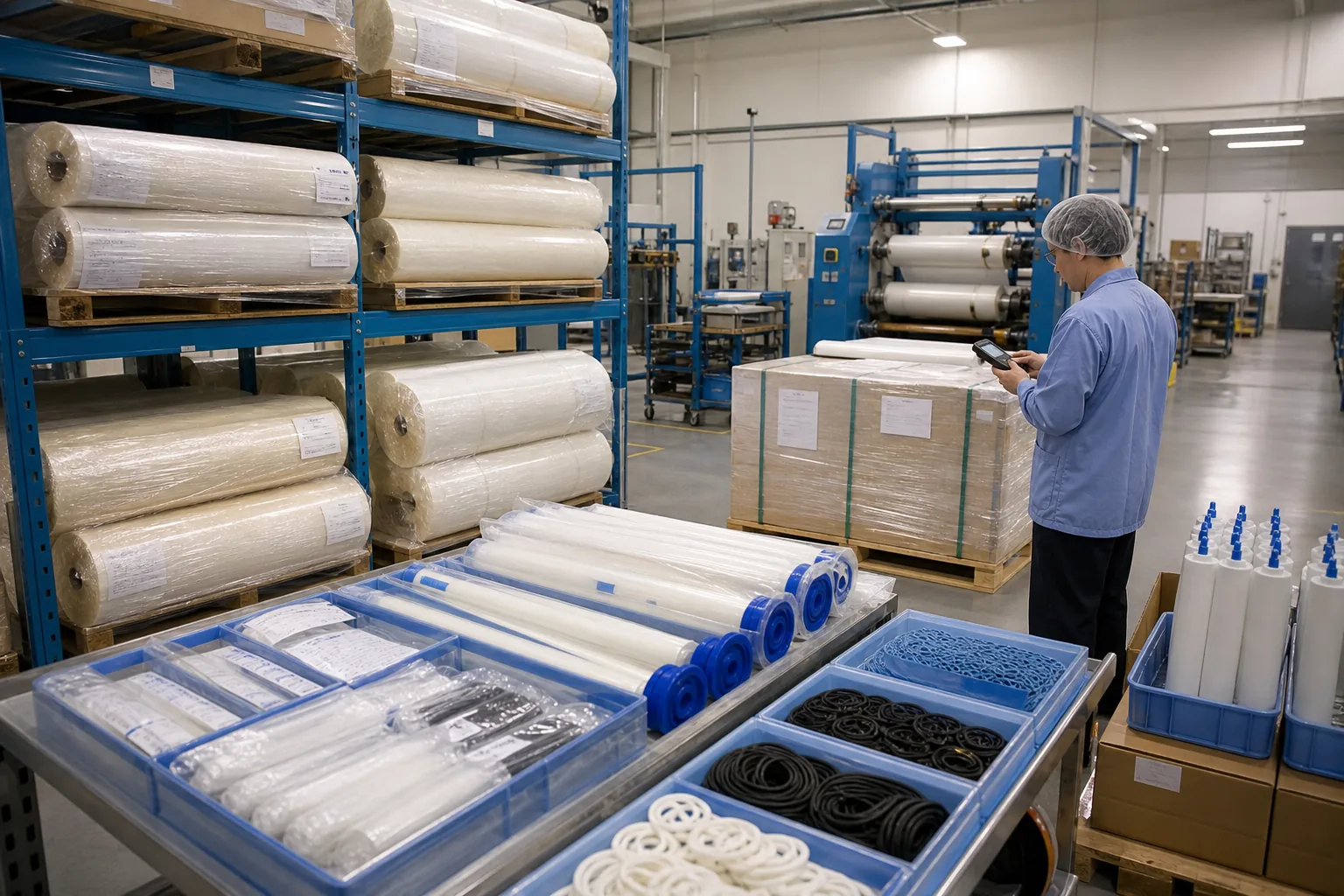
Build a stable life-science element program around compatible materials, defined production steps and practical quality records.
 Inside the plant
Materials & Components
- High-rejection membrane sheet
- Feed spacer & carrier
- Central tubes
- Brine seals & connectors
- PU / epoxy adhesive
- Wrap and tape materials
Precision Equipment
- Sheet and spacer cutting
- Carrier welding
- Controlled rolling
- Trimming equipment
- Outer wrapping
- Vacuum leak testing
Biopharmaceutical Process-Water RO Questions
How is RO used in biopharmaceutical process-water systems?
RO can serve as a central separation barrier before polishing, storage or distribution. Its exact position and the required water quality depend on the intended process use and the facility water-system design.
How does this differ from general pharmaceutical purified water?
This application focuses on biologics and life-science process risk: use-point context, contamination-control interfaces, supplier consistency, material traceability and change management. The broader purified-water page focuses more directly on single- and double-pass RO train architecture.
Can an RO element be described as validated or sanitary?
Only when exact evidence supports the specific claim. WECOME avoids unsupported labels. Material and production records can support an OEM or facility qualification process, but they do not replace system validation.
What should an OEM documentation package include?
Requirements should be agreed before production and may include material specifications, batch identification, incoming inspection expectations, production records, final QC criteria and change communication.
Does WECOME design complete biopharmaceutical water systems?
No. WECOME supplies RO membrane materials, components and element-production equipment. Process-water system design, validation and contamination control remain with qualified engineering and facility teams.
Planning an RO element for life-science process water?
Send the intended water use, feed analysis, treatment-train position, operating and cleaning conditions, element size, documentation requirements and production volume. We will help define a controlled material and equipment package.