

RO Membrane Materials for Pharmaceutical Purified Water
Pharmaceutical purified water reverse osmosis depends on more than salt rejection. Element manufacturers also need controlled materials, clean assembly, consistent construction and documentation that can support a validated water-treatment train. WECOME supplies the membrane materials, components and production equipment behind that repeatability.
RO Is a Core Stage, Not the Entire Validation Strategy
A pharmaceutical purified-water train may combine pretreatment, one or two RO passes, polishing, sanitization, storage and distribution. The exact arrangement is defined by feed quality, the required water specification and the site validation plan. An RO element contributes separation performance, but it does not make the complete system compliant by itself.
Feed preparation
Protect membranes from oxidants, hardness, particles and other incompatible feed conditions.
RO separation
Reduce dissolved ions and organic load within a defined single- or double-pass train.
Polishing boundary
EDI, UV, ultrafiltration or other stages may follow RO according to the system design.
Validated operation
Monitoring, sanitization, storage and distribution complete the site water strategy.
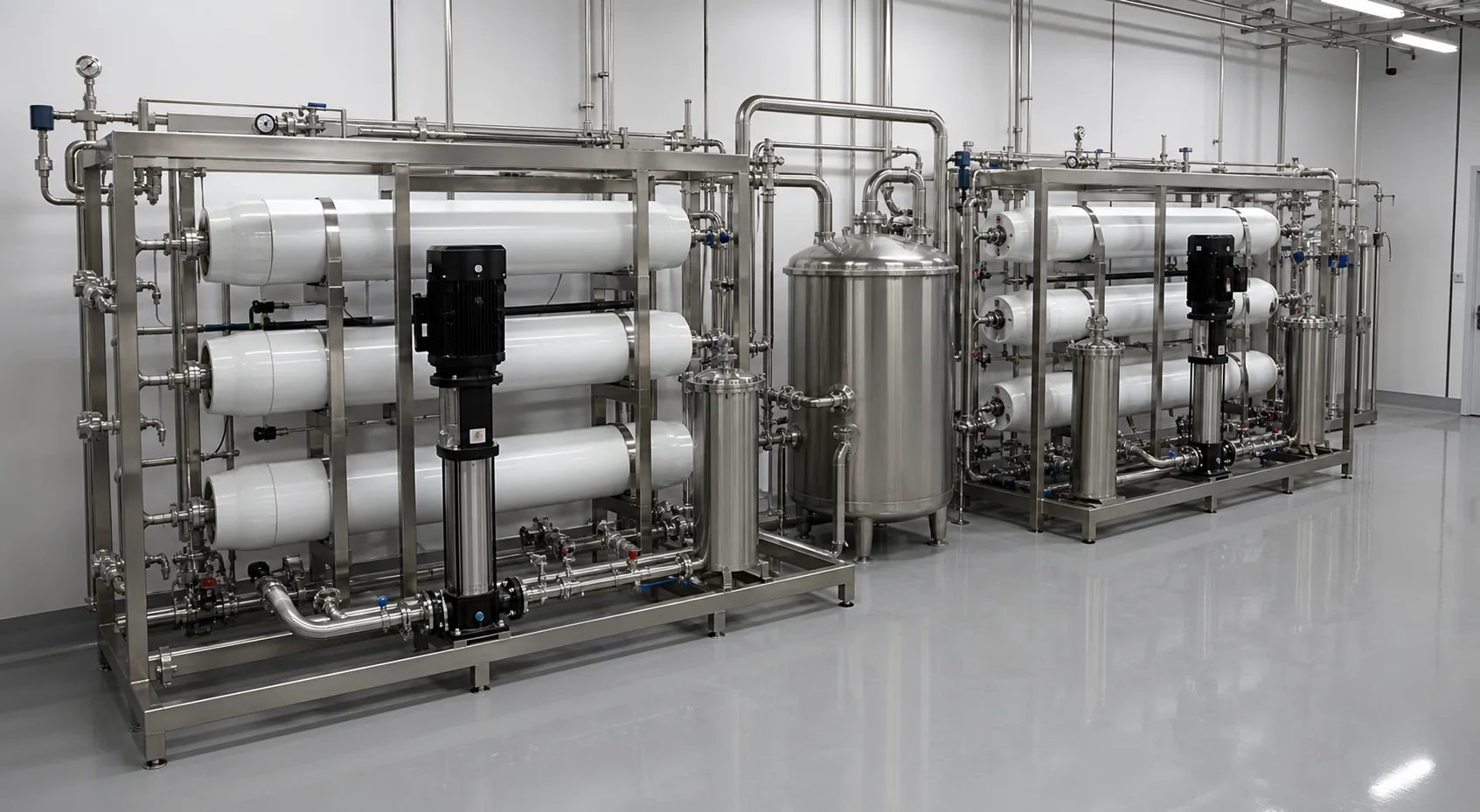
Single-Pass and Double-Pass RO Serve Different Targets
A single-pass system may be suitable where feed quality and downstream polishing support the required result. Double-pass RO adds a second membrane barrier and can reduce the ionic load reaching later stages. In both cases, element materials must be specified within the complete pharmaceutical water treatment design.
- Define feed and pretreatmentDocument oxidants, hardness, conductivity, organics, temperature and microbial control.
- Set the RO arrangementConfirm whether the system uses one pass, two passes or RO followed by polishing.
- Review compatibilityCheck membrane, adhesive, seals and components against operating and cleaning conditions.
- Set element acceptance criteriaAgree dimensions, flow, rejection, leak integrity and documentation requirements.
- Maintain traceabilityConnect incoming material batches, production records and final QC results.
Performance, Cleanliness and Evidence Must Travel Together
Pharmaceutical buyers evaluate more than a nominal membrane rating. They need confidence that materials, assembly and test records can support their own qualification and change-control process.
Defined Separation Duty
Match membrane performance to the feed, pass arrangement and downstream polishing load.
Controlled Material Inputs
Use consistent sheet, components, adhesive and seals with practical batch identification.
Repeatable Documentation
Keep incoming checks, production records and final test criteria aligned to the specification.
Six Inputs to Review Before Approving an Element Build
The useful question is not whether one component is ?pharmaceutical grade.? It is whether every selected material is documented, compatible with the intended operating conditions and assembled consistently.
Membrane Sheet
Select the RO membrane sheet for the pass arrangement, rejection target, pressure and cleaning envelope.
Feed Spacer
The feed spacer sets the feed-channel geometry and influences pressure drop and cleanability.
Central Tube
The central tube must match the element format, permeate collection and assembly tolerances.
Adhesive System
Review PU adhesive application, cure control and compatibility with specified operation and cleaning.
Seals & Components
Brine seals, end caps and connectors require dimensional, material and batch review before release.

Documented Materials Lose Value Without Process Discipline
Controlled handling, clean work surfaces, stable rolling and defined test records help element manufacturers turn approved inputs into repeatable output.
- Incoming status control — identify, inspect and release materials before production.
- Clean leaf preparation — protect membrane and carrier surfaces during cutting and assembly.
- Precision rolling — control alignment, tension, adhesive application and element dimensions.
- Final verification — record visual, dimensional, leak and performance checks by batch.
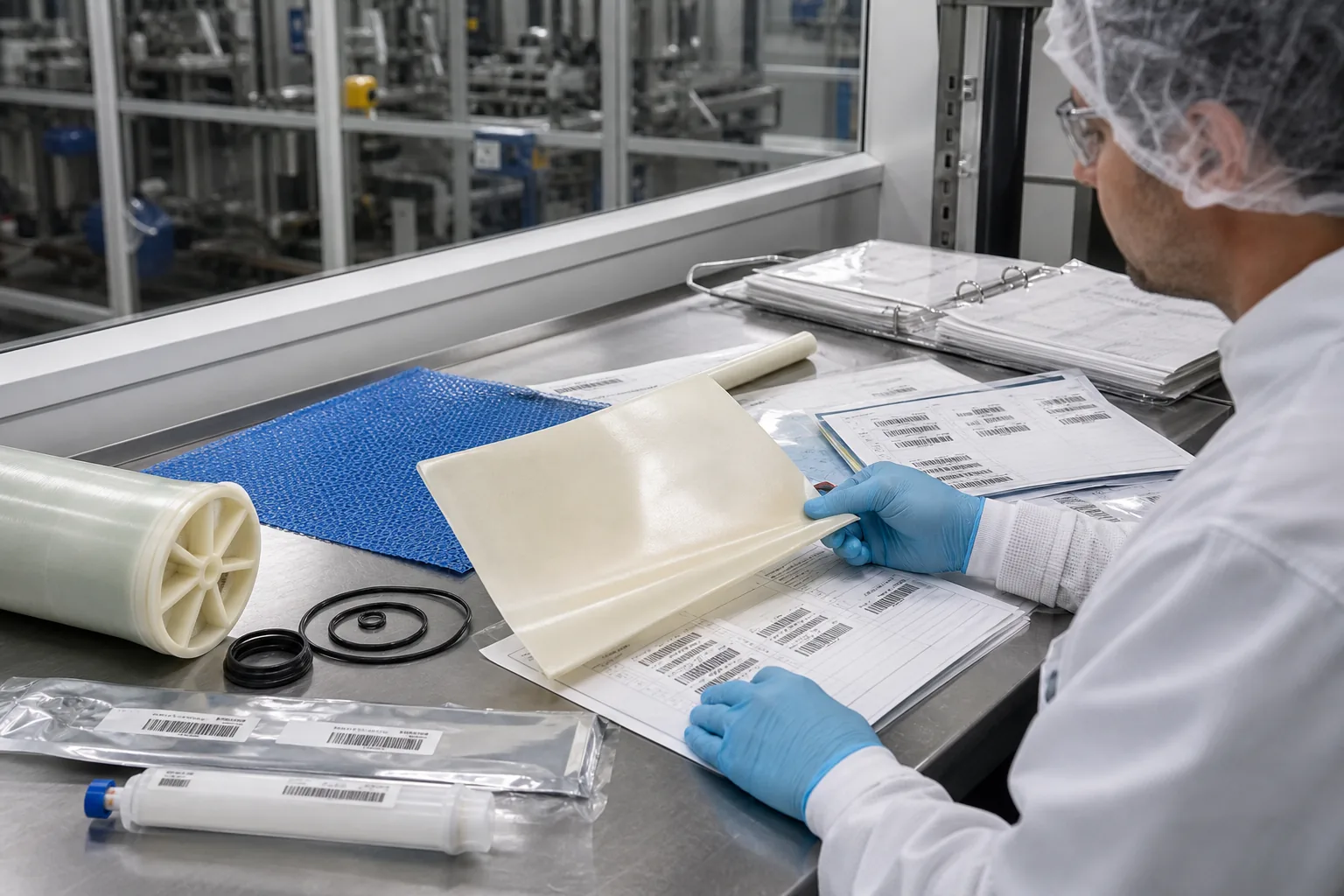
Build a Traceability Package Around the Agreed Specification
Documentation should be agreed before supply. The required package varies by customer and project, so the correct approach is to define what WECOME can provide and what the element manufacturer must generate during production.
- Material identification — link membrane, spacer, carrier, tubes, adhesive and seals to receiving records.
- Specification review — freeze dimensions, material versions and acceptance criteria before production.
- Production records — record critical preparation, rolling, curing and inspection steps.
- Change communication — control substitutions and revisions instead of treating materials as generic.
Keep Element Claims Inside the Validated Water Train
| Stage | Primary purpose | Element implication | Claim boundary |
|---|---|---|---|
| Pretreatment | Control oxidants, hardness and particles | Protect membrane compatibility and flow channels | Defined by feed and system design |
| First-pass RO | Reduce the main dissolved load | Stable rejection, flow and construction | RO permeate is not automatically final PW |
| Second-pass RO | Further reduce ionic load | Performance matched to interstage feed | Not required in every validated train |
| Polishing / distribution | Meet and maintain site water requirements | Outside the membrane element itself | RO must not be equated automatically with WFI |
Project validation, pharmacopoeial interpretation and final water-system compliance remain the responsibility of the pharmaceutical water-system owner and qualified engineering team.
Documented Materials and Precision Production Equipment
WECOME supports element manufacturers with compatible material sets, production equipment and technical documentation agreed for the supply program.
 Inside the plant
Materials & Components
- High-rejection membrane sheet
- Feed spacer & permeate carrier
- Central tubes
- Brine seals & connectors
- PU / epoxy adhesive
- Protective wrap & tape
Production Equipment
- Sheet & spacer cutting
- Carrier welding
- Precision rolling
- Trimming equipment
- Outer wrapping
- Vacuum leak testing
Pharmaceutical Purified-Water RO Questions
Is RO used in pharmaceutical purified-water systems?
Yes. RO is commonly used as a central separation stage within pharmaceutical purified-water trains. Pretreatment, the number of RO passes, polishing, sanitization, storage and distribution are selected as part of the complete validated system.
Does an RO element automatically comply with USP or EP?
No. Compliance applies to the validated water system and its documented operation, not automatically to a membrane element based on its application label. Material evidence and element records can support customer qualification, but exact claims require project-specific validation.
When is double-pass RO used for pharmaceutical water?
Double-pass RO may be used when lower ionic loading, greater separation redundancy or reduced demand on downstream polishing is required. The decision depends on feed quality, target water specification and the complete process design.
What documentation can be agreed for RO element materials?
Depending on the supply program, documentation may include product specifications, material data, batch identification, incoming inspection expectations and agreed change communication. Requirements should be confirmed before ordering.
Does WECOME supply complete pharmaceutical water systems?
No. WECOME supplies RO membrane materials, components and element-production equipment. Complete purified-water system design, validation, sanitization and distribution remain with the system engineering and pharmaceutical teams.
Need documented materials for pharmaceutical RO elements?
Send the feed analysis, single- or double-pass arrangement, operating and cleaning conditions, element format, required documentation and production volume. We will help define a practical material and equipment package.