

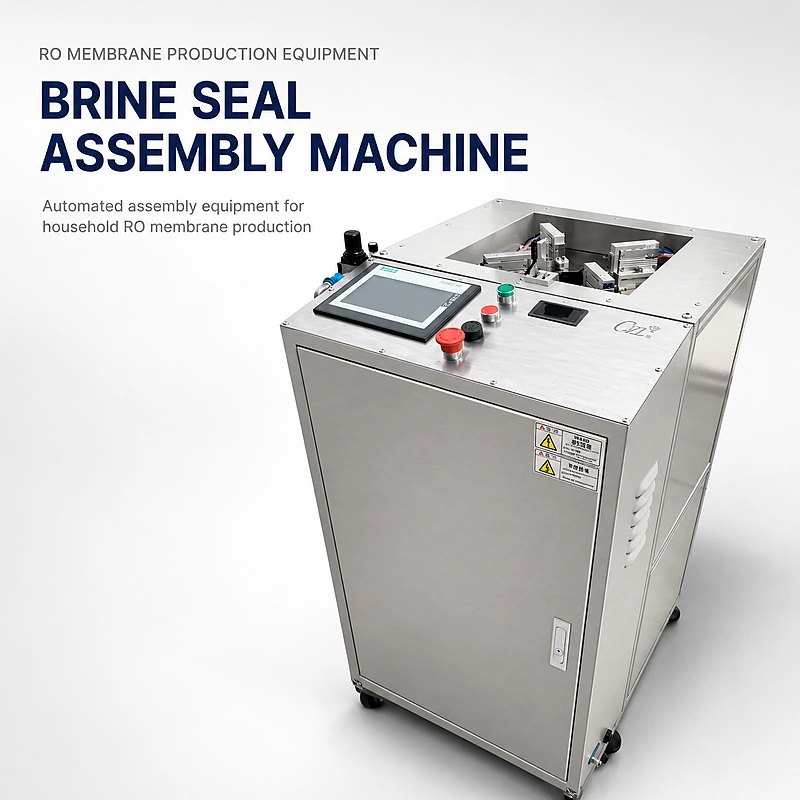
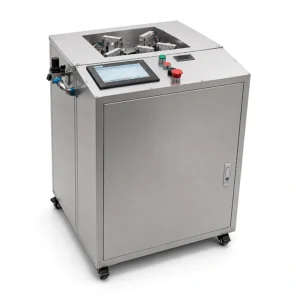


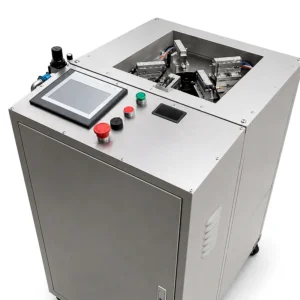
The Household RO Membrane Brine Seal Assembly Machine is a semi-automatic installation station for fitting brine seals onto common 1812-3013 residential spiral-wound RO membrane elements. The operator loads and unloads each element, while the machine completes the programmed brine-seal setting cycle automatically.
Its adjustable tooling supports membrane constructions from 1812 two-layer formats through 3013 seven-layer formats, with a maximum element diameter of 75 mm. Siemens motor, PLC and touchscreen control help manufacturers replace inconsistent hand installation with a faster, repeatable production step.
Automatic Brine Seal Installation with Manual Handling
A brine seal must be positioned consistently on the RO membrane element so the finished assembly can perform its intended sealing function. This RO membrane brine seal setting machine controls the installation action while retaining straightforward manual loading and unloading.
The machine installs the RO membrane brine seal. It is not the same as a tape-wrapping machine. When a customer’s element design requires a separate tape-retention step, use the dedicated Brine Seal Tape Winding Machine after confirming the production process.
How the Brine Seal Assembly Cycle Works
Confirm the matched parts
Check the element diameter, seal profile, seal orientation and validated recipe before production.
Position the membrane element
The operator manually places the compatible household RO element into the assembly fixture.
Run the automatic setting cycle
The Siemens-controlled sequence installs the brine seal according to the selected tooling and recipe.
Unload and verify placement
The operator removes the element and checks seal position, orientation and visible assembly condition.
Key Production Advantages
1812-3013 compatibility
Adjustable tooling covers common household element formats from two-layer 1812 through seven-layer 3013, subject to sample approval.
Siemens control platform
Siemens motor, PLC and touchscreen components provide coordinated motion, recipe control and a familiar operator interface.
Reduced manual assembly variation
Only loading and unloading remain manual; the controlled setting cycle reduces errors associated with hand fitting.
Fast single-piece cycle
A reference cycle of approximately 5-8 seconds per piece supports volume production when handling and material supply are balanced.
Low operator learning threshold
Touchscreen recipes and a focused load-run-unload workflow help new operators reach stable production after proper training.
Compact production footprint
The 800 × 680 mm floor footprint and 120 kg machine weight simplify workstation planning and export packing.
Brine Seal Assembly Machine Specifications
| Technical Item | Standard / Reference Data |
|---|---|
| Product Name | Household RO Membrane Brine Seal Assembly Machine |
| Model No. | Project-specific; confirm before quotation |
| Primary Function | Automatic installation of a brine seal onto a compatible household RO membrane element |
| Applicable Element Formats | 1812 two-layer through 3013 seven-layer constructions, subject to tooling confirmation |
| Maximum Element Diameter | 75 mm |
| Operation | Manual loading and unloading; automatic brine-seal assembly cycle |
| Reference Cycle Time | Approximately 5-8 seconds per piece, dependent on operator experience and matched production conditions |
| Reference 12-Hour Output | Approximately 6000-8000 pieces under stable material supply, validated settings and continuous operation |
| Motor / PLC / Touchscreen | Siemens |
| Frame | European-standard heavy-duty industrial aluminum profile |
| Operating Voltage & Power | AC 220 V / 1 kW instantaneous maximum power |
| Air Source Pressure | 0.4-0.7 MPa, clean and dry compressed air |
| Overall Dimensions (L × W × H) | 800 × 680 × 1280 mm |
| Equipment Weight | 120 kg |
| Packing Size | 900 × 750 × 1300 mm |
Technical data is based on the supplied standard configuration. Final fixture design, supported seal profiles, electrical standard, safety arrangement, cycle time and acceptance criteria must be confirmed against the customer’s membrane-element drawing, physical samples and signed technical agreement.
Production Capacity and Operator Planning
The stated 5-8 second cycle corresponds to a theoretical range of approximately 5400-8640 cycles over 12 continuous hours before allowing for replenishment, changeovers, inspection and planned stops. The stated 6000-8000 pieces per 12-hour shift is therefore a reasonable production reference when the element, seal, tooling and operator workflow are properly matched.
Capacity is a line-planning reference, not an unconditional guarantee
Practical output depends on operator handling speed, seal presentation, element-size changeovers, inspection frequency, compressed-air stability and upstream supply. WECOME should verify the required station quantity against the customer’s target shift output and actual samples.
Process Scope: Assembly vs. Tape Winding
This machine is designed to
- Install a matched brine seal onto a household RO membrane element
- Control the repeatable seal-setting action after manual loading
- Support common 1812-3013 formats up to 75 mm element diameter
- Reduce variation and repetitive effort compared with fully manual installation
Separate processes or equipment
- Tape retention or external wrapping, when required by the element design
- Membrane rolling, trimming and other component-assembly steps
- Vacuum integrity screening and hydraulic-performance testing
- 4040 or 8040 industrial element assembly without a dedicated industrial configuration
For dimensional planning and seal-profile discussion, review the RO Membrane Brine Seal Dimensions reference and send WECOME a physical seal and element sample before tooling approval.
Where This Machine Fits Best
Household RO element factories
Replace repetitive hand installation in recurring 1812-3013 residential membrane production.
Overseas local assembly
Support membrane manufacturers and water-treatment factories establishing local household RO element assembly.
OEM and ODM production
Use validated tooling and recipes for multiple customer-specific element and brine-seal combinations.
New-model validation
Evaluate seal fit, orientation and process repeatability before a new membrane format enters regular production.
R&D and pilot batches
Prepare controlled small-batch assemblies for membrane-component and process-development work.
Technical training centers
Demonstrate brine-seal handling, machine setup and production inspection with supervised operation.
Quality Checks Around Brine Seal Installation
Automation improves repeatability, but finished elements still require a defined inspection plan. Operators should verify that the approved seal is used, the orientation is correct, the seal is seated in the specified location and no visible twisting, tearing or displacement occurred during assembly.
Before the cycle
- Confirm element diameter and seal profile against the production order
- Check seal condition, orientation and lot identity
- Select the validated recipe and tooling position
After the cycle
- Inspect seating position and visible seal condition
- Separate abnormal assemblies for rework or engineering review
- Route the element to any required tape-winding and downstream QC steps
For the component’s purpose within a spiral-wound element, see Why RO Membrane Elements Need a Brine Seal.
Configuration, Samples and Delivery
| Project Input | What WECOME Confirms |
|---|---|
| Element Models | Target 1812-3013 formats, element outside diameter and production mix |
| Brine Seal Samples | Seal profile, material behavior, orientation and fixture compatibility |
| Production Target | Required pieces per shift, operator plan and recommended station quantity |
| Tooling and Recipes | Validated assembly settings for the approved element and seal combination |
| Electrical and Air Supply | Regional voltage, plug/interface standard and compressed-air requirements |
| Model No. | Assigned after the final technical configuration is approved |
| Packaging | 900 × 750 × 1300 mm reference packing size and export-protective packing |
| Technical Support | Installation guidance, commissioning, operator training and after-sales assistance |
Frequently Asked Questions
What does a household RO membrane brine seal assembly machine do?
It automatically installs a matched brine seal onto a compatible household spiral-wound RO membrane element after the operator loads the element. The operator then unloads and inspects the assembled piece.
Which RO membrane element sizes can the machine handle?
The stated configuration supports common household formats from 1812 two-layer through 3013 seven-layer constructions, with a maximum element diameter of 75 mm. Final compatibility requires sample and tooling confirmation.
Is this the same as a brine seal tape winding machine?
No. This machine installs or sets the brine seal onto the element. A brine seal tape winding machine performs a separate tape-retention or wrapping step when that step is required by the customer’s element design.
Is loading and unloading automatic?
No. Loading and unloading are manual. The brine-seal setting cycle itself is automatic and controlled by the Siemens PLC and touchscreen.
Can it really produce 6000-8000 pieces in 12 hours?
That is a reference output under stable operation with matched parts, validated tooling, adequate material supply and an experienced operator. Changeovers, inspection, replenishment and planned stops reduce practical output.
Can new operators use the machine?
Yes. The focused load-run-unload workflow and touchscreen control keep operation straightforward, but every operator still requires training in safe loading, recipe selection, seal orientation, quality inspection and abnormal-condition handling.
Can it assemble 4040 or 8040 industrial brine seals?
Not in the stated household configuration. Industrial element diameters and brine-seal structures require separately engineered tooling and equipment.
What should we send before requesting a quotation?
Send the target element models, outside diameter, element and seal drawings, physical brine-seal samples, required output per shift, regional electrical standard and compressed-air conditions. Sample trials are recommended before tooling approval.
Related Equipment and Technical Resources
Confirm the Element and Brine Seal Fit Before Quotation
Send WECOME your element drawing, seal drawing or samples, required output and local utilities. Our engineers will review fixture compatibility and expected shift capacity.