

RO Membrane Materials for Semiconductor Ultrapure Water
Reverse osmosis for semiconductor ultrapure water removes the main ionic and organic load before final polishing. WECOME supplies high-rejection membrane sheet, controlled components and precision production equipment for RO element manufacturers serving microelectronics UPW projects.
RO Reduces the Load Before the Polishing Loop
Semiconductor ultrapure water is produced by a complete treatment train. RO typically works in the primary-treatment section, reducing dissolved ions, silica, boron, organics and particles before EDI, degassing, UV, ion exchange, ultrafiltration or other polishing stages. Final fab water quality depends on the whole system and its operation.
Ionic control
High and stable rejection lowers the conductivity load reaching downstream polishing.
TOC sensitivity
Material cleanliness and pretreatment matter when organic contamination is tightly controlled.
Particle discipline
Protected materials and clean assembly reduce avoidable contamination during production.
Continuous output
Large UPW plants need repeatable 8040 elements across replacement and expansion batches.

Place the Element Requirement at the Correct UPW Stage
The RO element is specified from the feed entering the primary-treatment loop and the water quality required by the next stage. It is not specified by the final UPW resistivity target alone. Pretreatment protects the RO barrier; downstream polishing removes the remaining trace contaminants.
- Characterise source waterReview conductivity, hardness, silica, boron, TOC, particles and oxidants.
- Define pretreatmentConfirm filtration, dechlorination, softening or other protection ahead of RO.
- Set RO-stage targetsSpecify rejection, flow, pressure and the ionic load allowed into polishing.
- Match the element buildSelect sheet, spacer, carrier, tube, adhesive and structural components together.
- Verify consistencyUse incoming checks, precision rolling and leak/performance testing by batch.
Three Risks Shape Semiconductor UPW RO Elements
UPW projects reward consistency. A nominally high-rejection membrane is not enough when ionic leakage, contamination and manufacturing variation increase the burden on the polishing loop.
Residual Ionic Load
Stable salt rejection helps keep EDI and ion-exchange polishing inside their design load.
Trace Contamination
Clean material handling and controlled adhesives support lower avoidable organic and particle input.
Batch Variation
Precision dimensions, rolling and testing support consistent output across industrial element volumes.
Six Inputs Behind a Consistent UPW RO Element
Every material affects separation, hydraulics, contamination control or structural repeatability. The complete bill of materials should be frozen and reviewed as one element specification.
High-Rejection Sheet
Select the RO membrane sheet for low ionic leakage, stable flow and the defined cleaning envelope.
Clean Feed Spacer
Control feed spacer thickness and geometry for stable pressure drop and leaf alignment.
Adhesive System
Review PU adhesive identity, delivery, cure control and compatibility with the operating plan.
Seals & Components
Brine seals, end caps and connectors need dimensional consistency and traceable material supply.
High Rejection Must Be Reproduced Element After Element
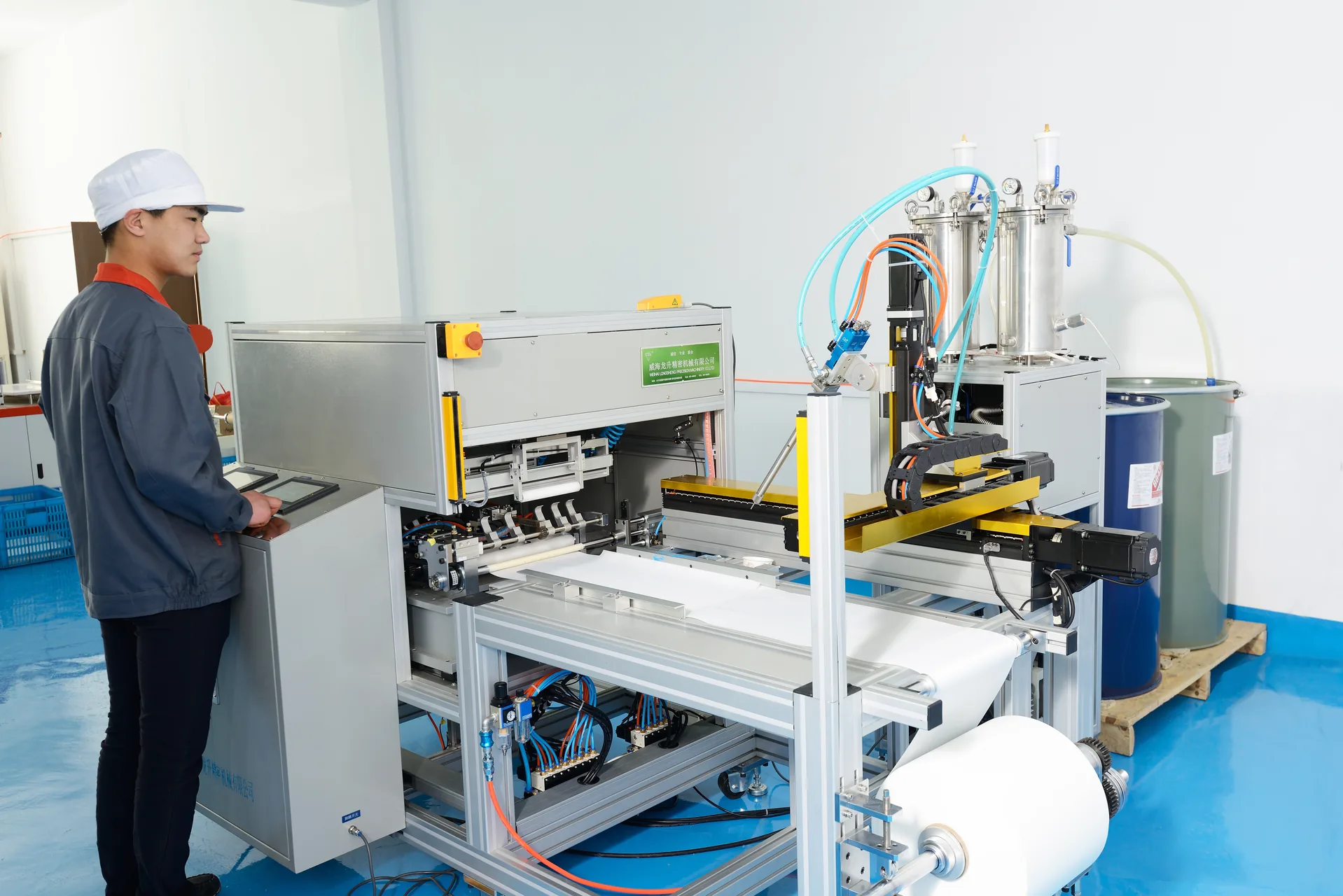
UPW element programs depend on controlled production, not only the membrane specification. Cutting accuracy, leaf alignment, adhesive delivery, winding tension and curing all influence the finished element.
- Incoming material checks — verify identity, condition and dimensions before release.
- Controlled leaf preparation — protect membrane, spacer and carrier surfaces from damage and debris.
- Precision rolling — maintain alignment and tension for repeatable channel geometry.
- Recorded testing — connect visual, dimensional, leak and performance results to the batch.
Test the Element Against the Agreed UPW-Stage Specification
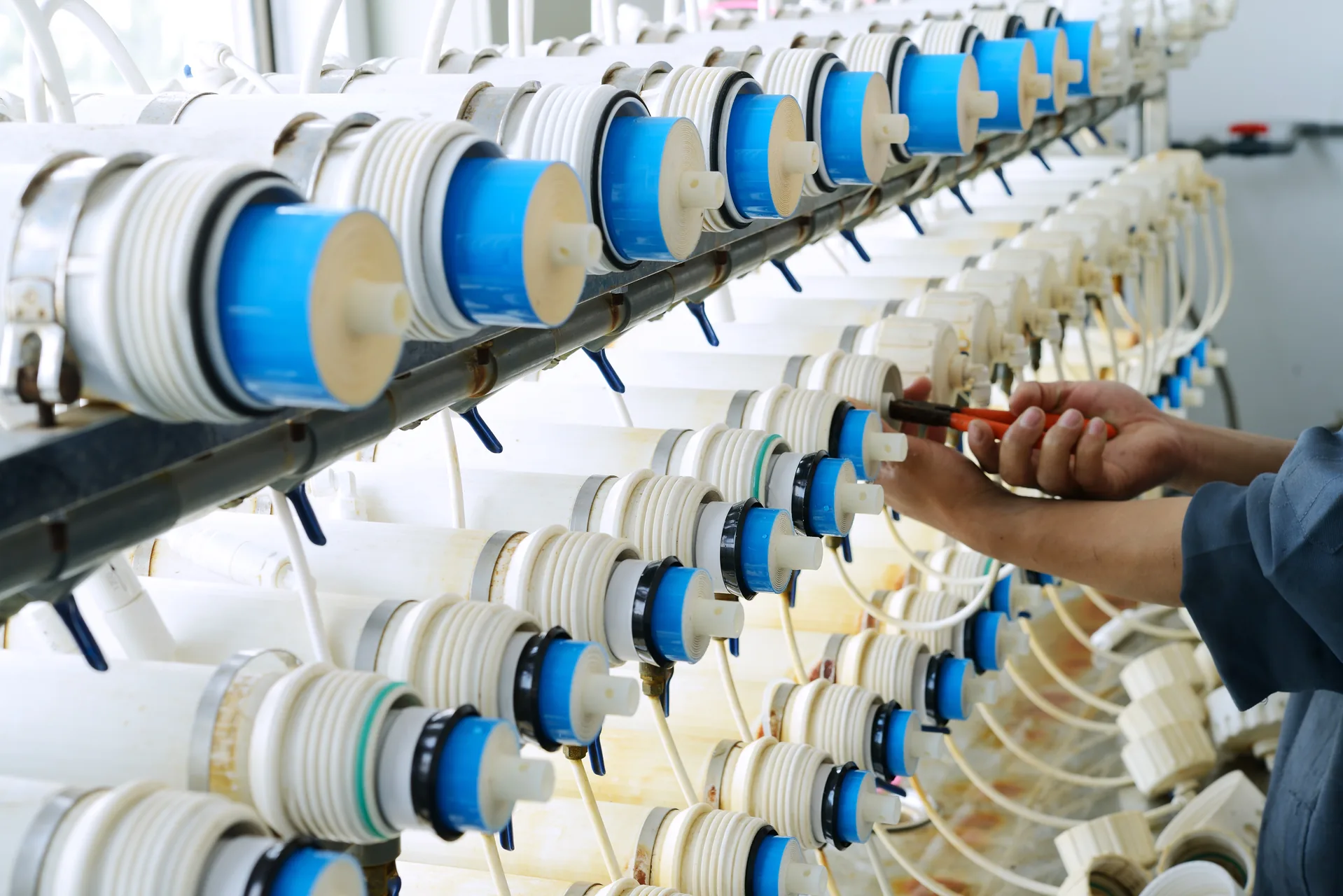
Final UPW quality cannot be guaranteed from a standalone factory test. Element testing should instead verify the agreed dimensional, leak, flow and rejection criteria under defined conditions, with records linked to production and material batches.
- Visual and dimensional inspection — confirm construction, surfaces and critical dimensions.
- Leak integrity — detect assembly defects before performance testing or shipment.
- Flow and rejection — use controlled test conditions so batches can be compared meaningfully.
- Batch traceability — connect materials, machine settings and test records to the finished element.
Primary Treatment and Final Polishing Have Different Jobs
| Stage | Main function | Element relevance | Boundary |
|---|---|---|---|
| Pretreatment | Control particles, hardness, oxidants and fouling load | Protect membrane performance and service life | Defined by source-water conditions |
| Primary RO | Remove the majority of dissolved ions and organics | High rejection, clean inputs and repeatable 8040 construction | Does not create final UPW alone |
| Secondary RO / EDI | Further reduce ionic load | RO-stage output determines polishing burden | Configuration is project-specific |
| UPW polishing loop | Remove trace ions, TOC, particles and dissolved gases | Outside the membrane element itself | Final quality depends on the complete loop |
High-Rejection Materials and Precision Production Equipment
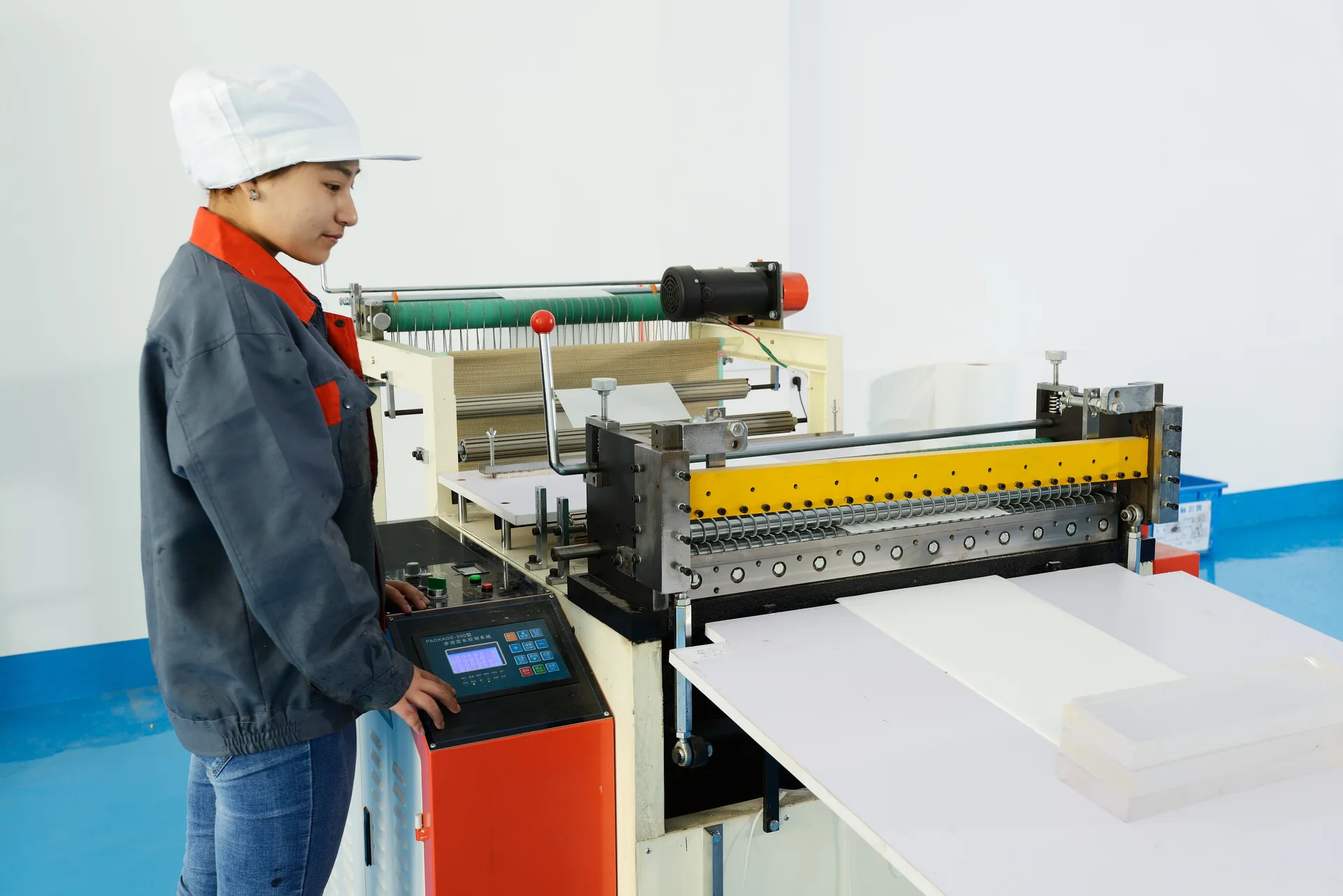
WECOME supports element manufacturers with material sets, industrial equipment and testing references for consistent UPW primary-treatment RO element production.
 WECOME production
Materials & Components
- High-rejection membrane sheet
- Feed spacer & carrier
- Central tubes
- Brine seals & connectors
- Controlled adhesives
- Wrap and tape materials
Precision Equipment
- Sheet and spacer cutting
- Carrier welding
- Industrial rolling
- Trimming equipment
- FRP outer winding
- Leak and performance testing
Semiconductor UPW Reverse-Osmosis Questions
What role does RO play in semiconductor ultrapure-water production?
RO is normally a primary-treatment barrier that removes most dissolved ions and reduces organic and particle load before final UPW polishing. EDI, ion exchange, UV, degassing and ultrafiltration may follow according to the fab design.
Can RO alone produce final semiconductor UPW?
No. Final UPW specifications are achieved and maintained by the complete treatment, polishing, storage and distribution system. RO performance affects downstream load but cannot guarantee fab-specific final purity by itself.
Why is low ionic leakage important for UPW RO elements?
Lower and more stable ionic leakage reduces the load on EDI and polishing resins, helping those stages operate within their intended range. The required rejection must be defined at the RO stage, not inferred only from final UPW targets.
How does manufacturing consistency affect UPW element performance?
Leaf dimensions, spacer alignment, winding tension, adhesive application, curing and leak integrity all affect flow and rejection. Precision equipment and recorded QC reduce avoidable variation between batches.
Does WECOME supply complete semiconductor UPW systems?
No. WECOME supplies RO membrane raw materials, components and element-production equipment. Complete UPW system design and final water-quality guarantees remain with qualified system engineering and fab teams.
Producing RO elements for semiconductor UPW?
Send the source-water analysis, pretreatment, RO-stage target, element format, operating conditions, required testing and production volume. We will help define the high-rejection materials and precision equipment package.