

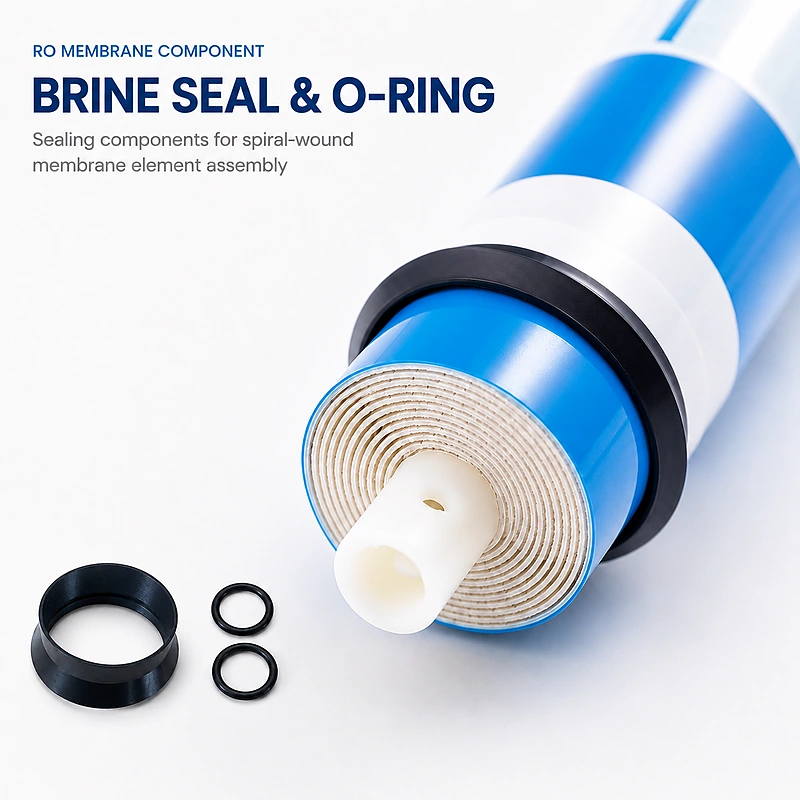



RO membrane brine seals are resilient V-ring or U-cup-style seals installed around the upstream end of a spiral-wound membrane element. They close the annular gap between the element body and the pressure-vessel wall so feedwater cannot bypass around the outside of the element and is instead directed into the feed-channel spacer.
This product range also includes small EPDM O-rings. Those O-rings serve a different sealing interface, typically around a permeate connector, adapter or product-water connection as defined by the element drawing. WECOME supplies black silicone V-rings and black EPDM O-rings in multiple dimensions for compact membrane-element programmes.
V-Ring Brine Seal vs Permeate O-Ring
Controls the element-to-vessel bypass path
Mounted around the element exterior near the feed end. The flexible lip responds to pressure and seals against the pressure-vessel bore, directing feed into the membrane element’s axial feed channels.
Seals a circular product-water connection
Installed on a connector, adapter or permeate-tube interface according to the assembly drawing. It is not a substitute for the external V-ring brine seal.
RO Membrane Brine Seal and O-Ring Specifications
| Model No. | Product Size | Material | Appearance | Qty / Box | Boxes / Pallet | Box Size | G.W. / Box |
|---|---|---|---|---|---|---|---|
| VR-3955S | 39 × 55 × 24 mm | Silicone | Black V-ring | 2,000 | 20 | 500 × 500 × 300 mm | 13 kg |
| VR-4155S | 41 × 55 × 24 mm | Silicone | Black V-ring | 2,000 | 20 | 500 × 500 × 300 mm | 13 kg |
| VR-4255S | 42 × 55 × 24 mm | Silicone | Black V-ring | 2,000 | 20 | 500 × 500 × 300 mm | 14 kg |
| VR-4455S | 44 × 55 × 24 mm | Silicone | Black V-ring | 2,000 | 20 | 500 × 500 × 300 mm | 14 kg |
| VR-4655S | 46 × 55 × 24 mm | Silicone | Black V-ring | 2,000 | 20 | 500 × 500 × 300 mm | 15 kg |
| OR-13265 | 13 × 2.65 mm | EPDM | Black O-ring | 100,000 | 20 | 460 × 460 × 300 mm | 10 kg |
| OR-1325 | 13 × 2.5 mm | EPDM | Black O-ring | 100,000 | 20 | 460 × 460 × 300 mm | 10 kg |
Dimensions are reproduced from the supplied model schedule. Before ordering, confirm which value represents the seal ID, OD, height or cross-section against a dimensioned drawing. The listed V-ring dimensions do not correspond to the outside diameter of standard 4040 or 8040 industrial elements.
How a Brine Seal Works Inside the Pressure Vessel
Pressure reaches the element
Feedwater enters the pressure vessel at the upstream end of the membrane-element train.
The seal contacts the vessel bore
The flexible lip is pressure-assisted against the vessel wall when installed in the specified orientation.
Water enters the feed channels
Closing the annular gap reduces external bypass and directs feed into the spacer channels across the membrane leaves.
O-rings protect product-water joints
Separate O-rings seal approved connector or adapter interfaces along the permeate collection path.
Performance Priorities
Dimensional consistency
Controlled mould dimensions help maintain the designed fit between the seal groove, element body and vessel interface.
Elastic recovery
The elastomer should recover after controlled compression so the sealing lip or O-ring maintains contact through handling and operation.
Pressure-assisted sealing
A correctly oriented V-ring uses upstream pressure to support contact with the pressure-vessel bore.
Water and chemical compatibility
Silicone or EPDM must be qualified for the actual feedwater, cleaning chemicals, temperature and exposure period.
Clean moulded surface
Inspect for flash, cuts, voids, deformation and contamination that could create a leak or installation problem.
Bulk production supply
Standard carton and pallet quantities support repeat assembly programmes and lot-based incoming inspection.
How to Select the Correct Seal
Identify the sealing interface
State whether the part seals the element-to-vessel gap or a permeate connector. Do not select only by the generic term “seal ring.”
Provide a dimensioned drawing
Include groove geometry, element diameter, vessel bore, connector diameter and tolerance stack.
Confirm orientation and compression
Define V-ring direction, O-ring squeeze, installation stretch and allowable movement during loading.
Specify the elastomer
Select silicone or EPDM only after checking water chemistry, temperature, cleaning agents and regulatory requirements.
Validate installation
Test lubricant compatibility, insertion force, lip rollover, twisting, pinching and damage during element loading.
Approve functional testing
Use the element manufacturer’s bypass, pressure, leakage or system performance test rather than visual inspection alone.
Incoming Inspection and Assembly Control
Small seal, measurable system consequence
A brine seal can look acceptable but fail through wrong dimensions, reversed orientation, damage or incompatible elastomer. Incoming checks must connect the part to the real housing and element drawing.
Typical Applications
Element-to-housing bypass control
Silicone V-ring models for compact membrane programmes whose groove and housing dimensions match the listed parts.
Connector and adapter O-rings
EPDM O-rings for approved 13 mm connection interfaces defined by the element or housing drawing.
Separate size confirmation required
Industrial brine seals and product-water O-rings can be evaluated from the exact element and vessel drawings; the seven listed models should not be assumed to fit.
Application-specific elastomer review
Material selection for pure water, ultrapure water, brackish water, seawater or reuse systems after chemistry and certification review.
Frequently Asked Questions
What does an RO membrane brine seal do?
It seals the annular space between the membrane element and the pressure-vessel wall, reducing feedwater bypass around the element and directing flow into the membrane feed channels.
Does the brine seal stop raw water entering the permeate tube?
Not directly. The brine seal controls the external feed-bypass path. Membrane-leaf adhesive, the central permeate tube and connector or adapter O-rings protect the product-water path.
What is the difference between the listed V-rings and O-rings?
The silicone V-rings are external brine-seal components. The small EPDM O-rings are intended for a circular connector or adapter interface specified by the assembly drawing.
Which direction should a V-ring brine seal face?
For a pressure-energised U-cup or V-ring design, the open lip commonly faces upstream toward the incoming feed. Always follow the approved element drawing and installation instruction for the exact seal.
Do the listed models fit standard 4040 and 8040 elements?
The supplied dimensions do not establish that fit. Standard 4040 and 8040 elements have much larger outside diameters, so industrial seals require separate dimensioned drawings and model confirmation.
Can silicone and EPDM be substituted for each other?
Not automatically. Their hardness, compression behaviour, temperature range, chemical compatibility and certification scope can differ. Approve the elastomer for the actual interface and service environment.
What information should be included in a brine seal enquiry?
Provide the element and housing model, seal location, dimensioned groove and bore drawing, elastomer requirement, hardness, water chemistry, pressure, temperature, cleaning chemicals, required certification and annual quantity.
Related Products and Technical Resources
Match the Seal to the Exact Interface
Send the element, housing or connector drawing with dimensions, tolerances, elastomer requirements and operating conditions.