
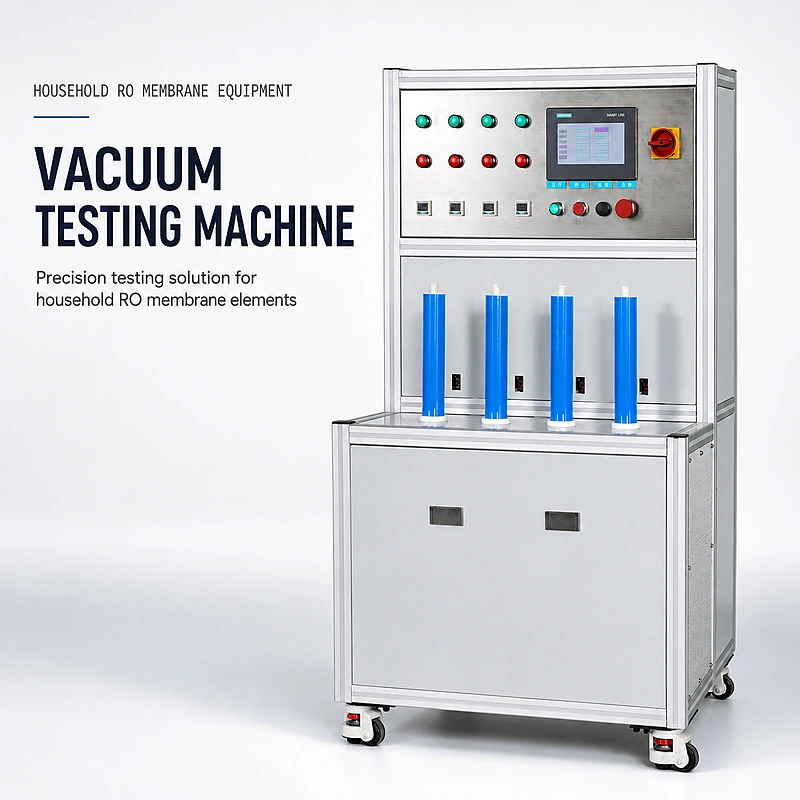
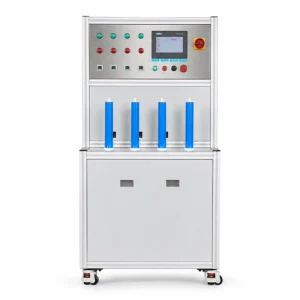
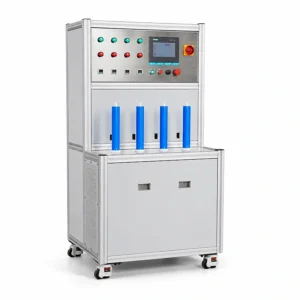
The Household RO Membrane Vacuum Testing Machine is dry, non-destructive integrity-screening equipment for spiral-wound residential RO membrane elements from 1810 through 3013. Model JYQJ-L-000 uses a negative-pressure vacuum-decay method to identify air-tightness failures before membrane elements leave production.
Operators load and unload the elements manually, while the PLC and touchscreen control the vacuum pressure and test time. Four test heads allow one, two, three or four elements to be checked in the same cycle. Unlike water-immersion leak checks, the dry process does not wet the membrane core or create test wastewater.
Dry Vacuum-Decay Integrity Screening
During a vacuum-decay test, negative pressure is applied to the membrane element and the pressure change is monitored for a defined period. An element that cannot maintain the specified vacuum is separated for inspection or rework. This makes the machine suitable for finding air-tightness defects associated with membrane-leaf glue lines, sealing interfaces and element assembly.
The process is designed for production screening rather than hydraulic-performance certification. For the technical principles and acceptance planning, see the RO membrane vacuum leak testing guide.
How the RO Membrane Vacuum Test Works
Position the elements
Manually place one to four compatible residential membrane elements onto the test heads.
Select the test recipe
Set the required vacuum pressure and test duration through the PLC touchscreen.
Apply negative pressure
The machine draws and holds the programmed vacuum while monitoring pressure decay.
Separate for the next step
Move conforming elements forward and route abnormal results to inspection or rework.
Key Production Advantages
Four-head testing layout
One, two, three or four membrane elements can be tested to match changing batch volume.
Fast manual workflow
Manual loading and unloading keeps operation straightforward, with a typical cycle of approximately five seconds per element under matched settings.
Dry, non-destructive inspection
No water immersion is required, helping avoid wet membrane cores, added drying steps, microbial exposure and test wastewater.
PLC recipe control
Vacuum pressure and testing time are adjustable through the touchscreen for repeatable production screening.
Capacity matching
One machine is expected to support the output of up to six household membrane rolling machines when cycle times and production schedules are properly matched.
Reduced QC labor
Multi-head testing and a controlled test cycle reduce repetitive inspection work compared with separate manual checks.
RO Membrane Vacuum Testing Machine Specifications
| Technical Item | Standard Configuration |
|---|---|
| Product Name | Household RO Membrane Vacuum Testing Machine |
| Model No. | JYQJ-L-000 |
| Overall Dimensions (L × W × H) | 800 × 650 × 1700 mm |
| Equipment Weight | 110 kg |
| Operating Voltage & Power | 220 V / 50 Hz, 1 kW |
| Control Mode | PLC and touchscreen operation |
| Testing Method | Negative-pressure vacuum-decay testing |
| Testing Time Range | 0-999 seconds, adjustable |
| Testing Pressure Range | 0 to -100 kPa, adjustable |
| Loading and Unloading | Manual operation |
| Applicable Element Sizes | 1810-3013, including common 1812, 2012, 3012 and 3013 formats |
| Elements Tested per Cycle | 1, 2, 3 or 4 pieces |
| Required Utility | Clean, dry compressed air |
Technical data above applies to the stated standard model. Final air-supply requirements, fixtures, acceptance thresholds and electrical configuration should be confirmed against the signed quotation and technical agreement.
What the Machine Checks – and What It Does Not
Correctly defining the inspection purpose prevents a vacuum test result from being used as a substitute for unrelated membrane-performance data.
Designed for
- Air-tightness integrity screening of spiral-wound residential RO elements
- Production checks for significant leakage at glue lines, seals or assembly interfaces
- Dry inspection before finished-element release, sorting or rework
- 1810-3013 household and residential RO element formats
Not a replacement for
- Salt-rejection, permeate-flow or other hydraulic-performance testing
- Detection of every form of chemical membrane damage
- Testing 4040 or 8040 industrial RO membrane elements
- Inspection of hollow-fiber ultrafiltration modules or special-shaped filter media
For a separate explanation of hydraulic validation, review RO membrane salt rejection and flow test basics. Manufacturers handling 4040 or 8040 elements should use a purpose-built industrial RO membrane vacuum testing machine.
Where to Use Vacuum Leak Testing in Production
After roll encapsulation
Screen semi-finished membrane elements after rolling and encapsulation before downstream assembly.
Final cartridge inspection
Check assembled finished filter cartridges before release, packing or shipment.
Sorting and rework
Use at a dedicated workstation to separate abnormal elements and verify reworked products.
Incoming sampling inspection
Sample outsourced membrane cores during warehouse receiving and supplier-quality checks.
New-model validation
Support integrity verification while developing or adjusting a new residential membrane format.
Laboratory R&D
Use in equipment research, process trials and third-party product-inspection workflows.
Production Fit and Capacity Planning
The four-head arrangement is designed for residential RO element plants that need faster integrity screening without a wet-test process. Under a typical matched workflow, one vacuum testing machine is expected to meet the inspection demand generated by up to six household RO membrane rolling machines.
Capacity should be verified against your actual test recipe
The approximately five-second figure is a production reference, not a universal guaranteed cycle. Element size, target vacuum, holding time, operator handling, pass/fail workflow and batch changeover all affect practical output. WECOME can calculate the recommended quantity of testing stations from your rolling-machine count and target shift capacity.
Configuration, Documentation and Delivery
| Project Item | Available Support |
|---|---|
| Element Fixtures | Confirm against the customer’s 1810-3013 element drawings and central-tube interface |
| Test Parameters | Vacuum pressure, holding time and screening logic confirmed during commissioning |
| Electrical Configuration | Standard 220 V / 50 Hz; regional requirements subject to engineering confirmation |
| Packaging | Export-protective packaging suitable for the confirmed shipping method |
| Documentation | Operating manual, electrical documentation and packing list supplied with the confirmed order |
| Technical Support | Installation guidance, commissioning support, operator training and after-sales assistance |
| Lead Time | Confirmed after equipment configuration and technical requirements are approved |
Frequently Asked Questions
What is an RO membrane vacuum testing machine used for?
It screens the air-tightness integrity of spiral-wound RO membrane elements by applying negative pressure and monitoring vacuum decay. It helps identify elements that require further inspection or rework before release.
Which RO membrane element sizes can model JYQJ-L-000 test?
The standard machine is intended for residential element formats from 1810 through 3013, including commonly used 1812, 2012, 3012 and 3013 sizes. Final fixture compatibility should be confirmed from the customer’s element drawing.
Does the vacuum leak test require water immersion?
No. It is a dry, negative-pressure test and does not require dipping the membrane element in water. This avoids wetting the membrane core and eliminates wastewater from the integrity-screening step.
How many membrane elements can be tested at one time?
The four-head machine can test one, two, three or four elements in a cycle. Loading and unloading are performed manually, while the PLC controls pressure and test time.
Can this machine test salt rejection and permeate flow?
No. It is used solely for air-tightness integrity screening. Salt rejection, water flux and other hydraulic-performance values require separate wet-performance testing equipment and procedures.
Can it test 4040 or 8040 industrial membrane elements?
No. Model JYQJ-L-000 is intended for household and residential membrane formats. WECOME provides separate industrial RO membrane vacuum testing equipment for 4040 and 8040 production requirements.
How should production capacity be calculated?
Use the number of rolling machines, elements per shift, selected vacuum pressure, holding time, operator handling time and expected rework rate. Under matched settings, one unit is expected to support up to six household rolling machines, but the final configuration should be verified for the actual line.
Related Equipment and Technical Resources
Confirm the Right Vacuum Test Configuration
Send your element sizes, rolling-machine quantity, target output per shift and required test cycle. WECOME will review fixture compatibility and line capacity before quotation.