

RO Membrane Element Structure: An Exploded View
See exactly what goes inside a spiral-wound reverse osmosis element — layer by layer, part by part. Click any component to view its specifications, technical explainer and product page.
A Sandwich of Layers, Wound Around a Tube
A spiral-wound RO element is built from flat membrane leaves. Each leaf is a sandwich: two sheets of RO membrane with a permeate carrier between them, glued on three sides to form an envelope. The open side attaches to the central tube.
Leaves are stacked with a feed spacer between them, then wound around the central tube. The roll is finished with an outer wrap, a brine seal and anti-telescoping end caps.
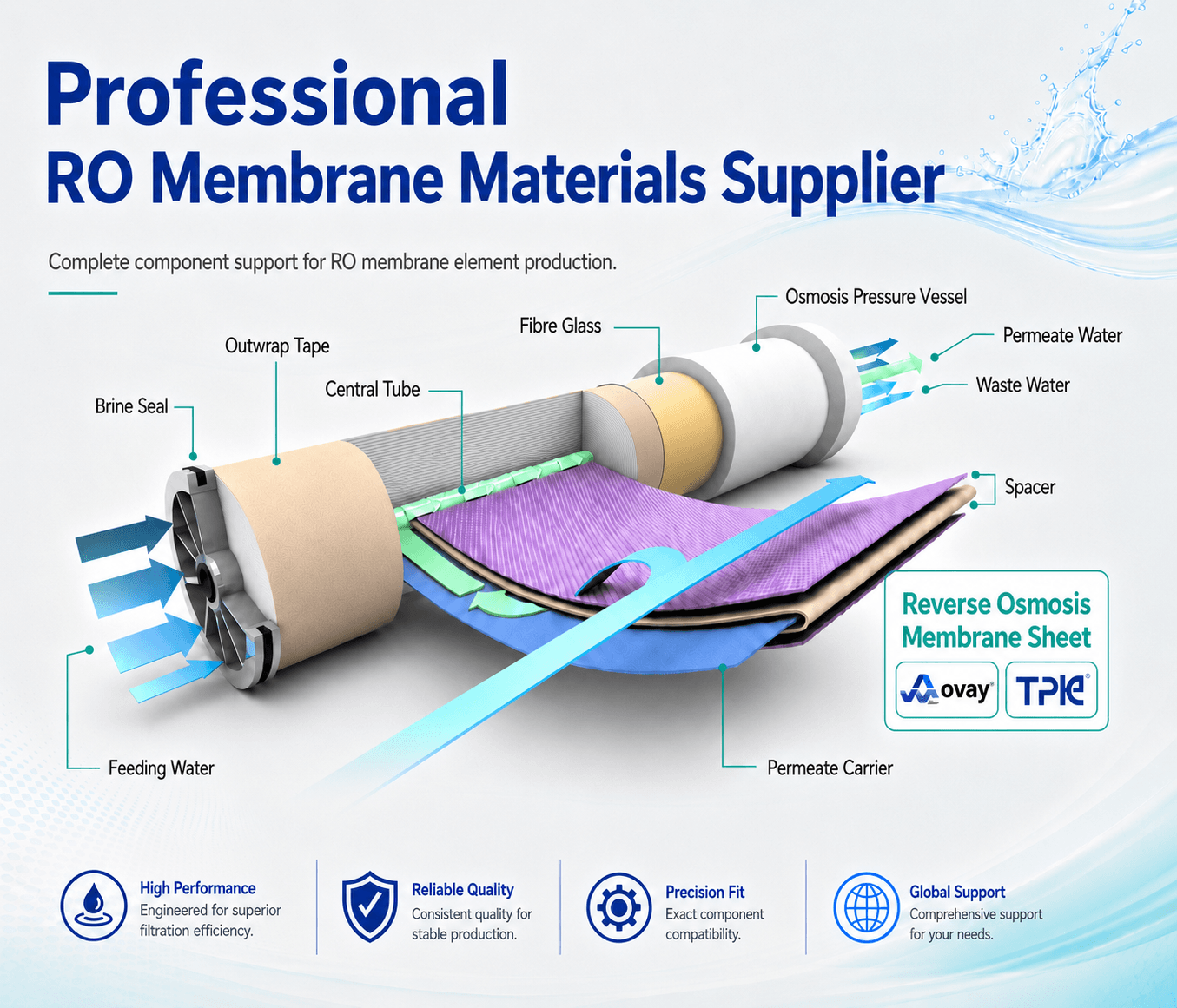
Exploded View of a Membrane Leaf
From the feed side to the central tube — the order in which the layers stack and roll. Click a layer for its data sheet.
Layers 1–5 form one leaf envelope; multiple leaves wind around the central tube (6) to make the finished element.
All the Parts of an RO Element
The internal layers plus the external hardware that finishes and protects the element. Each card links to its explainer, specs and product.
Feed Spacer
Diamond-net mesh that forms the feed channel and promotes turbulence to reduce fouling and concentration polarization.
RO Membrane Sheet
The thin-film composite active layer that performs the actual separation — rejecting dissolved salts while passing water.
Permeate Carrier
Tricot fabric inside the leaf envelope that carries permeate spirally inward to the central tube with minimal back-pressure.
Central Tube
The drilled core (product-water tube) that collects permeate from all leaves and channels it out of the element.
Adhesive / Glue
Polyurethane glue that seals the leaf envelope on three sides — the bond that keeps feed and permeate separated.
Brine Seal
Chevron / U-cup seal on the element exterior that forces feed water through the element instead of bypassing it in the vessel.
End Cap / ATD Cap
Anti-telescoping device fitted to each end to stop the wound layers from shifting (telescoping) under pressure.
Connector / Interconnector
Couplers and O-rings that join elements central-tube to central-tube inside a pressure vessel for multi-element trains.
From Flat Materials to a Finished Element
The four core stages a rolling line follows to turn flat materials into a spiral-wound element.
Build the leaf
Glue membrane sheets around a permeate carrier to form a sealed envelope.
Stack & attach
Add feed spacers between leaves and attach the open edges to the central tube.
Roll & wrap
Wind the leaves around the tube under controlled tension, then apply the outer wrap.
Finish & test
Fit brine seal and end caps, trim, then vacuum and performance test the element.
Building RO elements? We supply every part.
From membrane sheet and spacers to central tubes, seals, end caps, glue and tape — plus the machines to roll them. Tell us your element sizes and we’ll quote the full bill of materials.