

MATERIAL SELECTION / RO ELEMENT MANUFACTURING
A tape can look right on the roll and still lift, wrinkle or leave an inconsistent finish on the membrane element. How do you choose RO membrane outwrap tape before committing to a production order?
Are you specifying the right tape for the job?
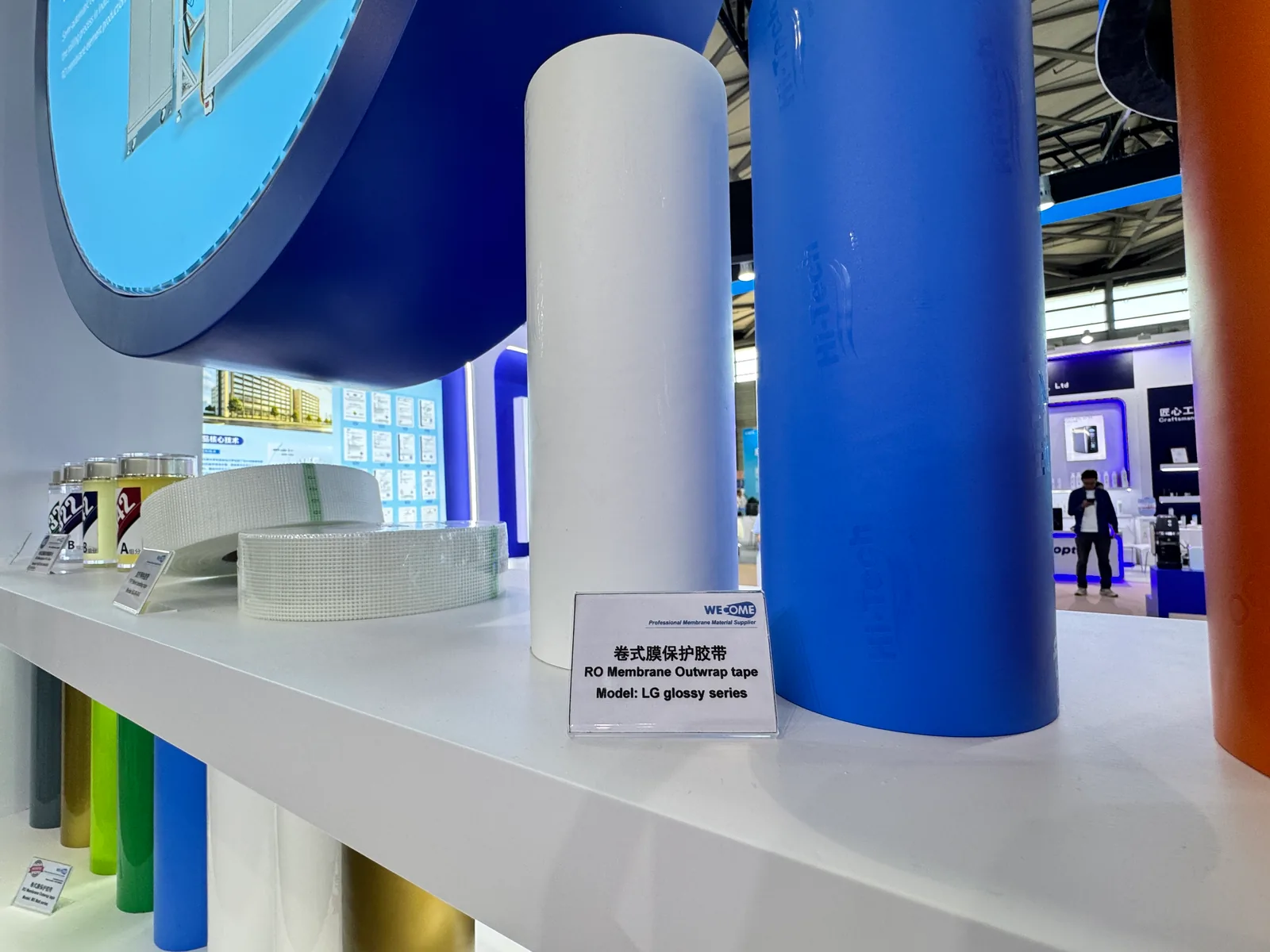
RO membrane outwrap tape is applied around the outside of the rolled element assembly. Its role is to retain and finish that assembly through the specified manufacturing and handling process. It is not the selective membrane layer, a membrane-leaf bonding adhesive or a substitute for a validated pressure-containing structure.
This distinction matters when purchasing departments receive a request for “RO membrane tape” without a drawing. An outer wrap, a narrow process tape and an adhesive used between membrane leaves can arrive in the same materials order but perform different functions.

If the requirement concerns the tube ends before rolling, check the central tube tape application instead. Do not replace an approved membrane-leaf adhesive with either tape simply because all three are described as bonding materials.
Is BOPP or CPP the better RO membrane outwrap?
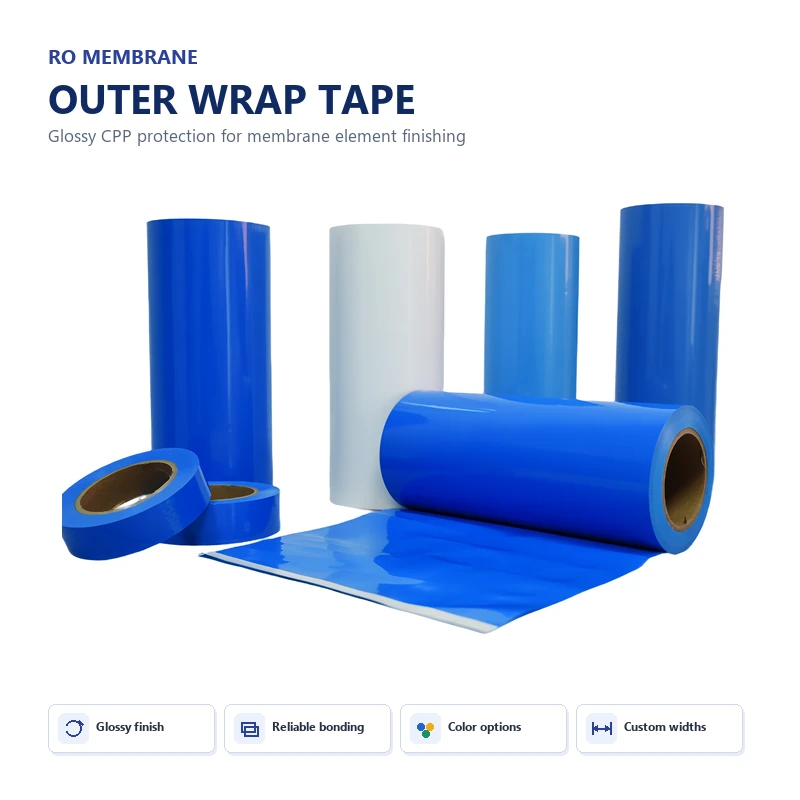
Neither name alone answers the question. Film family, orientation, thickness, coating and adhesive construction must be considered together. A glossy BOPP sample and a matte CPP sample differ in more than appearance, but the film name does not establish a universal winner for adhesion, water exposure or service life.
WECOME’s current product range lists the following combinations. Use them to shortlist samples, not to infer unlisted mechanical properties or approvals.
| Film family | Listed finish | Ask before approving |
|---|---|---|
| BOPP | Glossy | Which exact model, backing thickness and adhesive construction? Does the overlap bond to the glossy face under your process conditions? |
| CPP | Matte | How does the proposed grade unwind and conform at the intended tension? Does it hold an acceptable edge after the agreed conditioning period? |
| PP+PE | Matte | What is the supplied film construction? Which side receives the adhesive, and what total thickness and tolerance are controlled? |
| MOPP | Matte | What directional properties and winding orientation apply to this grade? How are unwind direction and installation identified? |
Do not assume that one family has a particular adhesive chemistry. Request the grade-specific technical data sheet. The published product listing does not establish a universal total thickness, peel-strength threshold or immersion-life rating for every option.
What does “white based” tell you?
Some listed BOPP models use this description. Treat it as wording to clarify against the approved technical specification, not proof of a particular adhesive chemistry, coating weight or compliance status. Ask the supplier to distinguish backing colour, adhesive appearance and any additional layer.
Which width and thickness will fit your element?
First define the area that must be covered. Tape width runs across the roll; consumed tape length runs in the wrapping direction. Confusing these two dimensions produces incorrect quotations and consumption estimates.
Can a 280 mm roll cover a 4040 or 8040 element?
Not as a full-length axial covering merely because the roll is labelled for RO membrane production. The current standard range includes 240, 255, 260, 280 and 320 mm widths, with 50 m roll lengths. These listed widths are primarily associated with compact household programs. For industrial elements, submit a drawing and the intended wrapping pattern.
A full-width circumferential wrap, separate bands and a helical wrap have different coverage, overlap and consumption requirements. Do not transfer the width or consumption of one method to another. Confirm any custom width or alternative wrapping method before purchase.
Should the purchase order specify film thickness or total tape thickness?
Specify both when they are relevant and available. Backing thickness describes the film; total tape thickness includes the supplied adhesive construction. A buyer comparing one supplier’s backing value with another supplier’s total value is not comparing equivalent products.
Also specify measurement units, tolerances and the agreed measurement method. Check finished diameter on the wrapped element rather than relying only on nominal tape thickness. Local seams and uneven application can matter even when the average build appears acceptable.
How can you estimate tape use without confusing width and length?
For a simplified single circumferential pass, the starting estimate is cut length = π × measured element diameter + seam overlap. For example, a measured diameter of 50 mm and a specified 20 mm seam overlap give approximately 177 mm per cut. These are illustrative inputs, not recommended element dimensions or overlap settings.
In that example, a 50 m roll contains about 282 theoretical cuts before setup waste, damaged ends or rejected wraps. This calculation assumes one strip covers the intended axial area and ignores stretch and thickness build. Multiple passes, bands or helical coverage need their own layout calculation. Use the tape length calculator only after checking that its selected method and assumptions match your process.
Why can a tape feel sticky but still fail at the seam?
Initial finger tack is not an acceptance test. The leading section may contact the element body while the closing seam contacts the tape’s own outer face. These are two different bonding surfaces. A sample that holds on one surface can still lift on the other.
General pressure-sensitive adhesive guidance identifies substrate condition, application pressure, temperature and time as relevant to bond development. However, general tape guidance does not establish the correct operating window for a particular RO outwrap grade. Use the supplier’s instructions and a trial on the actual materials.
- Actual surface: test the production element surface and the tape-to-tape overlap, not only a convenient metal coupon.
- Application: record tension, speed, alignment and how contact pressure is applied.
- Conditioning: define when the seam is inspected and under which temperature and storage conditions.
- Exposure: assess relevant water chemistry, temperature and duration where the construction will encounter water. Do not invent a universal immersion duration.
Avoid introducing a solvent or cleaning agent solely to make a sample pass. Confirm compatibility with the tape, membrane assembly and manufacturing procedure before changing surface preparation.
What should a useful sample trial actually prove?
A meaningful trial answers whether a defined grade can be applied consistently and remain acceptable through the agreed conditions. It does not simply show that one attractive element can be wrapped once.
- Freeze the starting specification. Record supplier, model, lot, width, total thickness, finish and roll storage history. Keep an identified reference sample.
- Run the intended recipe. Use representative element bodies, the actual wrapping pattern and the expected equipment. Include normal variation in operators or settings where it is relevant to production.
- Inspect immediately. Check coverage, alignment, wrinkles, bubbles, seam contact and finished diameter. Record reject reasons and usable output, not only machine speed.
- Inspect after agreed conditioning. Recheck edge lift, seam creep, adhesive transfer, appearance and dimensional fit. Include exposure testing appropriate to the application.
- Release a controlled specification. Agree acceptance criteria, inspection method, lot identification and change-notification requirements before the bulk order.
Set the sample quantity according to risk and production variability. A single successful wrap is not evidence that every roll in a shipment will behave identically. Equally, one failure should trigger an investigation into material and application conditions before concluding that the entire film family is unsuitable.
What should go on the incoming inspection sheet?
| Checkpoint | Record | Acceptance basis |
|---|---|---|
| Identity | Model, lot, label, receipt date | Approved purchase specification |
| Dimensions | Width, roll length verification, thickness | Agreed tolerances and measurement method |
| Roll condition | Edge alignment, damaged core, loose winding, contamination | Approved visual standard and usability |
| Process behaviour | Unwind, tracking, seam contact, residue | Controlled production trial |
| Conditioned assembly | Lift, creep, appearance and fit after specified conditions | Application-specific acceptance criteria |
What should you check when the wrap lifts or wrinkles?
The same visible defect can have several causes. The checks below are diagnostic starting points, not proof that the tape or machine is defective.
| Observed problem | Investigate first | Useful next trial |
|---|---|---|
| Seam edge lifts | Contamination, overlap contact, application conditions, grade compatibility | Repeat with controlled surface preparation and contact pressure; inspect after the same conditioning period. |
| Wrinkles or skew | Leading-edge alignment, tension, roll tracking and element geometry | Change one setting at a time and compare finished wraps against the same visual standard. |
| Adhesive residue or edge ooze | Storage conditions, temperature, compression and adhesive construction | Retain the lot sample and compare it with the approved reference under identical conditions. |
| Unwind force varies | Roll damage, storage history, winding quality and unwind direction | Compare positions within the roll and another identified roll from the shipment. |
| Finished diameter is inconsistent | Element diameter before wrapping, number of passes, thickness and overlap placement | Measure before and after wrapping at consistent positions, including the seam. |
Keep two different meanings of telescoping separate: layers shifting sideways within a tape supply roll are not the same fault as axial displacement inside a spiral-wound membrane element. A tidy outer wrap alone does not prove that the internal membrane construction is sound.
What should you send with an outwrap tape enquiry?
A clear RFQ lets the supplier propose a grade and sample plan instead of quoting by colour alone. Send the following information, marking unknown values as “to confirm” rather than inventing them.
- Element drawing, actual body diameter and required coverage length.
- Wrapping method: full-width circumferential, bands or helical.
- Requested tape width, roll length, core size and unwind direction.
- Preferred film family, finish, colour reference and printing requirements.
- Backing and total thickness requirements, if already validated.
- Production speed, tension method and relevant application conditions.
- Storage, handling and water-exposure conditions to be evaluated.
- Trial quantity, estimated recurring demand and destination.
- Required traceability, documentation and application-specific compliance evidence.
If compliance documentation is required, ask which exact product grade, application and scope it covers. A general company certificate or a statement about raw material does not automatically certify the finished tape for the intended water-contact use.
Need to shortlist an outwrap grade?
Review the WECOME outer wrap tape models and standard sizes, then send your drawing and wrapping method for sample selection. Confirm dimensions, adhesive construction and acceptance criteria before a bulk order.
Discuss Tape Samples & SpecificationsFrequently asked questions
Is RO membrane bonding tape the same as outwrap tape?
On the linked WECOME product page, “bonding tape” refers to the element’s outer wrap. The term can be ambiguous in a purchase request, so specify the installation location and include a drawing. It is not membrane-leaf bonding glue.
Does a thicker outwrap always perform better?
No. Thickness changes material build and can affect fit and process behaviour, but does not establish adhesion or suitability by itself. Compare the complete grade and the finished assembly against the approved requirements.
Can we select a replacement from colour and roll width alone?
No. Those details help identify a candidate but omit film construction, adhesive behaviour, thickness and exposure requirements. Validate the proposed replacement against a controlled reference and document the change.
Can a glossy grade be replaced with a matte grade?
Only after checking more than appearance. The closing overlap bonds to the outer face, so a changed surface can affect the assembly. Recheck overlap adhesion, labels or printing, winding behaviour and conditioning results.
What is the best outwrap tape for 8040 production?
There is no universal selection from the element designation alone. Define the construction and wrapping method first. Standard household-width rolls do not establish full-length industrial coverage, and tape is not a substitute for a specified reinforced shell.
Sources and specification boundary
Listed WECOME materials, finishes and sizes were checked against the outer wrap product page on 2 November 2026. The illustrations are selection schematics, not product cross-sections or certified drawings. Numerical examples are calculations with stated assumptions, not operating recommendations.
For general adhesive selection principles, see 3M’s overview of pressure-sensitive adhesive chemistries and Avery Dennison’s pressure-sensitive tape guidance. These references do not certify or specify WECOME products.

Bessie has 10+ years of experience in RO membrane materials and water treatment supply chains. At WECOME, she helps manufacturers and system integrators worldwide source the right membrane components — from feed spacers and permeate carriers to NSF-certified adhesives — backed by hands-on technical support.