

Why Do RO Membrane Elements Need a Brine Seal?
A brine seal helps stop feedwater from bypassing the outside of a spiral-wound RO membrane element. This guide explains its function, installation direction, difference from a connector O-ring, failure symptoms and the information needed to select the correct seal.
RO membrane elements need a brine seal to reduce the annular bypass path between the element body and the pressure-vessel wall. When the correct seal is fitted in the specified orientation, feedwater is directed into the feed-spacer channels instead of taking the easier path around the element. This supports the hydraulic conditions expected by the approved membrane-system design.
Use Verified Product Data, Not a Generic Size Assumption
WECOME's current product page lists separate V-ring brine seals and connector O-rings. The model code or a general “4040/8040” description is not enough to prove compatibility with a specific element or housing.
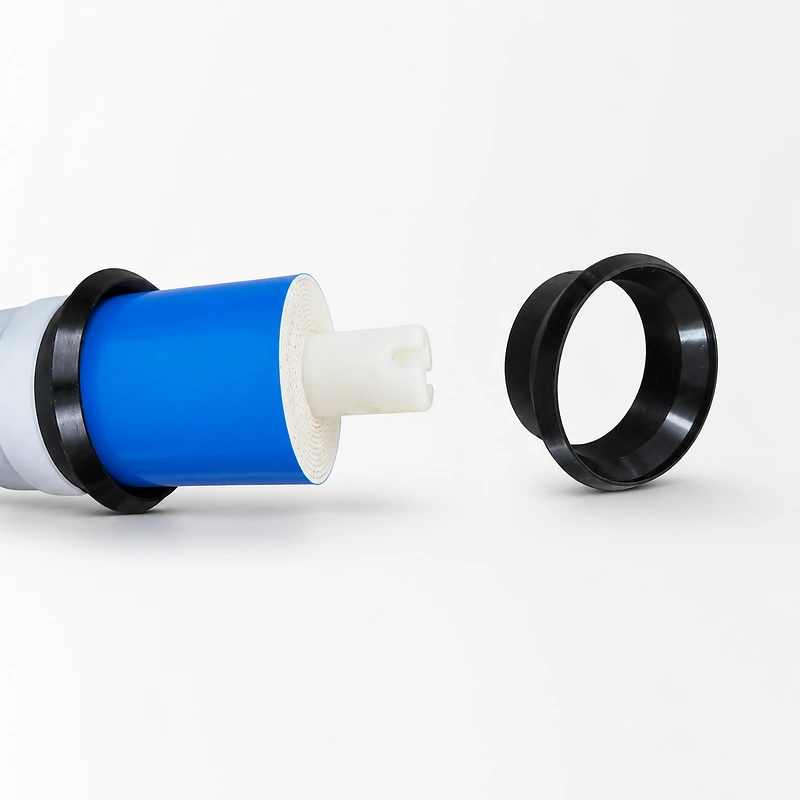
What Does an RO Membrane Brine Seal Do?
Inside an RO pressure vessel, feedwater can see two possible routes. The intended route is through the element's feed channels, where cross-flow passes across the membrane surface. The unintended route is the narrow annular space outside the element.
The brine seal is installed around the element exterior near the feed side. Its flexible lip contacts the approved housing interface and helps restrict that external route. Pressure then assists the seal while feedwater is directed into the element.
This does not mean the brine seal performs desalination. Salt rejection is created by the membrane active layer. The seal helps the assembled system deliver feed to that membrane through the intended hydraulic path.
- Reduces external feedwater bypass around the element body.
- Supports the designed axial flow through the feed spacer.
- Helps technicians separate bypass problems from membrane damage.
- Must allow installation without twisting, folding or lip damage.
RO Membrane Brine Seal vs Connector O-Ring
These parts may appear in the same membrane-element assembly, but they control different leakage paths and should not be described as interchangeable.
Element exterior to pressure vessel
The brine seal surrounds the element body. Its purpose is to restrict feedwater bypass around the outside of the element and direct flow into the feed channels.
Circular product-water connection
An O-ring seals a connector, adapter or permeate-tube interface identified by the assembly drawing. It protects a circular joint rather than the external element-to-vessel gap.
What Happens Without a Correct Brine Seal?
| Check point | Correctly matched and installed seal | Missing, damaged or incorrect seal |
|---|---|---|
| Feed path | Feed is directed toward the element's feed channels. | Part of the feed may bypass the element exterior. |
| Cross-flow | The approved hydraulic path can be maintained. | Flow distribution across the membrane leaves may change. |
| Performance reading | Testing reflects the intended assembly condition. | Apparent recovery or rejection can be affected by bypass, but other causes must also be checked. |
| Mechanical condition | Lip sits evenly without rolling, folding or excess compression. | A wrong size or orientation can deform the lip or prevent proper contact. |
| Troubleshooting | Seal condition is documented during assembly and inspection. | Technicians may incorrectly blame the membrane sheet before checking external bypass. |
Which Direction Should a Brine Seal Face?
For a pressure-assisted V-ring design, the open lip commonly faces toward the incoming feed so feed pressure helps expand the lip against the vessel wall. However, the approved drawing and the seal supplier's installation instruction are authoritative for the exact model.
Do not rely only on a photograph from another membrane brand. Housing bore, element shell, groove location, interconnector arrangement and loading direction can differ. An installation that looks similar may use a different sealing principle.
- Confirm the pressure-vessel feed direction before loading.
- Inspect the lip for cuts, permanent set, contamination or distortion.
- Use only an approved compatible lubricant when the procedure requires it.
- Prevent the lip from reversing, folding or catching during insertion.
- Record the model and installation orientation for later troubleshooting.
Symptoms of a Missing, Damaged or Reversed Brine Seal
These observations justify inspection, but none is proof on its own. Compare the current condition with the commissioning baseline and check all relevant sealing interfaces.
Lower-than-expected rejection
External bypass can contribute to an abnormal system result, especially after element replacement or reloading.
Unusual recovery pattern
A changed feed path may alter how flow is distributed, although instrumentation and operating conditions must also be verified.
Problem begins after service
A sudden change after membrane loading makes seal orientation, model, damage and connector assembly logical inspection points.
Folded or torn sealing lip
Rolling, cuts, permanent deformation or contamination may prevent uniform contact with the vessel wall.
Seal too loose or too tight
An incorrect cross-section or diameter can create inadequate contact, excessive drag or damage during installation.
No single clear cause
Inspect connector O-rings, adapters, central tubes and element integrity before concluding that the brine seal alone is responsible.
How to Select the Correct RO Membrane Seal
Identify the interface
Confirm whether the part seals the element exterior or a circular connector.
Supply dimensions
Provide groove, bore, shell and relevant seal dimensions with tolerances.
Check conditions
State water chemistry, temperature, pressure, cleaning chemicals and compliance needs.
Validate the assembly
Approve fit, loading and function on the actual element and housing before volume use.
Need to Match a Brine Seal or O-Ring?
Send the sealing location, model and dimensioned drawing. WECOME can compare your requirement with the confirmed V-ring and connector O-ring schedule.
RO Membrane Brine Seal FAQ
What does a brine seal do in an RO membrane element?
It restricts the external gap between the membrane element and pressure-vessel wall, helping direct feedwater into the feed-spacer channels rather than around the element body.
What happens if an RO membrane has no brine seal?
Feedwater may bypass the element exterior. The system may then operate differently from its approved hydraulic design, but actual performance symptoms depend on the full assembly and operating conditions.
Which direction should an RO membrane brine seal face?
For a pressure-assisted V-ring, the open lip commonly faces the incoming feed. Always follow the approved drawing or installation instruction for the exact element, housing and seal model.
Is a brine seal the same as a permeate connector O-ring?
No. A brine seal controls the external element-to-vessel bypass path. A connector O-ring seals a circular permeate-tube, adapter or connector interface identified by the assembly drawing.
Can a damaged brine seal cause low salt rejection?
External bypass can contribute to an abnormal result, but low rejection is not proof of brine-seal failure. Connector leakage, leaf damage, adhesive failure, operating conditions and instrumentation should also be checked.
Do brine seals automatically fit standard 4040 or 8040 elements?
No. A nominal element family does not confirm the exact shell, groove, seal lip or housing interface. Compatibility should be verified from actual dimensions and an approved drawing.
Can silicone and EPDM seals be substituted?
Not automatically. Elastomers can differ in compression behaviour, hardness, temperature range, chemical compatibility and approval scope. Use the material specified for the actual interface and service conditions.
How should a brine seal be inspected before installation?
Check the model, dimensions, lip orientation, surface condition and cleanliness. Reject seals with cuts, permanent set, distortion or contamination and follow the approved lubrication and loading procedure.
What information is needed to quote an RO membrane seal?
Provide the sealing location, element and housing or connector model, dimensioned drawing, relevant groove and bore dimensions, required material, operating conditions, annual quantity and documentation requirements.