
RO Membrane Element Quality Control Checklist
A practical, four-stage QC checklist for RO membrane element production — from incoming materials and in-process checks to final testing and traceability.
- Incoming material inspection
- In-process checks (rolling & gluing)
- Final performance & leak testing
- Documentation & traceability
Key Takeaways
- QC runs across four stages, not just final testing.
- Most defects are cheapest to catch early — at incoming and in-process.
- Every element should pass leak and performance testing before shipping.
- Records & traceability turn one-off checks into a real QC system.
Why a Stage-by-Stage QC Checklist Matters
Quality is built into an RO membrane element at every step — not inspected in at the end. A good checklist spreads control across incoming materials, in-process work and final testing, so problems are caught when they are still cheap to fix.
Use the checklist below as your production standard. It pairs naturally with the production workflow template and your production line checklist so quality control follows the same sequence as the work itself.
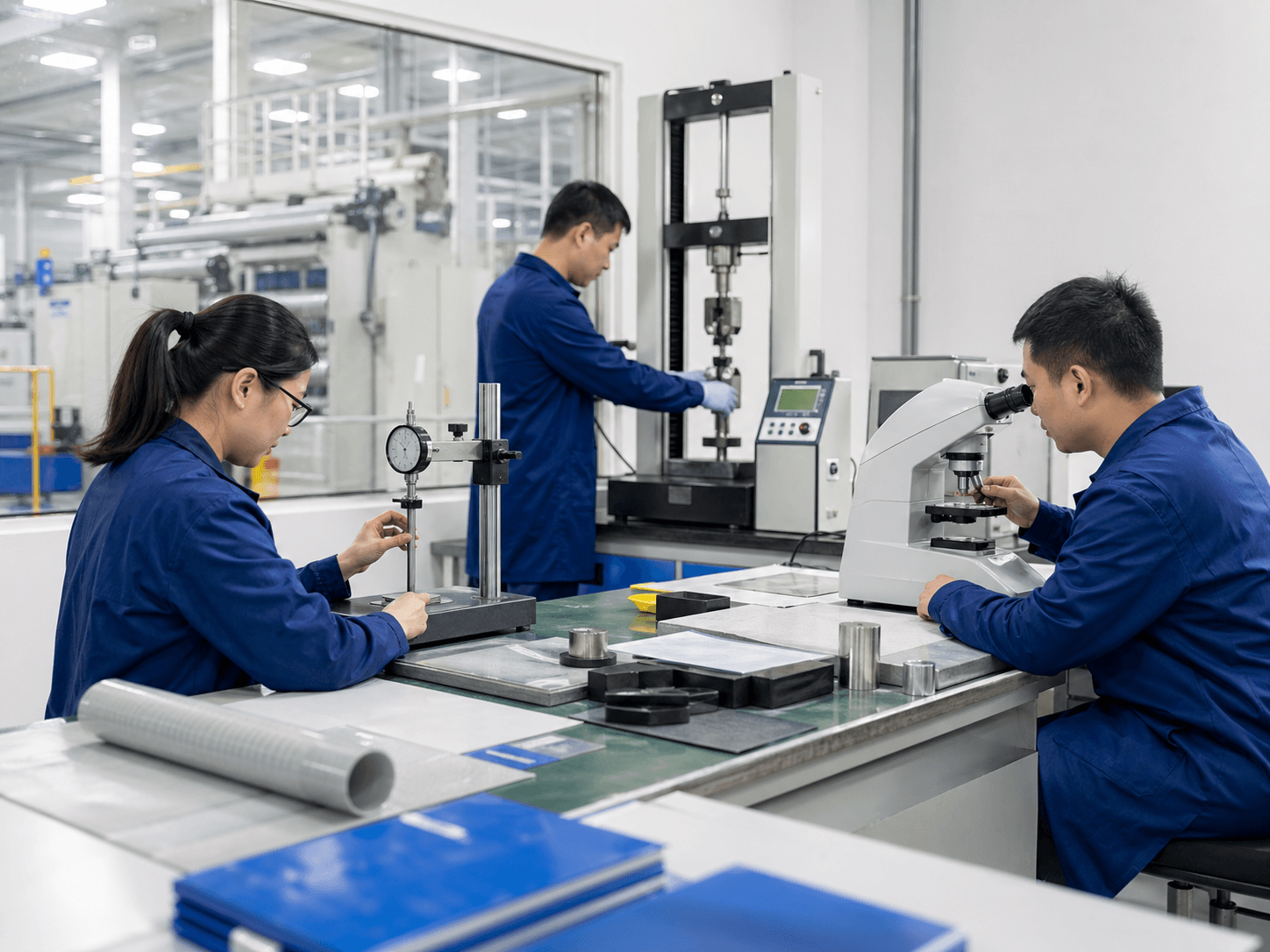
RO Membrane Element QC Checklist (4 Stages)
Tick items as you go — this is a working checklist. Download the PDF below to print it for your line or share it with your team.
A one-page PDF you can print for each production batch.
Build the Checklist into Your Daily Workflow
A checklist only works if it is used the same way every shift. Assign each stage to a role, define clear pass/fail criteria, and connect it to your testing references — for example the vacuum leak testing guide and visual inspection reference.
When something fails, trace it back: many final-test failures start as common rolling defects or out-of-spec incoming material. Tightening incoming inspection often removes problems downstream.
Make it stick
- Assign each stage to a named role
- Define clear pass / fail criteria
- Record results, don’t just tick
- Review failures weekly for patterns
- Update the checklist as you learn
Skipping QC Stages Costs More Than It Saves
A missed check rarely stays cheap. These are the four ways weak quality control shows up — usually after the element has already shipped.
Shipped Defects
Leaks or low rejection reach the customer, triggering returns and reputation damage.
Wasted Material
Defects caught at final test waste all the material and labour already invested.
Inconsistent Quality
Without set criteria, results vary by operator and shift — impossible to improve.
No Traceability
When a problem appears, missing records make the root cause impossible to find.
Building or upgrading your QC process?
We help RO membrane producers set up testing equipment and quality-control workflows. Tell us your element types and volume — we’ll point you to the right setup.
RO Membrane QC Checklist FAQ
What should an RO membrane element QC checklist include?
A complete RO membrane QC checklist covers four stages: incoming material inspection, in-process checks during rolling and gluing, final performance and leak testing, and documentation with batch traceability. Each stage needs clear pass/fail criteria.
At what stage are most element defects caught?
Many defects originate at incoming material and in-process rolling, even though they often surface at final testing. Catching them earlier — with incoming inspection and in-process checks — is far cheaper than scrapping a finished element.
What final tests confirm an RO membrane element is good?
The core final tests are a vacuum leak / integrity test, salt rejection measurement and permeate flow rate, plus a visual inspection and a dimensional check. See the vacuum leak testing guide for the procedure and pass criteria.
Why is traceability part of quality control?
Recording batch numbers, material lots and test results lets you trace any future problem back to its source and prove quality to customers. Without records, a checklist is a one-off check rather than a quality-control system.